Recent Articles

Superconducting phases of BiTe at high pressure

Manisha Yadav, Pallavi Malavi, S. Kisku, D. V. S. Muthu, V. Stopponi, M. Zacchigna, S. Lupi, P. S. Anil Kumar, A. K. Sood, and S. Karmakar

Phys. Rev. B 112, 214511 (2025) - Published 12 December, 2025

Intrinsic strength of diamond by shock-compression measurement of large and pure single crystals

Tsutomu Mashimo, Xun Liu, Makoto Tokuda, Nobuaki Kawai, Hiroshi Isobe, Masayuki Tsushida, Takateru Yamamuro, Fumiko Kurio, and Hitoshi Sumiya

Phys. Rev. B 112, 224111 (2025) - Published 12 December, 2025

Bipolar non-Hermitian skin effect and enhanced dynamics induced by long-range complex couplings

Xin-Ran Zou, Zhi-Xu Zhang, Jie Zhang, Wen-Xue Cui, Ji Cao, and Hong-Fu Wang

Phys. Rev. B 112, 224313 (2025) - Published 12 December, 2025

Current-induced spin-orbit torque and thermal effects in CoFe/Pt heterostructures via second and third harmonic Hall measurements

Manik Kuila, B. Maharana, B. Samantaray, and Z. Hossain

Phys. Rev. B 112, 224424 (2025) - Published 12 December, 2025

Coexistence of static and dynamic local magnetic fields in the distorted honeycomb lattice antiferromagnet Co2Te3O8

J. Khatua, Suheon Lee, M. Pregelj, Samiul Sk, S. K. Panda, Bassam Hitti, Gerald Morris, I. da Silva, Kwang-Yong Choi, and P. Khuntia

Phys. Rev. B 112, 224425 (2025) - Published 12 December, 2025

The bipartite lattice based honeycomb quantum magnets, characterized by low coordination numbers, provide a viable route to realize exotic quantum phenomena due to an intricate interplay between competing magnetic interactions, spin-orbit coupling, and crystal electric fields. Here, the authors demonstrate the coexistence of static and dynamic local magnetic fields governed by intraplanar further-neighbor interactions and weak interplanar antiferromagnetic coupling in a 3d transition metal ion based frustrated honeycomb lattice antiferromagnet stabilizing in the XY universality class.

Crossover of superconductivity across the antiferromagnetic end point in FeSe1−xSx under pressure

Kiyotaka Miyoshi, Takanobu Nakatani, Yumi Yamamoto, Takumi Maeda, Daichi Izuhara, and Ikumi Matsushima

Phys. Rev. B 112, 224510 (2025) - Published 12 December, 2025

Comment on “Thermal expansion and phase stability of BF3 (B=Sc, Y, La, Al, Ga, In) from first principles”

Martin T. Dove and Anthony E. Phillips

Phys. Rev. B 112, 226101 (2025) - Published 12 December, 2025

Reply to “Comment on ‘Thermal expansion and phase stability of BF3 (B=Sc, Y, La, Al, Ga, In) from first principles’ ”

Hiroki Koiso, Suguru Yoshida, Takayuki Nagai, Toshihiro Isobe, Akira Nakajima, and Yasuhide Mochizuki

Phys. Rev. B 112, 226102 (2025) - Published 12 December, 2025

Valley-dependent electronic properties in two-dimensional altermagnetic iron-based transition metal chalcogenides

An-Dong Fan, Yong-Kun Wang, Jin-Yang Li, and Si Li

Phys. Rev. B 112, 235135 (2025) - Published 12 December, 2025

Pressure-induced hole delocalization in the strongly correlated quasicubic charge-transfer perovskite LaBa2Fe3O8+δ

M. ElMassalami, S. Favre, and M. B. Silva Neto

Phys. Rev. B 112, 235136 (2025) - Published 12 December, 2025

Large magnetoresistance and quantum oscillations in the late transition-metal compounds T3In7 (T=Ni,Pd,Pt)

Joanna Blawat, Przemyslaw W. Swatek, Daniel Gnida, Szymon Krolak, Weiwei Xie, Tomasz Klimczuk, and Dariusz Kaczorowski

Phys. Rev. B 112, 235137 (2025) - Published 12 December, 2025

Topological ground state degeneracy of the two-channel Kondo lattice

Aleksandar Ljepoja and Yashar Komijani

Phys. Rev. B 112, 235138 (2025) - Published 12 December, 2025

Electronic structure of the A15 superconductors Nb3Sb and V3Si

Jianghao Yao, Chunxiang Wu, Tongrui Li, Jianyang Ding, Zhisheng Zhao, Yuzhe Wang, Rui Xu, Zhengtai Liu, Jishan Liu, Mao Ye, Minghu Fang, Donglai Feng, and Juan Jiang

Phys. Rev. B 112, 235139 (2025) - Published 12 December, 2025

Helical Fermi arc in altermagnetic Weyl semimetal

Yu-Hao Wan, Cheng-Ming Miao, Peng-Yi Liu, and Qing-Feng Sun

Phys. Rev. B 112, 235411 (2025) - Published 12 December, 2025

Magnetic control of quantum vacuum friction near a graphene sheet

Kaipeng Liu, Shiwei Dai, and Lixin Ge

Phys. Rev. B 112, 235412 (2025) - Published 12 December, 2025

The authors investigate here quantum vacuum friction acting on a rotating nanosphere near a graphene sheet and demonstrate that the friction force can be substantially tuned by a magnetic field. This tunability originates from the mode coupling between graphene’s magnetoplasmon polaritons and the localized surface phonon polaritons in nanospheres. Interestingly, the authors reveal that the axial Casimir force—a dissipationless friction—exhibits quantized steplike features as the magnetic field and/or the chemical potential increases. This phenomenon is attributed to the quantum Hall effect of graphene at low temperatures.

Many-body electronic structure in the pyrochlore superconductor CsBi2 and spin-liquid candidate Pr2Ir2O7

Wei Song et al.

Phys. Rev. B 112, 245131 (2025) - Published 12 December, 2025

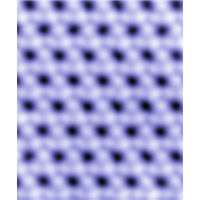
The authors present here the first atomic-scale investigation of the pyrochlore superconductor CsBi2 and the spin liquid Pr2Ir2O7 using scanning tunneling microscopy at 300 mK. The many-body electronic structure, including strong-coupling superconductivity and homogeneous Kondo-lattice resonance, are imaged. They further find unusual excitations, including vortex core states with threefold symmetry and site-dependent Zeeman splitting of the Kondo resonance, which provide atomic insight into the interplay between geometrical frustration and many-body phenomena in this pyrochlore lattice.

Perturbative renormalization group approach to magic-angle twisted bilayer graphene using topological heavy fermion model

Yi Huang, Yang-Zhi Chou, and Sankar Das Sarma

Phys. Rev. B 112, 245132 (2025) - Published 12 December, 2025

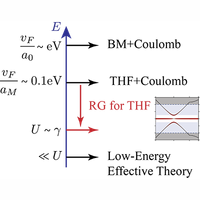
The authors present here a renormalization group analysis of the topological heavy fermion model in magic-angle twisted bilayer graphene. In the energy regime where interactions and hybridization compete, renormalization drives the system toward the chiral limit, lowering the effective interaction strength relative to hybridization. This work bridges the Kondo-like and Mott semimetal scenarios, providing a foundation for modeling the low-energy physics of strongly correlated moiré flat bands.

Floquet-Nambu theory of electron quantum optics with superconductors

Pablo Burset, Benjamin Roussel, Michael Moskalets, and Christian Flindt

Phys. Rev. B 112, 245412 (2025) - Published 12 December, 2025

Enabling and enhancing sliding ferroelectricity in homobilayers via atomic intercalation

Shuangli Yue, Dong-Hui Xu, Li Zhang, Gang Jiang, Mingli Yang, and Xian Wang

Phys. Rev. B 112, 245413 (2025) - Published 12 December, 2025

Bose-Hubbard polaron from weak to strong coupling

Tom Hartweg, Tanul Gupta, and Guido Pupillo

Phys. Rev. B 112, L220201 (2025) - Published 12 December, 2025

The authors perform here large-scale quantum Monte Carlo simulations in the grand-canonical ensemble to characterize a mobile impurity in a 2D Bose–Hubbard bath. They find that the polaron effective mass is a reliable probe of the Mott–superfluid transition only at weak coupling, while strong impurity–bath interactions induce MI±1 bound states with suppressed mobility. The work delivers controlled benchmarks across interaction strengths and clarifies how impurity physics manifests in experimentally relevant trapped atom systems.

Sign In to Your Journals Account

Filter

Recent Issues

Vol. 114, Iss. 24
15 October 2026
Vol. 114, Iss. 23
15 October 2026
Vol. 114, Iss. 22
15 October 2026
Vol. 114, Iss. 21
1 October 2026
Category
Article Type
Section

Filter

Article Lookup

Enter a citation