Recent Articles

Phonon amplification via the Cherenkov mechanism in a high-Q subterahertz acoustic cavity

Sujakala J. Sreerag, Richard P. Campion, Jake Greener, Anthony J. Kent, and Rajeev N. Kini

Phys. Rev. B 112, 085302 (2025) - Published 1 August, 2025

Broadband enhancement of near-field thermal radiation via gradient in-plane coupled mode

Gui-Cheng Cui, Cheng-Long Zhou, Yong Zhang, and Hong-Liang Yi

Phys. Rev. B 112, 085401 (2025) - Published 1 August, 2025

Absorbance marker: Detection of quantum geometry and spread of Wannier function in disordered two-dimensional semiconductors

Luis F. Cárdenas-Castillo, Shuai Zhang, Fernando L. Freire, Jr., and Wei Chen

Phys. Rev. B 112, 085402 (2025) - Published 1 August, 2025

Collective excitations and stability of a non-Fermi liquid state near a quantum critical point of a metal

Yasha Gindikin, Dmitrii L. Maslov, and Andrey V. Chubukov

Phys. Rev. B 112, L081101 (2025) - Published 1 August, 2025

At the edge of a phase transition in certain quantum materials, electrons can enter an exotic “strange metal” state, where they cease behaving like well-defined quasiparticles. The authors investigate here whether this state, in an isotropic system, is internally stable against perturbations with different angular momenta. By developing a theoretical framework to trace collective electron oscillations through the crossover from a Fermi liquid to a non-Fermi liquid regime, the authors demonstrate that the system remains stable under perturbations with all angular momenta — including the odd-momentum modes whose stability was previously questioned.

Fano combs in light scattering by dielectric resonators

Mikhail Bochkarev, Nikolay Solodovchenko, Gleb Chekmarev, Anna Ermina, Kirill Samusev, and Mikhail Limonov

Phys. Rev. B 112, L081102 (2025) - Published 1 August, 2025

The authors consider here the evolution of the Fano combs in the light scattering spectra on dielectric resonators under perturbations of the resonator shape (α) and excitation conditions (φ). The precise theory of electromagnetic Fano resonances and microwave experiments demonstrate that in the proximity of special points in the parametric space (α,φ), the Fano asymmetry q of a particular resonant line can reach any value under an appropriate perturbation, providing effective control of light interference in the far field.

Emergence of cascading flat bands in breathing superlattices

Moru Song, Jinyu Hu, Lina Shi, Yongliang Zhang, and Kai Chang

Phys. Rev. B 112, L081401 (2025) - Published 1 August, 2025

Current-driven dynamics of antiferromagnetic domain-wall skyrmions

Wooyon Kim, Jun Seok Seo, and Se Kwon Kim

Phys. Rev. B 112, 014454 (2025) - Published 31 July, 2025

Quantum spin dynamics of the honeycomb magnet K2Co2TeO6 in high magnetic fields

Patrick Pilch, Laur Peedu, Urmas Nagel, Toomas Rõõm, Changqing Zhu, Yurii Skourski, Xianghan Xu, Robert J. Cava, and Zhe Wang

Phys. Rev. B 112, 014455 (2025) - Published 31 July, 2025

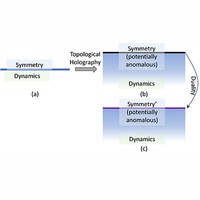
Duality via sequential quantum circuit in the topological holography formalism

Robijn Vanhove, Vibhu Ravindran, David T. Stephen, Xiao-Gang Wen, and Xie Chen

Phys. Rev. B 112, 035173 (2025) - Published 31 July, 2025

Dualities describe two quantum theories that secretly describe the same low-energy physics. The authors describe here how dualities emerge in the Topological Holography formalism – sometimes aptly called “sandwich – by changing the gapped boundary condition on top of the topological field theory. The authors show how this can be done on the lattice through the application of sequential quantum circuits and give systematic examples both in two and three dimensions.

Enhanced electron mobility in undoped Si/Si0.77Ge0.23 quantum wells with superior interface sharpness

Jingxiong Liu, Xinyou Liu, Wenlong Lu, Zonghu Li, Yiwen Zhang, Xiangsheng Wang, Chao Zhao, Gang Cao, Haiou Li, Guoping Guo, Zhenzhen Kong, Baochuan Wang, and Guilei Wang

Phys. Rev. B 112, 035308 (2025) - Published 31 July, 2025

Crossover in electronic specific heat near narrow-sense type-III Dirac cones

Keita Kishigi and Yasumasa Hasegawa

Phys. Rev. B 112, 035429 (2025) - Published 31 July, 2025

Single-crystal growth and physical characterization to fine-tune YbIn1−xTxCu4 (T=Au,Ag) towards the critical end point of the valence transition

Michelle Ocker, Bereket Ghebretinsae, Jan-Niklas Zimmermann, Sophie Würtele, Bernd Wolf, Alexandr Virovets, Michael Lang, Kristin Kliemt, and Cornelius Krellner

Phys. Rev. B 112, 045151 (2025) - Published 31 July, 2025

Controllable creation of topological boundary states in topological insulator based Josephson corner junctions

Xiang Wang, Duolin Wang, Yunxiao Zhang, Xiaozhou Yang, Yukun Shi, Bing Li, Enna Zhuo, Yuyang Huang, Anqi Wang, Zhaozheng Lyu, Xiaohui Song, Peiling Li, Bingbing Tong, Ziwei Dou, Jie Shen, Guangtong Liu, Fanming Qu, and Li Lu

Phys. Rev. B 112, 045430 (2025) - Published 31 July, 2025

Formation of Janus goldene by surface halogenation: First-principles calculations

Nguyen T. Hiep, Cuong Q. Nguyen, Chuong V. Nguyen, Tuan V. Vu, and Nguyen N. Hieu

Phys. Rev. B 112, 045431 (2025) - Published 31 July, 2025

Nonlinear valley Hall effect in a bilayer transition metal dichalcogenide

Zhichao Zhou, Ruijing Fang, Zhen Zhang, Xiaoyu Wang, Jiayan Rong, and Xiao Li

Phys. Rev. B 112, 045432 (2025) - Published 31 July, 2025

Nonadiabatic dynamics and universal behaviors in non-Hermitian systems under biorthogonal framework

Menghua Deng, Wei Li, Kangyi Hu, Chen Sun, and Fuxiang Li

Phys. Rev. B 112, L020306 (2025) - Published 31 July, 2025

The authors introduce here a novel theoretical framework based on time-dependent biorthogonal quantum formalism to deal with the nonadiabatic dynamics in a driven non-Hermitian quantum system. Applying this framework to a linearly driven system, Kibble-Zurek scaling behavior and defect freezing phenomenon can be observed under different quench paths. These results offer fundamental insights into non-Hermitian dynamics and open new avenues for exploring nonequilibrium quantum phenomena.

Strong photon coupling to high-frequency antiferromagnetic magnons via topological surface states

Henrik T. Kaarbø, Henning G. Hugdal, and Sol H. Jacobsen

Phys. Rev. B 112, L020411 (2025) - Published 31 July, 2025

In-plane magnetic field induced orbital Fulde-Ferrell-Larkin-Ovchinnikov superconductivity in twisted WSe2 homobilayers

Jihang Zhu, Yang-Zhi Chou, Yi Huang, and Sankar Das Sarma

Phys. Rev. B 112, L020507 (2025) - Published 31 July, 2025

The authors predict here that an in-plane magnetic field drives purely orbital Fulde–Ferrell–Larkin–Ovchinnikov superconductivity in twisted WSe2 homobilayers. They show finite-momentum pairing emerges above a critical field for symmetric layers (Vz = 0) and at any field when layers are polarized (|Vz| > 0), and they identify a sharp phase transition between two distinct FF phases when two moiré pockets coexist (region III). Their work establishes twisted WSe2 as a tunable platform for realizing and controlling FFLO states.

Uniform electronic states and s-wave superconductivity in a strongly disordered high-entropy compound X0.6Pt0.4Sb (X = Ru, Rh, Pd, Ir)

Yufu Yamada, Shunsaku Kitagawa, Taishi Ihara, Kenji Ishida, Naoto Uematsu, Daigorou Hirai, and Koshi Takenaka

Phys. Rev. B 112, L020508 (2025) - Published 31 July, 2025

Exceptional non-Hermitian topology associated with nontoroidal Brillouin zones

W. B. Rui and Z. D. Wang

Phys. Rev. B 112, L041127 (2025) - Published 31 July, 2025

Sign In to Your Journals Account

Filter

Recent Issues

Vol. 114, Iss. 30
15 November 2026
Vol. 114, Iss. 29
15 November 2026
Vol. 114, Iss. 28
15 November 2026
Vol. 114, Iss. 27
1 November 2026
Category
Article Type
Section

Filter

Article Lookup

Enter a citation