Recent Articles

Nonlocal transport from nonlinear valley responses

Jin Cao, Hui Wang, Shen Lai, Cong Xiao, and Shengyuan A. Yang

Phys. Rev. B 112, L121404 (2025) - Published 18 September, 2025

Reciprocity of valley responses breaks down in nonlinear regime, challenging conventional wisdom. While the linear valley Hall effect and its inverse process have equal response coefficients per Onsager’s principle, nonlinear regimes reveal distinct symmetries and mechanisms. This study unveils a novel framework for nonlocal transport, introducing unique scaling laws as experimental signatures. These breakthroughs deepen nonlinear valleytronics, paving the way for innovative device applications and future explorations.

Electrically switchable ferrovalleytricity in multiferroic heterobilayers

Yangyang Feng, Xinru Li, Ying Dai, Baibiao Huang, and Yandong Ma

Phys. Rev. B 112, 094109 (2025) - Published 17 September, 2025

Mechanism of defect formation in the quantum annealing of the random transverse-field Ising chain

Róbert Juhász

Phys. Rev. B 112, 094203 (2025) - Published 17 September, 2025

Global and local topological crystalline markers for rotation-symmetric insulators

Saavanth Velury, Yoonseok Hwang, and Taylor L. Hughes

Phys. Rev. B 112, 094204 (2025) - Published 17 September, 2025

Engineering harmonic emission through spatial modulation in a Kitaev chain

R. Nivash, S. Srinidhi, Jayendra N. Bandyopadhyay, and Amol R. Holkundkar

Phys. Rev. B 112, 094311 (2025) - Published 17 September, 2025

High-frequency susceptibility tensor in the inertial regime: Prediction for subterahertz magnonics in ferromagnets

Jonas Wiemeler, Michael Farle, and Anna S. Semisalova

Phys. Rev. B 112, 094433 (2025) - Published 17 September, 2025

Comparative study of terbium tellurides Tb2Te5 and TbTe3

I. Shamova, J.-Y. Sun, X.-Y. Chang, V. Popova, D. Chareev, L. Shvanskaya, D. Ksenofontov, A. Vorobyova, K. Lyssenko, A. Demidov, H.-Y. Yeh, W.-Y. Tzeng, J.-Y. Lin, C.-W. Luo, P. Monceau, E. Pachaud, E. Lorenzo, A. Sinchenko, A. Vasiliev, and O. Volkova

Phys. Rev. B 112, 094434 (2025) - Published 17 September, 2025

Magnetic monopole relaxation effects in spin ice Dy2Ti2O7

R. Edberg, A. Khansili, I. M. Fjellvåg, L. Ørduk Sandberg, P. P. Deen, K. Lefmann, P. Henelius, and A. Rydh

Phys. Rev. B 112, 094435 (2025) - Published 17 September, 2025

Emergent quasiparticles of the spin−1 trimer chain

Manodip Routh, Anutosh Biswas, and Manoranjan Kumar

Phys. Rev. B 112, 094436 (2025) - Published 17 September, 2025

Ultrafast x-ray diffraction of high-pressure phases in dynamically compressed TiO2

I. K. Ocampo, R. F. Smith, D. Kim, V. Prakapenka, S. Speziale, M. Schoelmerich, K. Appel, D. N. Polsin, M. Marshall, S. J. Tracy, F. Miozzi, H. J. Lee, E. Galtier, E. Cunningham, C. McGuire, C. Vennari, A. E. Gleason, and T. S. Duffy

Phys. Rev. B 112, 104103 (2025) - Published 17 September, 2025

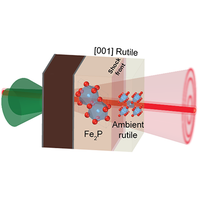
The authors combine here in situ femtosecond x-ray diffraction with laser velocimetry to map high-pressure phase transitions in shock compressed polycrystalline and single-crystal rutile (TiO2). Their results reveal the emergence of a distorted fluorite structure and the ultrafast synthesis of the Fe2P-type phase at pressures well below the equilibrium phase boundary. These transformations occur on nanosecond timescales, highlighting the unique pathways enabled by high-strain-rate loading and offering new insights into metastable phase formation in oxide materials.

Magnetic dynamics in NiTiO3 honeycomb antiferromagnet using neutron scattering

Srimal Rathnayaka, Luke Daemen, Tao Hong, Songxue Chi, Stuart Calder, John A. Schneeloch, Yongqiang Cheng, Bing Li, and Despina Louca

Phys. Rev. B 112, 104426 (2025) - Published 17 September, 2025

Variational scarring in open two-dimensional quantum dots

Fartash Chalangari, Joonas Keski-Rahkonen, Simo Selinummi, and Esa Räsänen

Phys. Rev. B 112, 115137 (2025) - Published 17 September, 2025

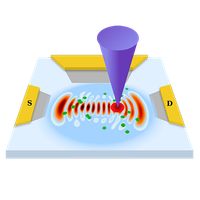
A precisely positioned nanotip can reconfigure the electron flow inside a quantum dot by inducing bouncing-ball scars—coherent enhanced probability density aligned with classical periodic orbits. These scarred pathways remain robust against disorder and, when connected to leads, channel electrons efficiently between source and drain. The work links controlled quantum interference to enhanced transport, highlighting a route toward “scartronics,” where engineered scars serve as functional electron highways in mesoscopic devices.

Instabilities of layer-polarized and quantum anomalous Hall phases in rhombohedral graphene

Ming Gong and X. C. Xie

Phys. Rev. B 112, 115138 (2025) - Published 17 September, 2025

Kinetic inductance coupling for circuit QED with spins

S. Günzler, D. Rieger, M. Spiecker, T. Koch, G. A. Timco, R. E. P. Winpenny, I. M. Pop, and W. Wernsdorfer

Phys. Rev. B 112, 115424 (2025) - Published 17 September, 2025

Exploring d-wave magnetism in cuprates from oxygen moments

Ying Li, Valentin Leeb, Krzysztof Wohlfeld, Roser Valentí, and Johannes Knolle

Phys. Rev. B 112, 125139 (2025) - Published 17 September, 2025

Emergent phases in the Yao-Lee model via coupling to topological spin textures

Muhammad Akram and Onur Erten

Phys. Rev. B 112, 125140 (2025) - Published 17 September, 2025

Electronic structure, magnetic transition, and Fermi surface instability of the room-temperature altermagnet KV2Se2O

Yuanji Xu, Huiyuan Zhang, Maoyuan Feng, and Fuyang Tian

Phys. Rev. B 112, 125141 (2025) - Published 17 September, 2025

Phonon-induced effects in quantum dot absorption and resonance fluorescence with a hierarchy of pure states

Sebastian Toivonen and Kimmo Luoma

Phys. Rev. B 112, 125419 (2025) - Published 17 September, 2025

Missing link between the two-dimensional quantum Hall problem and one-dimensional quasicrystals

Anuradha Jagannathan

Phys. Rev. B 112, L100102 (2025) - Published 17 September, 2025

Phonon-assisted upconversion photoluminescence with high thermal sensitivity of rare-earth doped nanoparticles in vacuum optical tweezers

Xiaojun Guo, Yanzhen Xiao, Xiangtai Xi, Sihan Wang, Hairong Zheng, Volker Deckert, Zhengkun Fu, and Zhenglong Zhang

Phys. Rev. B 112, L100301 (2025) - Published 17 September, 2025
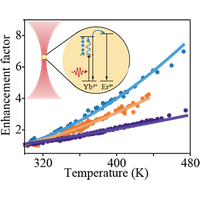
The authors achieve here high thermal sensitivity in upconversion luminescence from optically levitated NaYF4:Yb³⁺/Er³⁺ nanoparticles in vacuum. By tuning excitation wavelength, they control the number of phonons involved in the absorption and energy transfer processes. Larger energy mismatch (e.g., 1064 nm excitation) requires more phonons, resulting in greater thermal enhancement. The temperature-dependent phonon population model explains the observed sensitivity, advancing nanoscale thermometry applications in quantum optics and nanophotonics.

Sign In to Your Journals Account

Filter

Recent Issues

Vol. 114, Iss. 30
15 November 2026
Vol. 114, Iss. 29
15 November 2026
Vol. 114, Iss. 28
15 November 2026
Vol. 114, Iss. 27
1 November 2026
Category
Article Type
Section

Filter

Article Lookup

Enter a citation