Recent Articles

Trigonal distortion in the Kitaev candidate honeycomb magnet BaCo2(AsO4)2

M. M. Ferreira-Carvalho, S. Rößler, C. F. Chang, Z. Hu, S. M. Valvidares, P. Gargiani, M. W. Haverkort, Prashanta K. Mukharjee, P. Gegenwart, A. A. Tsirlin, and L. H. Tjeng

Phys. Rev. B 112, 125135 (2025) - Published 16 September, 2025

The authors utilize here high-precision inverse partial fluorescence yield x-ray absorption and magnetic circular dichroism to investigate whether the conditions for Kitaev physics are met in the honeycomb lattice compound BaCo2(AsO4)2. The measurements reveal considerable trigonal distortion in the CoO6 octahedra, larger than the Co 3d spin-orbit coupling constant. These results point out the necessity to tune the crystal structure by substitutions or uniaxial pressure to obtain a more cubic environment for the Co ions so that electronically Kitaev interactions can emerge.

Berry phases in the bosonization of nonlinear edge modes

Mathieu Beauvillain, Blagoje Oblak, and Marios Petropoulos

Phys. Rev. B 112, 125136 (2025) - Published 16 September, 2025

Parton mean-field theory of a Rydberg quantum spin liquid induced by density-dependent Peierls phases

Benno Bock, Simon Ohler, and Michael Fleischhauer

Phys. Rev. B 112, 125137 (2025) - Published 16 September, 2025

Analytical solution for the relaxed atomic configuration of twisted bilayer graphene including heterostrain

Jian Kang and Oskar Vafek

Phys. Rev. B 112, 125138 (2025) - Published 16 September, 2025

The lattice relaxation in twisted bilayer graphene (TBG) is usually obtained by numerically solving a set of nonlinear equations. Here, the authors first compare the results of two models often employed to determine the relaxation with available experimental data. They then derive an analytical formula to describe the lattice relaxation for the unstrained and strained TBG. Though approximate, the analytical formulas for the unstrained system are highly accurate unless the twist angle is less than 0.4°, far below the first magic angle. When the twist angle is around or above ≳ 1°, the formulas for the strained system are also highly accurate, even if the heterostrain is as large as 1%. These formulas are useful for the construction of the electronic continuum model.

Probing intervalley coupling via exciton hybridization in a charge-tunable GaAs/AlAs quantum dot

Arnault Raymond, Paola Atkinson, Antoine Chapuis, Savvas Germanis, Florent Margaillan, Mathieu Bernard, Valia Voliotis, and Benoit Eble

Phys. Rev. B 112, 125302 (2025) - Published 16 September, 2025

Addressable and tunable module for donor-based scalable silicon quantum computing

Shihang Zhang, Yu He, and Peihao Huang

Phys. Rev. B 112, 125303 (2025) - Published 16 September, 2025

Construction of diverse two-dimensional models with arbitrary Chern number from one-dimensional models

S. Sajad Dabiri and Hosein Cheraghchi

Phys. Rev. B 112, 125418 (2025) - Published 16 September, 2025

Proposal for spin superfluid quantum interference device

Yanyan Zhu, Eric Kleinherbers, Leonid Levitov, and Yaroslav Tserkovnyak

Phys. Rev. B 112, L100405 (2025) - Published 16 September, 2025

Optical detection of four-spin chiral interaction in a two-dimensional honeycomb ferrimagnet

B. Murzaliev, M. I. Katsnelson, and M. Titov

Phys. Rev. B 112, L100406 (2025) - Published 16 September, 2025

Bosonic quantum breakdown Hubbard model

Yu-Min Hu and Biao Lian

Phys. Rev. B 112, L100504 (2025) - Published 16 September, 2025

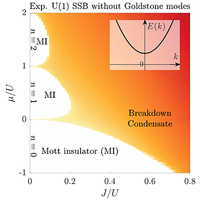
Symmetry and its spontaneous breaking play a fundamental role in classifying quantum phases of matter. Here, the authors propose a bosonic quantum breakdown Hubbard model with an unconventional global symmetry, called the exponential U(1) symmetry. The model undergoes a first-order phase transition into breakdown condensate spontaneously breaking the exponential U(1) symmetry, which surprisingly exhibits no gapless Goldstone modes. These results shed new light on the exploration of unconventional phases of matter with exponential symmetries.

Equation of state of boron carbide B4C

Joshua D. Coe, Ching-Fong Chen, Carl W. Greeff, Dana M. Dattelbaum, J. Tinka Gammel, Brianna L. Musicó, Chad A. McCoy, Pat Kalita, Brittany A. Branch, and John Carpenter

Phys. Rev. B 112, 094106 (2025) - Published 15 September, 2025

First-principles study on anomalously high thermal conductivities in trirutile ternary oxides

XiaoYun Guo, BoCheng Lei, LiLi Zhang, YiNeng Huang, and Jian Zhou

Phys. Rev. B 112, 094310 (2025) - Published 15 September, 2025

Charge and magnetic orders in a two-band model with long-range interactions for infinite-layer nickelates NdNiO2

Tharathep Plienbumrung, Jean-Baptiste Morée, Andrzej M. Oleś, and Maria Daghofer

Phys. Rev. B 112, 094511 (2025) - Published 15 September, 2025

Deeper insight into the terahertz response of conventional superconductors under magnetic field

M. Šindler, F. Herman, F. Kadlec, and C. Kadlec

Phys. Rev. B 112, 094512 (2025) - Published 15 September, 2025

Determination of the melting temperature of hexagonal ice using Lee-Yang phase transition theory

Ling Liu, Yihua Dong, Qi-Jun Ye, and Xin-Zheng Li

Phys. Rev. B 112, 104102 (2025) - Published 15 September, 2025

Universal localization-delocalization transition in chiral-symmetric Floquet drives

Adrian B. Culver, Pratik Sathe, Albert Brown, Fenner Harper, and Rahul Roy

Phys. Rev. B 112, 104205 (2025) - Published 15 September, 2025

Simulating quantum circuits with tree tensor networks using density-matrix renormalization group algorithm

Aditya Dubey, Zeki Zeybek, and Peter Schmelcher

Phys. Rev. B 112, 104312 (2025) - Published 15 September, 2025

System symmetry and the classification of out-of-time-ordered correlator dynamics in quantum chaos

Fuxing Chen and Ping Fang

Phys. Rev. B 112, 104313 (2025) - Published 15 September, 2025

Trilinear coupling and toroidicity in multiferroics

Andrea Urru, Alessio Filippetti, Jorge Íñiguez-González, and Vincenzo Fiorentini

Phys. Rev. B 112, 104422 (2025) - Published 15 September, 2025

Sign In to Your Journals Account

Filter

Recent Issues

Vol. 114, Iss. 30
15 November 2026
Vol. 114, Iss. 29
15 November 2026
Vol. 114, Iss. 28
15 November 2026
Vol. 114, Iss. 27
1 November 2026
Category
Article Type
Section

Filter

Article Lookup

Enter a citation