Recent Articles

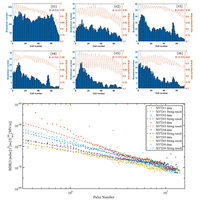
First results from a high-frame-rate, multi-GHz ionizing particle detection system geared toward accelerator diagnostic applications

Mohammadreza Mohseni Ferezghi, Carl Grace, Mark Gulley, Bryce Jacobson, Dongsung Kim, Forest Martinez-McKinney, James McDaniel, Sean McHale, Tyler Morris, Samuel Mudford, Rene Padilla, Tarun Prakash, Eric Prebys, Bruce A. Schumm, Kyung-Wook Shin, John Smedley, Aidan Tiernan, and Max Wilder

Phys. Rev. Accel. Beams 29, 062901 (2026) - Published 16 June, 2026

Next-generation particle accelerators facilities will require diagnostic systems that can operate at multi-GHz repetition rates. We have designed and tested an ionizing-particle detection system that achieves a 4-5 GHz response rate over a dynamic range of over 1000. The system consists of a novel compact signal path mated to a co-designed custom IC, all developed by the collaboration that authored the article. The resulting ionizing particle detection system is the best-performing fast particle detection system ever built. In addition to accelerator physics, this system could find application in high energy physics, advanced laser system development, and fusion energy science.

Combined simulation and experimental characterization of space-charge compensation in a high-intensity proton Low Energy Beam Transport (LEBT)

Pallavi Priyadarshini, Jose V. Mathew, and Rajesh Kumar

Phys. Rev. Accel. Beams 29, 064201 (2026) - Published 12 June, 2026

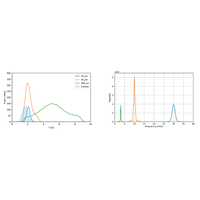
In high-intensity proton accelerators, beam quality is strongly affected by space-charge effects, especially in the low energy beam transport (LEBT) region, where space-charge compensation (SCC) is essential for maintaining beam quality. In this work, we combine detailed simulations and experiments to study SCC dynamics in the LEHIPA LEBT, using PIC-MCC modelling along with dedicated diagnostics. A novel Particle Monitor Probe captures the time evolution of SCC, while a Retarding Field Analyzer measures the degree of compensation. In addition, a multiwire profiler is used to measure beam profiles under varying gas pressure, providing a comprehensive picture of the process.

Two-color x-ray free-electron laser based on self-seeding configuration

Yixuan Liu, Kai Hu, Chuan Yang, Tao Liu, Dong Wang, and Weiqing Zhang

Phys. Rev. Accel. Beams 29, 060701 (2026) - Published 11 June, 2026

We present a two-color XFEL scheme based on a self-seeding configuration. In this scheme, a chirped electron beam first generates a chirped x-ray pulse in the initial undulator. The electron beam is then directed through a chicane, while the chirped x-ray pulse is sent through a multilayer-based two-color filter to produce a two-color seed. Finally, the seed is amplified to saturation by the electron beam in the second undulator, yielding ultrashort two-color x-ray pulses that are separated both spectrally and temporally. This work offers a novel approach for the generation of ultrashort two-color XFEL pulses.

Radiation environment at FCC-ee experimental insertion regions

Alessandro Frasca, Manuela Boscolo, Giacomo Broggi, Roderik Bruce, Francesco Cerutti, Andrea Ciarma, Barbara Humann, Narender Kumar, Anton Lechner, Giuseppe Lerner, Giulia Nigrelli, Fabrizio Palla, and Carsten P. Welsch

Phys. Rev. Accel. Beams 29, 061001 (2026) - Published 8 June, 2026

The electron–positron Future Circular Collider (FCC-ee) is an ambitious post-LHC project at CERN, designed to deliver collisions at four interaction points along a 91-km ring. At the experimental insertions, multiple radiation sources produce a challenging radiation environment exposing detectors and machine equipment. This work presents a comprehensive FLUKA model of the FCC-ee experimental insertions, characterizing the full radiation environment and identifying dominant sources in each region for the two extreme operational modes, at the Z pole and at the tt¯ threshold. The results crucially support the machine design, informing shielding strategies and technology choices.

Beam profile evolution induced by rf crab cavity amplitude noise in the CERN SPS

A. Fornara, R. B. Appleby, H. Bartosik, X. Buffat, R. Calaga, S. Kostoglou, G. Sterbini, G. Trad, and N. Triantafyllou

Phys. Rev. Accel. Beams 29, 061002 (2026) - Published 8 June, 2026

Crab cavities are essential to the HL-LHC upgrade to restore geometrical luminosity loss at the main interaction points. Amplitude noise from their low-level RF systems drives both emittance growth and transverse beam tail evolution. In this CERN SPS experiment we demonstrate that crab cavity amplitude noise produces emittance growth with an unexpected dependence on octupole induced tune spread through beam-coupling impedance, while reducing the heavy-tail population of the beam profile. Through dedicated simulations we quantitatively reproduce both effects, establishing a validated framework to predict crab cavity noise impact in future operation.

Embedded structure design of nanocrystalline soft magnetic alloy cores for high-power synchrotron rf cavities: Power density redistribution and thermal optimization

Bin Wu, Jian Wu, Junjie Zeng, Chunlin Zhang, Xiang Li, Yang Liu, Wei Long, Yue Yuan, Shengyi Chen, Junyu Zhu, Shenghua Liu, Xuerui Hao, and Xiao Li

Phys. Rev. Accel. Beams 29, 062001 (2026) - Published 8 June, 2026

We present a new embedded structure for nanocrystalline soft magnetic alloy (MA) cores in proton/heavy-ion synchrotron RF cavities. The design uses ribbons of different thicknesses in distinct radial regions, effectively transferring power loss from inner thicker ribbons to thinner ribbon regions, overcoming the drawback of conventional cores fabricated from uniformly thick ribbons, where power loss concentrates in inner diameters. The embedded structure effectively improves temperature distribution and increases shunt impedance, as validated by numerical simulations and experiments. These results provide a theoretical foundation for the performance optimization of MA cores.

Online electron beam trajectory correction in free-electron lasers via adaptive dictionary learning

Bowen Zhang, Nengyuan Zhang, Nanshun Huang, Chao Feng, and Zhentang Zhao

Phys. Rev. Accel. Beams 29, 062801 (2026) - Published 8 June, 2026

Beam trajectory control in free-electron lasers relies on static response matrices (RM) that become outdated as machine conditions drift, degrading correction performance. We propose an online dictionary learning method that continuously refines the RM during routine operation with modest data requirements. Simulations demonstrate that this approach achieves a root-mean-square error of 0.2 m/rad or lower for RM elements using only ~1000 trajectory–excitation data pairs. Online experiments at the Shanghai Soft X-ray Free-Electron Laser confirm robust orbit stabilization with correction precision better than 0.01 mm, enabling real-time trajectory correction in low-repetition-rate linacs.

First beam test of an additively manufactured H-mode linac structure made from pure copper

Hendrik Hähnel, Philipp Müller, Jan Dominik Kaiser, Adem Ateş, Leonie Bauer, Benjamin Dedić, Ulrich Ratzinger, Patrick Reichart, Günther Dollinger, and Michael Mayerhofer

Phys. Rev. Accel. Beams 29, 060101 (2026) - Published 5 June, 2026

Additive manufacturing of pure copper enables the production of complex RF cavities with features such as internal cooling channels. We report the successful demonstration of proton-beam acceleration in an additively manufactured pure-copper Interdigital H-mode structure (IH-DTL). The 433 MHz six-gap cavity accelerated 1.4 MeV protons to 2.212 MeV at 25 kW RF power, realizing an effective accelerating gradient of 5.6 MV/m while reaching cavity peak fields up to 68 MV/m without RF breakdown. With RF performance and vacuum operation on par with conventionally manufactured IH-type cavities, this experiment demonstrates the viability of additive manufacturing for future efficient linac structures.

Direct neutron reactions in storage rings utilizing a supercompact cyclotron neutron target

Ariel Tarifeño-Saldivia, César Domingo-Pardo, Iris Dillmann, and Yuri A. Litvinov

Phys. Rev. Accel. Beams 29, 061601 (2026) - Published 3 June, 2026

Measuring neutron-capture cross sections on radioactive nuclei is one of the main open challenges in nuclear astrophysics, yet no existing technique can reach most of the relevant isotopes. We present the conceptual design of a free-neutron target driven by a supercompact cyclotron, optimized for integration into a low-energy ion storage ring using readily available technologies. Monte Carlo simulations show that the design enables a proof-of-concept demonstration at the CRYRING storage ring and is scalable to high neutron densities at future dedicated facilities, opening the path toward direct neutron-induced reaction measurements in inverse kinematics on stored radioactive beams.

High-power performance and analysis of six X-band high-gradient accelerating structures

Heng Deng, Hao Zha, Jiaru Shi, Qiang Gao, Yingchao Du, Boyuan Feng, Xiancai Lin, Hongyu Li, Jian Gao, Fangjun Hu, Qingzhu Li, Weihang Gu, Wenhui Huang, Chuanxiang Tang, and Huaibi Chen

Phys. Rev. Accel. Beams 29, 050401 (2026) - Published 29 May, 2026

X-band high-gradient structures are critical enabling technology for compact linear accelerators and gamma-ray sources. We present tuning, conditioning, and performance of six identical XT72 structures for Tsinghua’s VIGAS gamma source. All reliably achieve 80 MV/m with breakdown rate below 1×10⁻⁴ per pulse, revealing strong localization of breakdowns near high-field input coupler cells, a power-law decay of the normalized breakdown rate, and a dependence on input power waveform. These results provide key benchmarks for high-gradient structure conditioning and future compact facilities.

Design and optimization of rf structures for the CLIC main beam injector linacs

A. Kurtulus, S. Doebert, A. Grudiev, A. Latina, J. Leuthold, J. Smajic, and Y. Zhao

Phys. Rev. Accel. Beams 29, 051603 (2026) - Published 29 May, 2026

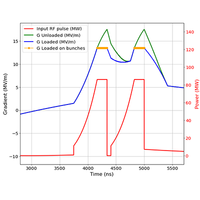
The Compact Linear Collider (CLIC) injector linacs must sustain high-gradient acceleration under strong beam loading and tight wakefield constraints. We present optimized 2 GHz traveling-wave structures combining iris tapering, RF pulse shaping, and a novel double-train RF operation scheme. Together, these enable stable acceleration with controlled wakefields and flat gradients across long bunch trains. The resulting design significantly reduces the required number of RF structures, klystrons, and peak RF power, yielding a more compact and energy-efficient injector complex compatible with future collider RF systems.

Longitudinal dynamics of extreme plasma-based compression of electron beams

Kelly K. Swanson, Thamine Dalichaouch, Agostino Marinelli, Brendan O’Shea, Mark J. Hogan, and Claudio Emma

Phys. Rev. Accel. Beams 29, 052802 (2026) - Published 29 May, 2026

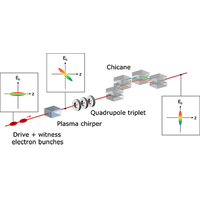
Ultrashort, high-current electron beams can drive advances in next-generation accelerators, ultrafast light sources, and attosecond science, yet conventional compression techniques are fundamentally limited by collective effects and beam degradation. Using simulations and analytical modeling, we demonstrate that plasma-based compression can achieve orders-of-magnitude stronger longitudinal compression while preserving beam quality. By imprinting energy chirps exceeding 500 MeV/μm onto an electron bunch, this approach can compress beams to durations approaching 10 nm and peak currents nearing 1 MA, enabling unprecedented beam brightness and new regimes of ultrafast beam-driven science.

Mitigation of third-order resonances in the Fermilab Recycler Ring

Cristhian Gonzalez-Ortiz, Robert Ainsworth, and Peter Ostroumov

Phys. Rev. Accel. Beams 29, 054001 (2026) - Published 29 May, 2026

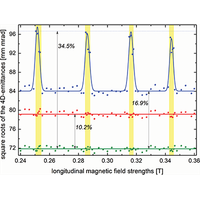
Third-order resonances limit performance in high-intensity bunched beams. We experimentally demonstrate mitigation in the Fermilab Recycler Ring by minimizing resonance driving terms using sextupole correction. Measurements with bunched beams across low and high intensities show reduced beam loss, emittance growth, and halo population. These results establish resonance control as a key tool for intensity-frontier accelerator operation.

Matched transport of intense coupled beams in periodic solenoid focusing channels

C. Xiao and L. Groening

Phys. Rev. Accel. Beams 29, 054401 (2026) - Published 27 May, 2026

The concept of matched transport in periodic quadrupole focusing channels has been extended from uncoupled beams to those exhibiting significant correlations between the two transverse degrees of freedom.

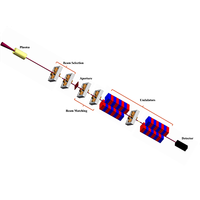
In this paper, several rms-moment-matched transport solutions exhibiting substantial interplane coupling are derived analytically for a periodic solenoid focusing channel with alternating polarities. Particle tracking simulations, performed along this channel using the particle-in-cell Beampath code, confirm that the proposed rms-moment matching formalism remains accurate and robust even in the presence of strong nonlinear space-charge forces.

Multicolor x-ray free-electron laser generation using optical klystron for multiframe diffraction imaging

Xiaodan Liu, Hanxiang Yang, Bingyang Yan, Yue Wang, Nanshun Huang, Liqi Han, Jie Cai, Han Wen, Jinqing Yu, Haixiao Deng, and Xueqing Yan

Phys. Rev. Accel. Beams 29, 050704 (2026) - Published 26 May, 2026

X-ray free-electron lasers provide new opportunities for probing ultrafast dynamical processes in matter. Here we present a four-color XFEL scheme for multiframe diffraction imaging, in which the whole electron beam is used to generate pulses with adjustable wavelength separation and controllable time delay. By introducing optical-klystron enhancement in split undulators, the scheme improves FEL intensity while reducing the total undulator length.

Short-pulse high-power THz generation using optical klystron FELs: Simulation results

Najmeh Mirian

Phys. Rev. Accel. Beams 29, 050703 (2026) - Published 21 May, 2026

This paper presents a compact route to ultrashort, high-intensity THz light using unseeded optical-klystron free-electron lasers. Time-dependent 3D simulations at 10, 30, and 100 µm show how natural THz slippage can phase-align energy modulation, create strong microbunching, and drive coherent amplification without an external seed. The study demonstrates sub-picosecond pulses with multi-hundred-megawatt peak powers, examines dispersion, diffraction, and harmonic-bunching options, and introduces a chicane-embedded optical-delay scheme to restore beam-radiation overlap for staged amplification. These results point toward compact, powerful tunable THz FEL sources for science.

Broad-bandwidth x-ray free-electron lasers driven by plasma wakefield accelerators

Bo Peng, Yang Wan, Zhen Wang, Jianfei Hua, and Wei Lu

Phys. Rev. Accel. Beams 29, 050702 (2026) - Published 20 May, 2026

A simple yet effective scheme for spectral broadening is proposed which utilizes a plasma wakefield accelerator (PWFA) to impart a large energy chirp to an electron beam and a specifically designed transport system then selectively injects the portion of the beam meeting the lasing requirements. A start-to-end simulation demonstrates that a high-brightness X-ray FEL exhibiting a full-width bandwidth reaching 20% can be generated which is approximately five times greater than what is achievable with conventional accelerator technology.

SPARC_LAB facility for advanced acceleration and radiation experiments

R. Pompili et al.

Phys. Rev. Accel. Beams 29, 051602 (2026) - Published 19 May, 2026

The SPARC LAB facility, operating at the LNF-INFN laboratories in Frascati in Italy, has been recently upgraded with the aim to enable user-oriented applications by offering high-brightness electron beams and ultra-short light pulses from THz up to the soft X-rays range. The paper summarizes the electron beams and radiation parameters and describes the layout and main infrastructures available to external users.

Mitigation of transverse single-bunch instabilities with longitudinal impedance, feedback, and chromaticity

Liwei Pan, Yuan Zhang, Kazuhito Ohmi, Chuntao Lin, Na Wang, Yuzhe Liu, and Siyuan Feng

Phys. Rev. Accel. Beams 29, 051001 (2026) - Published 15 May, 2026

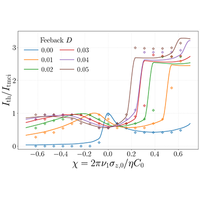
We present a method for suppressing transverse single-bunch instabilities, using the combined action of longitudinal impedance, feedback, and chromaticity. The key stabilization mechanism arises from two effects: feedback and positive chromaticity shift the dominant modes of instabilities, while longitudinal impedance introduces a tune spread in these modes. The theory is applied to three electron storage rings. Both the analysis and simulation lead to consistent conclusions.

Surface synthesis of multipolar TE-mode cavities

O. Betteridge, R. J. Apsimon, and O. Apsimon

Phys. Rev. Accel. Beams 29, 052801 (2026) - Published 14 May, 2026

Transverse Electric (TE) RF cavities are important tools for beam manipulation and beam-quality improvement, but systematic methods for designing cavities with prescribed multipolar TE fields remain limited. This work presents a method for synthesizing such cavities by superimposing cylindrical standing-wave solutions and enforcing conducting boundary conditions through numerical optimization. CST eigenmode simulations validate the resulting hybrid geometries and show that the prescribed multipolar content is realized with high modal purity.

Sign In to Your Journals Account

Filter

Recent Issues

Vol. 29, Iss. 10
October 2026
Vol. 29, Iss. 9
September 2026
Vol. 29, Iss. 8
August 2026
Vol. 29, Iss. 7
July 2026
Category
Article Type
Section

Filter

Article Lookup

Enter a citation