Recent Articles

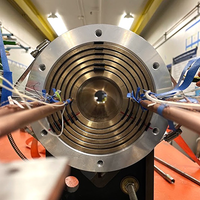
324-MHz interdigital H-mode drift tube linac for muon acceleration

Y. Nakazawa, Y. Ibaraki, E. Cicek, K. Futatsukawa, Y. Fuwa, N. Hayashizaki, T. Iijima, H. Iinuma, Y. Iwata, Y. Kondo, T. Mibe, S. Mizobata, T. Morishita, M. Otani, K. Sumi, and Y. Takeuchi

Phys. Rev. Accel. Beams 29, 093201 (2026) - Published 1 September, 2026

Precise measurements of the muon anomalous magnetic moment motivate the development of a low-emittance muon beam at J-PARC using rf linacs. Positive muons have so far been accelerated only through the radio-frequency quadrupole (RFQ) stage. We report the first full-size 324-MHz interdigital H-mode drift tube linac dedicated to muon acceleration. Designed to follow the RFQ and accelerate muons from 0.34 to 4.26 MeV, it uses a cost-effective three-piece copper cavity with monolithic drift tubes. Low-power tuning reduced the peak-to-peak on-axis field error to 1.4%. The cavity operated stably at the nominal peak power of 390 kW and reached an accelerating field 10% above the design value.

Electrode plasma transport into the gap of high-current Z-pinch accelerators

D. R. Welch, T. C. Genoni, C. Thoma, A. Russell, W. A. Stygar, K. K. Tummel, K. Beckwith, J. H. Hammer, and N. Bennett

Phys. Rev. Accel. Beams 29, 093301 (2026) - Published 1 September, 2026

In the Z-pinch pulsed-power accelerators, multi-MA currents rapidly heat the electrodes above the threshold for plasma formation. The stability and dynamics of an electron sheath emitted from the highly magnetized electrode plasmas are investigated using semi-analytic theory and kinetic particle-in-cell simulation which show strong resistive plasma instability (RPI) growth. The nonlinear evolution of the RPI drives electron vortices and uncovers sufficient ion charge for plasma transport across the gap in several nanoseconds with plasma densities sufficient to generate published current losses via a Hall mechanism.

Accurate calculation of path-length variation due to intrabeam scattering for an electron beam traversing a lattice

Zhilong Pan, Wenxuan Wu, Jingyuan Zhao, Chuanxiang Tang, Xiujie Deng, and Alexander Wu Chao

Phys. Rev. Accel. Beams 29, 094901 (2026) - Published 1 September, 2026

We present a more accurate formula for calculating the intra-beam scattering (IBS)-induced path length deviation of an electron beam traversing the lattice, which can aid in lattice optimization. Additionally, we have developed a tool to simulate IBS-kick effects on beam dynamics. The tool can directly compute the IBS equilibrium emittance in storage rings and efficiently evaluate the associated path length deviations for an electron beam traversing a lattice. These capabilities are important for applications such as optical stochastic cooling and steady-state microbunching, which strictly require the isochronicity of lattice.

Optimizing the interaction geometry of inverse Compton scattering x-ray sources

C. W. Sweers and O. J. Luiten

Phys. Rev. Accel. Beams 29, 083405 (2026) - Published 31 August, 2026

Inverse Compton scattering (ICS) is a promising method for generating coherent and tunable x-rays in a compact setup. Optimizing ICS x-ray sources is often left to simulations, which can be time consuming and not always provide a physical understanding of the limitations. This paper presents a closed form analytical framework to optimize the output of an ICS x-ray source at arbitrary interaction angles between pulsed electron and laser beams. We find that a co-propagating, grazing angle geometry is especially useful for soft x-ray generation.

Three-dimensional simulation of the University of Hawai‘i FEL oscillator with cavity desynchronization

Amir Weinberg, Levi K. C. Fisher, Eremey Valetov, and Siqi Li

Phys. Rev. Accel. Beams 29, 083406 (2026) - Published 31 August, 2026

Free-electron laser oscillators exhibit rich dynamics that can strongly affect pulse stability and output power. Using a three-dimensional, time-dependent simulation framework for the University of Hawai‘i FEL oscillator, we characterize its saturation, temporal and spectral evolution, and response to cavity desynchronization. We find that modest desynchronization can enhance pulse energy, while larger detuning suppresses spiking and improves robustness to timing jitter, providing guidance for future operation of the facility.

Theoretical and experimental studies of energy modulation to demodulation in seeded free-electron lasers

Hanxiang Yang, Nanshun Huang, Zipeng Liu, Zhangfeng Gao, Shengbin Ye, Wencai Cheng, Shudong Zhou, Jinya Chen, Cheng Yu, Wei Zhang, Tao Liu, and Haixiao Deng

Phys. Rev. Accel. Beams 29, 083407 (2026) - Published 31 August, 2026

Laser-induced energy modulation and demodulation play a critical role in advanced beam-manipulation schemes for coherent radiation generation, while residual energy modulation can degrade electron-beam quality and limit scheme performance. Here, we systematically investigate the transition from modulation to demodulation through theory and three-dimensional simulations, explore a route toward complete demodulation, and develop diagnostics for weak residual modulation, followed by preliminary experiments at SXFEL. This work reports the first experimental observation of energy demodulation in a seeded FEL and establishes diagnostics for resolving weak residual modulation.

In situ estimation of the maximum secondary electron yield in the LHC Vacuum Pilot Sector beam pipe via electron cloud measurements and numerical simulations

Quentin Duong, Vincent Baglin, and Gaël Sattonnay

Phys. Rev. Accel. Beams 29, 083503 (2026) - Published 31 August, 2026

Electron cloud buildup limits the performance of high-intensity proton accelerators like the LHC, driving beam instabilities and cryogenic heat loads. Existing methods to measure the maximum secondary electron yield (δmax) typically require dedicated instrumentation and beam-time interruptions. This work introduces a novel in situ technique that extracts δmax directly from routine electron cloud current measurements during standard LHC operation, using the transition to a linear regime with the number of injected bunches. Applied to Vacuum Pilot Sector data, it enables noninvasive, long-term monitoring of vacuum-surface conditioning.

Seeding of self-modulation using truncated seed bunches as a path to high gradient acceleration

N. Z. van Gils et al. (AWAKE Collaboration)

Phys. Rev. Accel. Beams 29, 083601 (2026) - Published 31 August, 2026

Adding a relativistic ionization front to electron beam seeding is an effective way to control the self-modulation of an entire proton bunch in plasma. By using the relativistic ionization front to truncate an available electron seed bunch, reproducible seeding of self-modulation is demonstrated at plasma densities seven times higher than previously achieved, while simultaneously increasing the seed wakefield amplitude. This opens a route to controlled, high-gradient plasma wakefield acceleration with long proton drivers.

Plasma dechirper and lens for electron beams from laser wakefield acceleration in a tailored density profile

T. L. Steyn, A. Panchal, O. Vasilovici, F. M. Herrmann, S. Schöbel, P. Ufer, O. Khomyshyn, Y.-Y. Chang, I. Moulanier, M. Masckala, M. Samir, C. Ballage, M. LaBerge, F. Massimo, P. Désesquelles, S. Dobosz Dufrénoy, U. Schramm, A. Irman, and B. Cros

Phys. Rev. Accel. Beams 29, L080501 (2026) - Published 31 August, 2026

Minimizing energy spread and divergence is essential for using electron beams from laser-wakefield accelerators (LWFA) in applications such as compact free-electron lasers. Here the authors report the first experimental demonstration of dechirping of an LWFA beam, combined with a plasma lensing effect within a single tailored plasma density profile. These mechanisms take place in a down-ramp followed by a long, low-density plasma tail, and generate electron beams with a FWHM charge of 40 pC, 3.4% energy spread, and 0.46 mrad divergence, reaching a peak spectral brightness of 8 pC/MeV/mrad.

Nonlinear dynamics optimization based on minimizing resonance driving terms along a storage ring

Bingfeng Wei, Zhenghe Bai, Guangyao Feng, Pascale Brunelle, Alexandre Loulergue, and Laurent S. Nadolski

Phys. Rev. Accel. Beams 29, 083404 (2026) - Published 28 August, 2026

This paper develops an efficient nonlinear optimization method that minimizes on- and off-momentum ring-averaged resonance driving terms, which is applied to the SOLEIL storage ring. One optimized solution achieves a dynamic aperture comparable to that obtained from tracking-based nonlinear optimization while improving beam lifetime, as experimentally validated. It is also found that reducing ring-averaged resonance driving terms helps optimize working point and control tune shifts with momentum.

Design and nonlinear optimization of a one-fold lattice for the Super Tau-Charm Facility collider rings

Tao Liu, Anton Bogomyagkov, Demin Zhou, Penghui Yang, Sangya Li, Linhao Zhang, Ye Zou, Jingyu Tang, and Qing Luo

Phys. Rev. Accel. Beams 29, 083703 (2026) - Published 28 August, 2026

The lattice design for the Super Tau-Charm Facility (STCF), a high-luminosity, low-energy electron-positron collider, is challenging. This work presents the design and nonlinear optimization of a one-fold STCF lattice and provides a framework for high-luminosity low-energy electron-positron colliders. The design procedure comprises lattice-independent global parameter optimization, interaction region design with local chromatic correction and crab-waist sextupoles, and full-ring nonlinear optimization with a two-stage strategy. The optimized lattice achieves target luminosity while maintaining sufficient dynamic aperture, momentum acceptance, and Touschek lifetime.

Studies of enhanced SASE at the soft x-ray beamline Athos at SwissFEL

S. Reiche, E. Prat, A. Dax, M. Huppert, S. Neppl, A. Trisorio, C. Vicario, and E. Ferrari

Phys. Rev. Accel. Beams 29, 083403 (2026) - Published 24 August, 2026

Enhanced SASE (ESASE) operation of an FEL uses a train of current spikes to locally enhance the electron beam current for improved FEL performance. However, these current spikes generate a strong space charge field, which builds up a linear chirp over each current spike. This effect must be compensated by a positive taper of the undulator field, but measurements at SwissFEL show a much stronger optimum taper than anticipated. Elongation of each current spike under its own space charge force spreads the already-induced microbunches of the FEL amplification apart, causing an adiabatic red shift in the emitted radiation. This effect is visible in the plot which shows matching simulations.

RF cavity design and beam loading effects in the rectilinear cooling channel for a muon collider

C. Barbagallo, A. Grudiev, D. Merenich, X. Lu, and T. Luo

Phys. Rev. Accel. Beams 29, 083803 (2026) - Published 24 August, 2026

High-gradient normal-conducting copper cavities equipped with beryllium windows are essential for enhancing muon cooling channel performance in a future muon collider. This study presents a comprehensive physics-based design framework including cavity optimization with an advanced hybrid frequency-time domain beam-loading analysis. The results demonstrate that local compensation schemes effectively mitigate single-bunch wakefield effects, providing critical design guidelines for high-intensity muon cooling applications.

Impact of thermal annealing on stress, morphology, and field emission of NbTiN thin films

Frederic Braun, Florian Brockner, and Dirk Lützenkirchen-Hecht

Phys. Rev. Accel. Beams 29, 084302 (2026) - Published 24 August, 2026

Multilayer NbTiN coatings are a promising route toward superconducting RF cavities operating beyond the limits of bulk niobium. By combining XRD, optical profilometry, AFM, UPS, and field-emission scanning microscopy, we show that high-temperature annealing substantially improves the microstructure and suppresses field emission, increasing the onset field from below 60 MV/m to about 200 MV/m. The results establish thermal annealing as a key processing step for enhancing the performance and reliability of NbTiN thin films for next-generation SRF cavities.

Fabrication and test of a 6-tesla-class high-temperature superconducting dipole magnet at 4.2 K

Dmytro Abraimov et al.

Phys. Rev. Accel. Beams 29, 083902 (2026) - Published 14 August, 2026

Can high-temperature superconductors take accelerator dipoles past the limits of Nb-Ti and Nb₃Sn? The U.S. Magnet Development Program and industry partners tested C3, a canted-cosine-theta dipole wound with commercial REBCO CORC® wires, reaching 5.99 T in a 65 mm clear aperture at 4.2 K, with no measurable degradation after a thermal cycle. Field quality and energy loss were limited by strong conductor magnetization, yet the results reveal no fundamental showstopper on the path to 8–10 T. Alongside the magnet performance, the authors report fabrication incidents and open questions candidly and invite accelerator physicists to join as early adopters of this emerging technology.

Spectrotemporal properties of the coherently emitted synchrotron radiation: A machine learning approach

Arjun Radha Krishnan, Arne Held, Carsten Mai, Zohair Usfoor, Vivek Vijayan, and Shaukat Khan

Phys. Rev. Accel. Beams 29, 085101 (2026) - Published 13 August, 2026

At the 1.5-GeV synchrotron light source DELTA, ultrashort radiation pulses are produced via coherent harmonic generation (CHG), where femtosecond laser pulses modulate the electron energy and a magnetic chicane produces periodic density maxima, giving rise to coherent emission at harmonics of the laser wavelength. This paper investigates CHG spectra under variation of the chicane and laser parameters. By combining numerical simulations with a convolutional neural network, the group-delay dispersion and third-order dispersion of the laser pulses can be extracted from the data. Conversely, these tunable parameters can be used to control the spectrotemporal properties of the CHG pulses.

Development of high gradient quadrupole magnets in HEPS storage ring

Mei Yang, Yingshun Zhu, Yafeng Wu, Xianjing Sun, Qing Li, Ran Liang, Chuang Shen, Siyu Chen, Yuandi Xu, Shu Yang, Lei Wu, Chunhua Li, Yi Jiao, and Fusan Chen

Phys. Rev. Accel. Beams 29, 083901 (2026) - Published 12 August, 2026

To meet the extreme brightness requirements of fourth-generation light sources, HEPS has developed a family of quadrupole magnets employing saddle-shaped coils, customized pole profiles, and “Magic Finger” harmonic compensation. The magnets feature a 26 mm aperture, an 80 T/m gradient, and field harmonics below 4×10⁻⁴. Through finite-element simulations and high-precision field measurements, their saturation behavior, current-dependent harmonics, and batch-to-batch reproducibility were systematically characterized on both solid and laminated magnets. The validated design offers a proven engineering baseline for future low-emittance light source magnet systems.

Online optimization of nonlinear lattice using a data-driven chaos indicator

Minghao Song and Yongjun Li

Phys. Rev. Accel. Beams 29, L081601 (2026) - Published 12 August, 2026

Online optimization of nonlinear beam dynamics in operating accelerators remains challenging because it requires a measurable chaos indicator capable of distinguishing irregular beam motion from radiation damping, beam decoherence, and measurement noise. We experimentally demonstrate the first online optimization of a storage-ring nonlinear lattice using a data-driven chaos indicator derived from the predictability of turn-by-turn beam motion. Implementation at the NSLS-II storage ring enlarges the dynamic aperture and improves off-axis injection efficiency, establishing a model-independent framework for accelerator optimization based solely on measured beam dynamics.

Strongly tapered field generation by beat frequency undulator

Binghao Zhang, Yuanfang Xu, Nanrui Yang, Qika Jia, Zhouyu Zhao, and Heting Li

Phys. Rev. Accel. Beams 29, 083402 (2026) - Published 11 August, 2026

Conventional undulator tapering methods, such as gap variation or electromagnetic control, often involve complex mechanical structures or power supply systems. This work presents a beat frequency undulator composed of two permanent magnet arrays with slightly different periods, whose magnetic field superposition generates a longitudinal beat frequency envelope. By longitudinally shifting one array, the taper strength and direction can be dynamically controlled without gap adjustment or electromagnetic tuning, providing a robust and flexible solution for undulator tapering.

Dynamic phase-driven cascade focusing and acceleration of subrelativistic electrons in on-chip inverse-Cherenkov particle accelerators

Minghao Liu, Weihao Liu, Liwen Zhang, and Shengguang Liu

Phys. Rev. Accel. Beams 29, 083602 (2026) - Published 11 August, 2026

Dielectric laser accelerators (DLAs) achieve ultrahigh acceleration gradients on silicon chips, promising compact tabletop accelerators. However, subrelativistic operation is hindered by phase slippage from velocity changes and transverse beam loss in microscale channels. Inverse Cherenkov (ICR) DLAs offer high efficiency through fundamental mode fields, but strict phase matching requires precision tapered structures. This work proposes a dynamic phase-driven cascaded ICR-DLA with a four-stage tapered prism driven by a single laser pulse. Phase slippage is leveraged to alternate electrons between focusing and defocusing during acceleration, achieving stable long-range beam confinement.

Sign In to Your Journals Account

Filter

Recent Issues

Vol. 29, Iss. 10
October 2026
Vol. 29, Iss. 9
September 2026
Vol. 29, Iss. 8
August 2026
Vol. 29, Iss. 7
July 2026
Category
Article Type
Section

Filter

Article Lookup

Enter a citation