Recent Articles

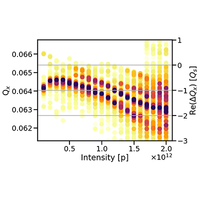
Post long shutdown 2 CERN proton synchrotron transverse impedance model: Description and beam-based validation

Sébastien Joly, Mauro Migliorati, Nicolas Mounet, and Benoît Salvant

Phys. Rev. Accel. Beams 29, 024201 (2026) - Published 4 February, 2026

High-brightness synchrotrons are increasingly limited by collective effects, particularly transverse impedance and space charge, which lead to beam degradation and losses. The interplay of transverse impedance, space charge, and chromatic effects complicates predictions and makes realistic validation of the CERN Proton Synchrotron (PS) impedance model challenging. We present beam-based measurements performed at the PS and macroparticle tracking simulations that address these issues and quantify the impact of the key mechanisms. This work provides a robust foundation for assessing PS beam stability in present and future operational scenarios.

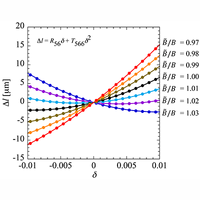
Formulation of energy-dependent pathlength variation for a two Double Bend Achromat dogleg

Kouichi Soutome, Toru Hara, Eito Iwai, Kenji Yasutome, Hirokazu Maesaka, and Hitoshi Tanaka

Phys. Rev. Accel. Beams 29, 020701 (2026) - Published 2 February, 2026

Recently, the generation of ultra-short XFEL pulses of less than 1 fs has been reported using additional electron bunch compression with a self-modulated energy chirp. This paper discusses an optimal bunch compression scheme using a two-DBA (Double Bend Achromat) dogleg and an electron bunch having the reverse energy chirp. By changing the bending angles of the DBA section (B→B˜), the longitudinal dispersions R56 and T566 can be controlled without altering the trajectory and transverse envelope of the electron beam in the downstream section. A method for evaluating R56 and T566 of a whole two-DBA dogleg is presented, which is applicable to the case of varied bending angles.

First plasma processing trial of a quarter-wave resonator cryomodule at the Facility for Rare Isotope Beams

Walter Hartung, Wei Chang, Yoo-Lim Cheon, Kyle Elliott, Sang-Hoon Kim, Taro Konomi, Patrick Tutt, Yuting Wu, and Ting Xu

Phys. Rev. Accel. Beams 29, 012003 (2026) - Published 29 January, 2026

As large-scale superconducting-cavity accelerator facilities transition from the construction phase to the operational phase, the attention shifts from producing high-performance cryomodules to maintaining cryomodule performance. In situ plasma processing has helped to reduce field emission in superconducting linacs for protons and electrons. This paper reports the first results of plasma processing on a quarter-wave cryomodule for heavy ions at the Facility for Rare Isotope Beams.

Simulation of electron bunch compression for a megaelectronvolt ultrafast electron diffraction facility at the National Centre for Nuclear Research in Poland

M. Staszczak, J. Krzywiński, P. Czuma, P. Krawczyk, R. Nietubyć, and J. Sekutowicz

Phys. Rev. Accel. Beams 29, 013501 (2026) - Published 29 January, 2026

This paper describes the beam dynamics of an ultrafast electron diffraction facility now under construction at the National Centre for Nuclear Research (NCBJ). The first stage is due for commissioning in June 2026. The second stage, in which the room-temperature injector will be replaced by an SRF injector, is planned for 2027. In both stages, the facility will include an injector and an HZDR/RI cryomodule housing two TESLA-type SRF cavities. In the second stage, it will operate in cw mode with an SRF linac, enabling repetition rates of up to 200 kHz for very short bunches of 1–100 fC.

Full-scatter vector field analysis of an overmoded and periodically loaded cylindrical structure for the transportation of THz radiation

Adham Naji, Pawan Kumar Gupta, and Gennady Stupakov

Phys. Rev. Accel. Beams 29, 012002 (2026) - Published 28 January, 2026

Highly overmoded iris-line waveguides offer an attractive solution for the efficient transportation of THz pulses over long distances. This paper presents the general (full-scatter) field analysis for the iris-line and its discontinuities under a paraxial excitation by an arbitrary source. By developing an advanced technique that combines Lorentz’s reciprocity theorem (with a generalized guided-field configuration), uniqueness theorem, and an equivalent current-source theorem by Schelkunoff, we derive the general scattered-field coefficients analytically and examine the effects of screen thickness, transient regime, diffraction loss, and ohmic loss on the propagation properties.

Erratum: Materials adopted for particle beam windows in relevant experimental facilities [Phys. Rev. Accel. Beams 27, 024801 (2024)]

Lorenzo Notari, Michele Pasquali, Federico Carra, Marcello Losasso, and Marilena Tomut

Phys. Rev. Accel. Beams 29, 019901 (2026) - Published 27 January, 2026

Near-infrared noise in intense electron bunches

Sergei Kladov, Sergei Nagaitsev, Young-Kee Kim, Daniel R. Broemmelsiek, Zhirong Huang, Jonathan Jarvis, Alex H. Lumpkin, Jinhao Ruan, Andrea Saewert, and Randy M. Thurman-Keup

Phys. Rev. Accel. Beams 29, 012801 (2026) - Published 23 January, 2026

Near-infrared optical transition radiation is used to measure density noise in relativistic electron bunches under conditions relevant to coherent electron cooling. We show that uncompressed beams exhibit noise consistent with the shot-noise limit, implying no reduction of the cooling rate, while compression leads to strong microbunching and coherent emission.

Two-mirror resonator for next-generation Compton gamma-ray source

Will Delooze, Wei Li, and Ying K. Wu

Phys. Rev. Accel. Beams 29, 013403 (2026) - Published 22 January, 2026

A primary goal of next-generation Compton gamma sources (CGSs) is to combine mature accelerator technology with high-power Fabry-Perot cavities to achieve a two-to-three orders of magnitude increase in total scattered flux over state-of-the-art CGSs. In this work, we re-examine the performance of nearly-concentric two-mirror resonators as laser drivers for next-generation storage ring-based CGSs by introducing a new figure of merit, S, that quantifies their proximity to instability. We then demonstrate how to improve the design choices for the two-mirror resonator to enhance the achievable gamma-ray beam flux.

Multiphysics analysis of cryogenically cooled photocathode in a continuous wave SRF injector cavity

Dmitry Bazyl, Klaus Floettmann, Elmar Vogel, and Igor Zagorodnov

Phys. Rev. Accel. Beams 29, 013402 (2026) - Published 20 January, 2026

Superconducting RF photoinjectors with thread-mounted cathodes, which allow cavity cleaning with the photocathode installed, offer record accelerating fields for CW electron sources driving FELs, UEDs, and THz facilities. Recently, DESY’s SRF photoinjector demonstrated a 50 MV/m peak field on-axis with a copper photocathode. A unique feature of this layout is the photocathode’s direct interface to superfluid helium at 2 K. The critical question is whether UV drive-laser heating can impose operational limitations. To address this, we developed and studied transient and steady-state coupled multiphysics models.

Identification of optimal conditions for betatron x-ray generation in subcritical density plasma

Abdughupur. Ablimit, L. Q. Han, X. Y. Zhao, C. OuYang, H. Wen, and J. Q. Yu

Phys. Rev. Accel. Beams 29, 013401 (2026) - Published 13 January, 2026

Laser wakefield acceleration can produce accelerating fields of hundreds of GV/m, enablng a compact alternative to conventional accelerators. However, reaching the potential of both electron charge and radiation brightness requires precise tuning of laser-plasma interactions. We identify the optimal laser pulse duration and focal spot size needed to maximize performance in subcritical density plasmas. Using 3D-PIC simulations, we show that a 550 TW laser pulse can generate massive electron beams with charges reaching tens of nanocoulombs and energies up to 500 MeV. Electron oscillations emit high-flux X-rays. Optimization is a significant step toward compact, high-brightness X-ray sources.

Design, realization, and testing of a brazing-free C-band radio frequency photogun

D. Alesini, F. Cardelli, G. Di Raddo, L. Faillace, M. Ferrario, A. Gallo, A. Giribono, G. Latini, S. Lauciani, A. Liedl, L. Pellegrino, L. Piersanti, S. Pioli, J. Scifo, B. Serenellini, G. J. Silvi, L. Spallino, A. Vannozzi, C. Vaccarezza, L. Ficcadenti, T. G. Lucas, L. Hol, and P. Craievich

Phys. Rev. Accel. Beams 29, 012001 (2026) - Published 12 January, 2026

Radio-frequency (rf) photo-guns are the most common electron sources used in LINACs for free-electron laser and Compton facilities, as they provide very low-emittance, high-brightness electron bunches. The innovative C-band system (operating at 5.712 GHz) that we have developed and tested pushes the frontiers of high-gradient rf photo-guns, combining cathode peak fields above 160 MV/m with repetition rates of up to 1 kHz. Its realization relies on a novel brazing-free technology developed at the National Institute for Nuclear Physics (INFN, Italy), enabling significant improvements in the mechanical and electrical performance of high-gradient rf devices.

Isochronous lattice design with time-of-flight fluctuation reaching subattoseconds based on high-order achromat

Zhilong Pan, Jingyuan Zhao, Chuanxiang Tang, Xiujie Deng, and Alexander Wu Chao

Phys. Rev. Accel. Beams 28, 124001 (2025) - Published 30 December, 2025

Fluctuations in electron time-of-flight (ToF) during lattice transport is crucial for various applications, such as ultrafast electron diffraction, optical stochastic cooling in storage rings (SR), and sustaining steady-state microbunching in SR. This paper introduces a design concept aimed at reducing the electron beam’s ToF fluctuation in an isochronous lattice up to the sub-attosecond level, while nonlinearity is minimized based on high order achromat lattice. We also present an optimized design example achieving ≈0.3 attoseconds root-mean-square ToF fluctuation (equivalent to 0.1 nm) with specific beam emittance values of ϵx ~1 nm, ϵy ~1 nm, and σδ ~10−3

Reinforcement learning for real-time luminosity optimization in colliders

R. Mamutov, G. Baranov, and A. Gerasev

Phys. Rev. Accel. Beams 28, 122802 (2025) - Published 29 December, 2025

A reinforcement learning algorithm for real time luminosity optimization in colliders is designed and benchmarked. Prior to training, the input data undergoes multi-stage preprocessing before being fed into a neural network. The approach combines offline pretraining on historical accelerator data with online fine-tuning during operation and shows an average improvement of about 4% in luminosity. Detailed algorithmic descriptions as well as a high-level statistical summary of the new tuning algorithm are provided.

Development of a novel tunable gradient permanent quadrupole magnet

Shaoxiang Dong, Yimin Yang, Bingshun Zhang, Yiyue Wang, and Guangyao Feng

Phys. Rev. Accel. Beams 28, 122401 (2025) - Published 23 December, 2025

This work reports the design and experimental validation of a novel tunable-gradient permanent quadrupole magnet (PQM) that combines compactness, energy efficiency, and precise field control. The prototype delivers a continuous tuning range of 39 T/m with a peak gradient of 65 T/m, while maintaining excellent field quality with multipole errors below 5 × 10⁻⁴. Its fully permanent-magnet configuration eliminates the need for power supplies andmcooling systems, offering a compact and sustainable solution for next-generation light sources and free-electron lasers.

Performance degradation induced by different forms of carbon contamination in superconducting rf cavities and their recovery strategies

Tongtong Zhu, Andong Wu, Yuan He, Shichun Huang, Zongheng Xue, Chunlong Li, Hao Guo, Pingran Xiong, Tiancai Jiang, Qingwei Chu, Didi Luo, Ziqin Yang, Teng Tan, Mengxin Xu, Zhijun Wang, Shenghu Zhang, Kun Zhang, and Hongwei Zhao

Phys. Rev. Accel. Beams 28, 123101 (2025) - Published 23 December, 2025

Carbon is an unavoidable contaminant on metal surfaces, yet its precise impact on SRF cavity performance remains a critical question. This study systematically investigates the underlying mechanisms through which distinct forms of carbon contamination, including adsorbed carbon and deposited carbon, degrade SRF cavity performance, and explores corresponding recovery strategies. The findings advance our understanding of performance degradation and recovery mechanisms induced by carbon contamination, thereby establishing a foundation for selecting optimal online recovery methods.

Demonstration of a code coupling framework for modeling beam-collimator impacts in the advanced photon source

A. J. Dick, J. Dooling, M. Borland, G. Navrotksi, Y. Lee, S. Riedel, D. Lee, and N. Cook

Phys. Rev. Accel. Beams 28, 123001 (2025) - Published 22 December, 2025

As modern accelerators reach higher and higher brightness beams, there is more potential for damage due to direct beam strikes with beamline components. Particle tracking and matter interaction simulations are commonly used in accelerator physics but there are no simulation codes which capture all the physics present in these interactions. We present a method for coupling several software programs to capture the dynamic physics present and demonstrate its use in modeling beam losses in the Advanced Photon Source.

X-ray transition radiation by high-energy electrons in a thin solid target placed in an external magnetic field

I. V. Demydenko, S. V. Trofymenko, A. P. Potylitsyn, G. Kube, and A. V. Shchagin

Phys. Rev. Accel. Beams 28, 124501 (2025) - Published 18 December, 2025

This work is dedicated to the study of X-ray transition radiation by 2–10 GeV electrons in a thin target placed in a strong magnetic field. Due to interference effects, the total emission can differ significantly from the simple sum of transition and synchrotron radiation and both constructive and destructive interference is possible. The magnitude of interference effects as a function of electron energy and detector acceptance angle is studied.

Rigorous study on the longitudinal beam coupling impedance of a cylindrical lossy pipe in normal and anomalous regimes

A. Curcio, M. Migliorati, A. Mostacci, and L. Palumbo

Phys. Rev. Accel. Beams 28, 121601 (2025) - Published 15 December, 2025

Accurate knowledge of beam-pipe impedance is essential for controlling wakefields and energy loss in modern accelerators. We derive a comprehensive theory that predicts the impedance of metallic vacuum pipes under a wide range of materials, temperatures, and bunch durations including regimes where classical models fail. This unified approach helps improve the reliability and performance of future high-brightness machines.

On-line measurement of beam phase and energy gain based on beam-cavity interaction

Lingyun Gong, Rihua Zeng, Chengye Xu, Zhijun Wang, Francesco Grespan, Paolo Pierini, Muyuan Wang, and Yuan He

Phys. Rev. Accel. Beams 28, 122801 (2025) - Published 15 December, 2025

On-line monitoring of beam status is crucial for stable operation of accelerators, especially high-power machines. Here we introduce two novel methods for the on-line monitoring of beam phase and energy gain, based on the beam-cavity interaction. The methods are successfully validated in both single-cell and multicell cavities, demonstrating their broad applicability for accelerator control and diagnostics. The precision of the methods improves with the increase of the beam current, and remains satisfactory even when the current is only about 3 mA.

Mean transverse energy of electrons generated from mixed thermionic, multiphoton, and field emissions

Po-Hsun Wu (吳柏勳) and Yen-Chieh Huang (黃衍介)

Phys. Rev. Accel. Beams 28, 123402 (2025) - Published 9 December, 2025

The brightness of an electron source is strongly influenced by the underlying electron-emission mechanisms. This work presents a unified theory for calculating the mean transverse energy of electrons produced through mixed thermionic, multiphoton, and field emission processes, enabling accurate estimates of source brightness when multiple mechanisms are involved. The theory successfully accounts for thermionically assisted multiphoton emission from a copper photocathode illuminated by an intense infrared laser.

Sign In to Your Journals Account

Filter

Recent Issues

Vol. 29, Iss. 10
October 2026
Vol. 29, Iss. 9
September 2026
Vol. 29, Iss. 8
August 2026
Vol. 29, Iss. 7
July 2026
Category
Article Type
Section

Filter

Article Lookup

Enter a citation