Letters

Emergent infrared conformal dynamics: Applications to strongly interacting quantum states

Jeff Maki and Fei Zhou

Phys. Rev. A 109, L051303 (2024) - Published 16 May, 2024

The authors exploit a connection between the theoretical renormalization group equation flow and the expansion dynamics of strongly interacting quantum gases. This analysis shows that there shall be an emergent conformal symmetry that restricts the dynamics and limits entropy production in one dimension, while it is absent in three-dimensions.

Isometric tensor network optimization for extensive Hamiltonians is free of barren plateaus

Qiang Miao and Thomas Barthel

Phys. Rev. A 109, L050402 (2024) - Published 14 May, 2024

Strongly correlated quantum many-body systems from condensed matter and particle physics are very hard to study classically and variational quantum algorithms (VQAs) may be hampered by barren plateaus, where energy gradients decay exponentially in the system size. The authors prove that this critical problem can be resolved by employing VQAs based on suitable isometric tensor network states, establishing a new route for the investigation of strongly correlated quantum matter on NISQ devices.

Chiral odd-Chern-number lattice supersolidity with tunable unpaired Majorana fermions in a Rydberg-dressed Fermi gas

Shuai Li, Rui Tian, Min Liu, Maksims Arzamasovs, and Bo Liu

Phys. Rev. A 109, L051302 (2024) - Published 13 May, 2024

The authors propose a chiral odd Chern number lattice supersolid (CLSS) state realized through designing the specially spatial dependence of the effective Rydberg-dressed interaction in a single component Rydberg-dressed Fermi gas in an optical lattice. They show multiple number-tunable chiral Majorana fermions can be supported in CLSS, with potential applications in topological quantum computation.

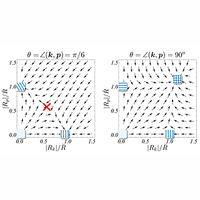
Stable-fixed-point description of square-pattern formation in driven two-dimensional Bose-Einstein condensates

Keisuke Fujii, Sarah L. Görlitz, Nikolas Liebster, Marius Sparn, Elinor Kath, Helmut Strobel, Markus K. Oberthaler, and Tilman Enss

Phys. Rev. A 109, L051301 (2024) - Published 10 May, 2024

The authors theoretically describe the stabilization of crystalline structures in interaction-driven Bose-Einstein condensates by analytically deriving a complex-valued Ginzburg-Landau equation for pattern formation. The resulting equation captures the competition between linear instability induced by the drive and nonlinear suppression induced by interactions and, in agreement with recent experiments, explains the emergence of square grid density patterns as stable states.

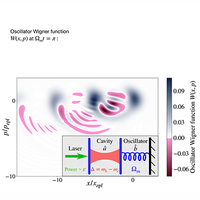
Nonclassical mechanical states in cavity optomechanics in the single-photon strong-coupling regime

Jonathan L. Wise, Clément Dutreix, and Fabio Pistolesi

Phys. Rev. A 109, L051501 (2024) - Published 7 May, 2024

In the context of cavity optomechanics in the strong-coupling regime, the authors present a method for generating nonclassical motional states of a mechanical resonator. The states’ nonclassical nature, which is manifested by a strongly negative Wigner function, is found to be due to the interplay between the intrinsically nonlinear optomechanical interaction and the laser drive applied to the cavity.

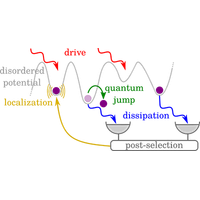
Quantum jumps in driven-dissipative disordered many-body systems

Sparsh Gupta, Hari Kumar Yadalam, Manas Kulkarni, and Camille Aron

Phys. Rev. A 109, L050201 (2024) - Published 6 May, 2024

The authors investigate whether nonequilibrium environments can promote localization rather than destabilize it. By studying the impact of quantum jumps on the localization transition in driven-dissipative systems, the authors reveal pathways to enhance localized regimes using simple yet realistic postselection schemes.

No-go theorem for entanglement distillation using catalysis

Ludovico Lami, Bartosz Regula, and Alexander Streltsov

Phys. Rev. A 109, L050401 (2024) - Published 3 May, 2024

Not all entanglement is distillable, i.e., extractable in pure form. In this work, the authors show that being assisted by catalysts, which generally can help transform quantum states, is not enough to change this; certain entangled states will stay “bound entangled” even when catalysts are allowed.

Anomalous noise spectra in a spin-exchange-relaxation-free alkali-metal vapor

K. Mouloudakis, J. Kong, A. Sierant, E. Arkin, M. Hernández Ruiz, R. Jiménez-Martínez, and M. W. Mitchell

Phys. Rev. A 109, L040802 (2024) - Published 30 April, 2024

The authors perform spin-noise spectroscopy on an unpolarized 87Rb vapor in the spin-exchange-relaxation-free regime and observe noise spectral distributions that deviate strongly from Lorentzian models that accurately describe lower-density regimes. This observation shows that new kinds of information can be extracted from noise spectra and may improve atomic vapor sensors.

Submicrosecond high-fidelity dispersive readout of a spin qubit with squeezed photons

Chon-Fai Kam and Xuedong Hu

Phys. Rev. A 109, L040402 (2024) - Published 29 April, 2024

This work focuses on enhancing the dispersive readout of a single electron spin qubit by utilizing displaced squeezed vacuum states for the probe photons. The built-in quantum correlations of squeezed photons lead to significant improvements in qubit readout fidelity and speed.

Interaction quenches in nonzero-temperature fermionic condensates

H. Kurkjian, V. E. Colussi, P. Dyke, C. Vale, and S. Musolino

Phys. Rev. A 109, L041302 (2024) - Published 29 April, 2024

The authors investigate the nonequilibrium dynamics of the order parameter of a fermionic condensate following an abrupt change in the pairing interaction at nonzero temperature. They express the magnitude of the resulting oscillations with Tan’s contact, and identify strong thermal effects as the temperature approaches the critical value, in particular for the nonlinear evolution which follows deep quenches.

Quantifying nonstabilizerness through entanglement spectrum flatness

Emanuele Tirrito, Poetri Sonya Tarabunga, Gugliemo Lami, Titas Chanda, Lorenzo Leone, Salvatore F. E. Oliviero, Marcello Dalmonte, Mario Collura, and Alioscia Hamma

Phys. Rev. A 109, L040401 (2024) - Published 24 April, 2024

The authors establish a connection between nonstabilizerness and a readily measurable property – the entanglement spectrum. This connection not only provides a deeper understanding of quantum complexity but also offers a practical way to probe nonstabilizerness even in noisy environments.

Many-body theory calculations of positron binding to halogenated hydrocarbons

J. P. Cassidy, J. Hofierka, B. Cunningham, C. M. Rawlins, C. H. Patterson, and D. G. Green

Phys. Rev. A 109, L040801 (2024) - Published 22 April, 2024

Many-body theory is used to study positron binding in halogenated hydrocarbons ab initio. As well as reproducing recent experimental binding energies, the general effect of halogenation is discussed and explained: fluorinated molecules generate a weaker positron-molecule correlation potential than their chlorinated and brominated counterparts owing to fluorinated molecules having higher molecular orbital ionization energies and a lower density of electron states near the highest occupied molecular orbitals.

PT-phase diagram with quantum jump in a non-Hermitian photonic structure

Xinchen Zhang, Yun Ma, Qi Liu, Nuo Wang, Yali Jia, Qi Zhang, Zhanqiang Bai, Junxiang Zhang, Qihuang Gong, and Ying Gu

Phys. Rev. A 109, L041503 (2024) - Published 19 April, 2024

In a parity-time (PT) symmetric photonic dimer structure, the authors analytically obtained the phase diagram with quantum jumps induced by loss and gain, defined a Hermitian exchange operator to characterize different PT phases, and engineered the quantum state and Hong-Ou-Mandel interferences. Their study paves the way for quantum state engineering, quantum interferences, and logic operations in non-Hermitian photonic systems.

Efficient general waveform catching by a cavity at an absorbing exceptional point

Asaf Farhi, Wei Dai, Seunghwi Kim, Andrea Alù, and Douglas Stone

Phys. Rev. A 109, L041502 (2024) - Published 17 April, 2024

The authors show that a resonator designed to operate at an absorbing exceptional point is substantially better at capturing a naturally emitted decaying waveform than a conventional cavity with a similar Q factor. This enhanced performance can lead to improved protocols for classical and quantum state transfer between resonant cavities.

Causal links between operationally independent events in quantum theory

Shubhayan Sarkar

Phys. Rev. A 109, L040202 (2024) - Published 11 April, 2024

The work challenges the concept of “classical independence” between physical systems by demonstrating that within quantum theory two systems can affect each other despite no observable changes, unveiling the interconnected nature of the quantum world. The findings also unveil potential applications for device-independent certification of quantum states and measurements.

Suppressing electromagnetic local density of states via slow light in lossy quasi-one-dimensional gratings

Benjamin Strekha, Pengning Chao, Rodrick Kuate Defo, Sean Molesky, and Alejandro W. Rodriguez

Phys. Rev. A 109, L041501 (2024) - Published 11 April, 2024

The authors derive bounds on the suppression of the bandwidth-integrated local density of states (LDOS). They show that effective one-dimensional gratings which support a slow light mode can achieve near-perfect LDOS suppression even in the presence of material loss.

Caustic effects on high-order harmonic generation in graphene

Fulong Dong, Qinzhi Xia, and Jie Liu

Phys. Rev. A 109, L041102 (2024) - Published 10 April, 2024

The authors find a harmonic enhancement structure in the high-order harmonic generation spectrum of graphene. Further investigation indicates that the structure is associated with the bunching of multiple interband electron-hole recombination trajectories, in analogy to the focusing behavior of light rays known as caustics.

Energy-resolved spin correlation measurements: Decoding transverse spin dynamics in weakly interacting Fermi gases

J. Huang and J. E. Thomas

Phys. Rev. A 109, L041301 (2024) - Published 10 April, 2024

The authors measure transverse spin correlations in energy space to uncover hidden spin dynamics in a weakly interacting Fermi gas. The correlation functions reveal the microscopic structure of a demagnetizing or magnetizing synthetic spin lattice, which models a collective Heisenberg Hamiltonian, and provide new observables for studies of transitions between dynamical phases.

Nonlinear interference and electron dynamics: Probing photoelectron momentum distributions in strong-field ionization

Danish Furekh Dar and Stephan Fritzsche

Phys. Rev. A 109, L041101 (2024) - Published 5 April, 2024

The authors unravel the complexities of nonlinear interference phenomena in laser-atom interaction, demonstrating the role of an electron as a carrier of the obscured fundamental frequencies inherent in the laser pulse. Through theoretical analysis, they identify how interactions between electrons and the concealed fundamental frequencies within intense laser pulses craft distinctive interference patterns and confinement effects in the momentum landscape, offering profound insights into the quantum dynamics underpinning ionization processes.

Transmission of vortex electrons through a solenoid

G. K. Sizykh, A. D. Chaikovskaia, D. V. Grosman, I. I. Pavlov, and D. V. Karlovets

Phys. Rev. A 109, L040201 (2024) - Published 1 April, 2024
The authors delve into the dynamics of vortex electrons as they transition from a vacuum into a magnetic field and propagate within it. They show that nonstationary Laguerre-Gaussian states offer a genuine description of the electron motion, revealing oscillations in the electrons’ root-mean-square radius, which is significantly larger than expected.

Sign In to Your Journals Account

Filter

Category
Section

Filter

Article Lookup

Enter a citation