Highlights

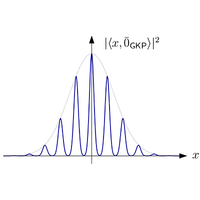
Quantum illumination with high-dimensional Bell states

Armanpreet Pannu, Amr S. Helmy, and Hesham El Gamal

Phys. Rev. A 110, L050603 (2024) - Published 25 November, 2024

This work explores a protocol for quantum illumination using high-dimensional Bell states, showing that discrete-variable states can be effective in detecting targets across different noise conditions. The findings suggest that Bell states may serve as a viable alternative to continuous-variable states in quantum sensing, expanding the possibilities for entanglement-enhanced applications.

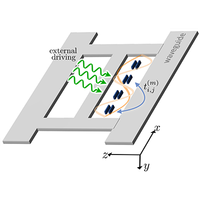
Anderson localization versus hopping asymmetry in a disordered lattice

E. T. Kokkinakis, K. G. Makris, and E. N. Economou

Phys. Rev. A 110, 053517 (2024) - Published 19 November, 2024

Within the framework of non-Hermitian photonics, the authors investigate the interplay between disorder and non-Hermiticity in a one-dimensional disordered lattice. They show that the competition between the effects of disorder and non-Hermiticity results in qualitatively distinct phases of wave diffraction, including counterintuitive characteristics regarding the relation between the strength of disorder and the wave packet’s velocity.

Collisional thermometry for Gaussian systems

Gabriel O. Alves, Marcelo A. F. Santos, and Gabriel T. Landi

Phys. Rev. A 110, 052421 (2024) - Published 14 November, 2024

The authors extend the idea of nonequilibrium collisional quantum thermometry to continuous variables. They restrict their investigation to Gaussian systems, which makes it possible for them to compute the quantum Fisher information even for a large number of probes.

Unimolecular processes in diatomic carbon anions at high rotational excitation

Viviane C. Schmidt, Roman Čurík, Milan Ončák, Klaus Blaum, Sebastian George, Jürgen Göck, Manfred Grieser, Florian Grussie, Robert von Hahn, Claude Krantz, Holger Kreckel, Oldřich Novotný, Kaija Spruck, and Andreas Wolf

Phys. Rev. A 110, 042828 (2024) - Published 31 October, 2024

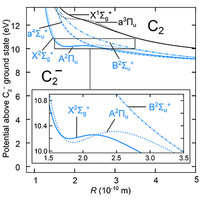
The authors present a combined experimental and theoretical study of the decay of excited dicarbon anions, to address possible mechanisms leading to the delayed autofragmentation and autodetachment that has been observed before, but has not been well understood. Their results present strong evidence that C2− ions in quasistable levels of the quartet electronic states are the so-far unidentified source of the unimolecular decay.

Universal limit on spatial quantum superpositions with massive objects due to phonons

Carsten Henkel and Ron Folman

Phys. Rev. A 110, 042221 (2024) - Published 25 October, 2024

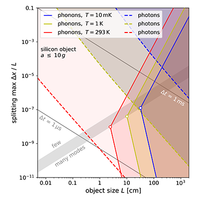
In matter-wave interferometers, it was thought that spatial superpositions could be protected from decoherence by improved isolation from the environment (materialized, e.g., by blackbody photons). The authors show that the internal degrees of freedom within any large object are sufficient to track which-way information, consequently reducing the interference contrast of a coherent spatial superposition.

Generalized theory for optical cooling of a trapped atom with spin

Saumitra S. Phatak, Karl N. Blodgett, David Peana, Meng Raymond Chen, and Jonathan D. Hood

Phys. Rev. A 110, 043116 (2024) - Published 24 October, 2024

The authors develop a generalized optical cooling model for a bound atom with spin in a single or counterpropagating beam configuration with different polarizations. They perform simulations with hyperfine levels and demonstrate good agreement with a simplified spin model. The results provide valuable insights into optimizing cooling schemes.

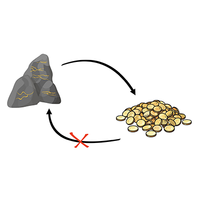
Transport through a lattice with local loss: From quantum dots to lattice gases

J. R. Anglin

Phys. Rev. A 110, 043317 (2024) - Published 22 October, 2024

The author studies the quantum-gas realization of the fermion transport problem through a finite one-dimensional lattice of quantum dots, with localized particle loss from the central lattice site. The author shows that this model represents one limiting case of a larger class of models that can be realized with cold quantum gases in optical lattices.

Quantum optimal control robust to 1/fα noises using fractional calculus: Voltage-controlled exchange in semiconductor spin qubits

Bohdan Khromets and Jonathan Baugh

Phys. Rev. A 110, L040602 (2024) - Published 22 October, 2024

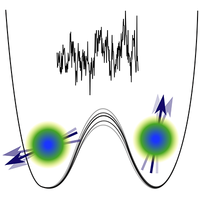
The authors combine fractional calculus with optimization methods to design control signals that enhance the performance of quantum systems in noisy environments. They focus on identifying the ideal pulse characteristics to minimize the disruptive effects of electrical noise on exchange gates for semiconductor spin qubits.

Stabilizer entropies are monotones for magic-state resource theory

Lorenzo Leone and Lennart Bittel

Phys. Rev. A 110, L040403 (2024) - Published 18 October, 2024

The authors prove the monotonicity of stabilizer entropies under general stabilizer operations. This result establishes stabilizer entropies as the only known family of monotones that are experimentally measurable and computationally tractable.

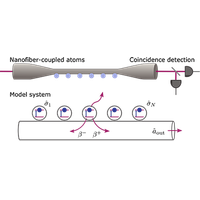
Predicting correlations in superradiant emission from a cascaded quantum system

Felix Tebbenjohanns, Christopher D. Mink, Constanze Bach, Arno Rauschenbeutel, and Michael Fleischhauer

Phys. Rev. A 110, 043713 (2024) - Published 17 October, 2024

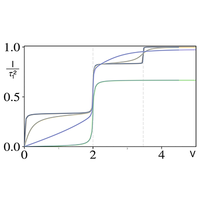
The authors develop a method to calculate second-order correlations for the light field radiated by a strongly excited cascaded system of two-level emitters. The results directly address the recent experimental study of superradiant decay of highly excited collective spin states of up to a thousand atoms.

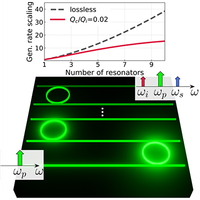
Superspontaneous four-wave mixing in a sequence of lossy ring resonators

Amideddin Mataji-Kojouri and Marco Liscidini

Phys. Rev. A 110, 043509 (2024) - Published 15 October, 2024

The authors study photon pair generation by superspontaneous four-wave mixing in single-channel and double-channel sequences of ring resonators in the presence of loss. They show that, in the presence of loss, superradiant photon-pair generation in single-channel sequences is achievable only when the resonators are either deeply over- or undercoupled.

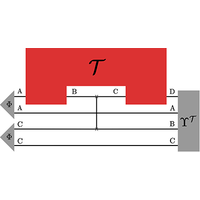
Process tensor distinguishability measures

Guilherme Zambon

Phys. Rev. A 110, 042210 (2024) - Published 10 October, 2024

The paper critiques the use of Choi divergences in resource theories of quantum processes, demonstrating that they fail to satisfy key conditions necessary for proper monotone measures. Instead, the author introduces generalized divergences, which meet these conditions and are argued to be more suitable for distinguishing quantum combs and defining monotones in various applications.

Classical simulation of non-Gaussian bosonic circuits

Beatriz Dias and Robert König

Phys. Rev. A 110, 042402 (2024) - Published 1 October, 2024

The authors present efficient classical algorithms for simulating linear bosonic circuits applied to non-Gaussian states composed of superpositions of Gaussian states. Their approach, based on an augmented covariance matrix formalism, enables exact simulations with polynomial runtime in the number of modes and circuit size, and quadratic runtime in the number of superposition terms. They also present an approximate algorithm whose runtime is linear in the number of superposition terms.

Extended-Josephson-junction qubit system

Andrey Grankin, Alicia J. Kollár, and Mohammad Hafezi

Phys. Rev. A 110, 032621 (2024) - Published 23 September, 2024

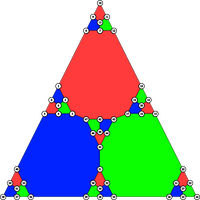
The authors develop a theoretical framework for describing the light-matter interaction in extended Josephson junctions. They show that each such junction can host multiple plasmon modes, each encoding a qubit, and that it is possible to address each qubit mode individually with frequency-momentum-selective coupling, which could prove useful in future quantum simulation or computing applications.

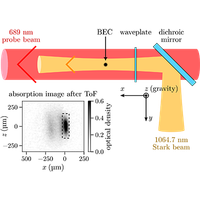
Differential polarizability of the strontium intercombination transition at 1064.7 nm

Romaric Journet, Félix Faisant, Sanghyeop Lee, and Marc Cheneau

Phys. Rev. A 110, 032819 (2024) - Published 23 September, 2024

The authors present measurements of the scalar, vector, and tensor components of the differential dynamic polarizability of the strontium intercombination transition at 1064.7 nm, which is highly relevant for the engineering of optical trapping potentials. They also identify a magic ellipticity of the polarization where the differential polarizability vanishes.

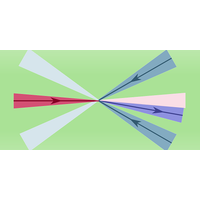
Fundamental constants from photon-photon scattering in three-beam collisions

A. J. MacLeod and B. King

Phys. Rev. A 110, 032216 (2024) - Published 18 September, 2024

A proposed experiment involving an x-ray beam and two optical beams could determine the values of fundamental constants in quantum electrodynamics.

Concatenated Steane code with single-flag syndrome checks

Balint Pato, Theerapat Tansuwannont, and Kenneth R. Brown

Phys. Rev. A 110, 032411 (2024) - Published 11 September, 2024

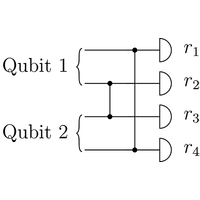
This paper examines a fault-tolerant error-correction protocol for a particular concatenated Steane code that requires only two ancilla qubits per generator. The authors enhance its performance by finding an appropriate gate ordering of the syndrome measurements that tolerates up to four faults. They run noise simulations at the circuit level to suggest that this code has a significantly higher noise threshold than a comparable color code, in contrast to what other noise models predict.

Limitations in fluorescence-detected entangled two-photon-absorption experiments: Exploring the low- to high-gain squeezing regimes

Tiemo Landes, Brian J. Smith, and Michael G. Raymer

Phys. Rev. A 110, 033708 (2024) - Published 9 September, 2024

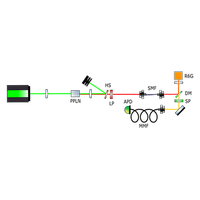
The authors present an experimental study of entangled two-photon absorption in solvated rhodamine 6G, providing strong evidence that the orders-of-magnitude increases in two-photon-absorption efficiency by using entangled light reported in previous studies cannot be explained by the community’s current understanding of the process. Thus, the sought-after advantages of using two-photon absorption of time-frequency-entangled photon pairs as a practical tool for enhancing molecular spectroscopy and biological imaging remains elusive.

Flexible entangled-state generation in linear optics

Brendan Pankovich, Alex Neville, Angus Kan, Srikrishna Omkar, Kwok Ho Wan, and Kamil Brádler

Phys. Rev. A 110, 032402 (2024) - Published 4 September, 2024

Entangled dual-rail photonic qubit states are important resource states for measurement-based and fusion-based quantum computing. However, their generation is highly challenging due to the probabilistic nature of entangling operations. Here, the authors introduce a formalism using ZX diagrams to design linear optical systems that can generate entangled multiqubit states of dual-rail photonic qubits. This formalism makes it easier to compare methods for creating a desired photonic state and to find the most optimal one.

Quantum repeater node with free-space coupled trapped ions

Max Bergerhoff, Omar Elshehy, Stephan Kucera, Matthias Kreis, and Jürgen Eschner

Phys. Rev. A 110, 032603 (2024) - Published 3 September, 2024

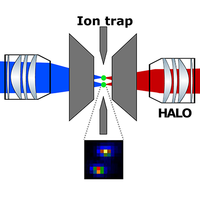
Quantum repeater cells are crucial for overcoming loss in long-distance quantum networks. Here, the authors present a trapped-ion implementation of a quantum repeater cell, using two 40Ca+ ions that act as quantum memories and are coupled to free-space photonic channels. With this setup they are able to demonstrate asynchronous generation of atom-photon and photon-photon entanglement.

Sign In to Your Journals Account

Filter

Section

Filter

Article Lookup

Enter a citation