Highlights

Experimental study of time-dependent side channels in quantum key distribution

Hao Tan, Weiyang Zhang, Liying Han, Sheng-Kai Liao, and Feihu Xu

Phys. Rev. A 111, 042622 (2025) - Published 28 April, 2025

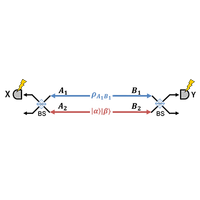
Quantum key distribution allows remote parties to share secret keys with proven security. However, in most systems, these schemes will also modulate light that gets leaked between the signal pulses, resulting in time-dependent side channels. Here, the authors experimentally study practical quantum key distribution with these side channels, analyzing the security risks and the corresponding countermeasures.

Nonadiabatic-coupling-mediated argon dimer dissociation by slow and low-charge-state ion collisions

Yu Zhang, Jiarong Wang, Xiaoqing Hu, Baihui Ren, Tianming Meng, Pufang Ma, Yueying Qi, Yong Wu, Jianguo Wang, Yaming Zou, Bingsheng Tu, Amine Cassimi, and Baoren Wei

Phys. Rev. A 111, 042824 (2025) - Published 24 April, 2025

The authors report the experimental observation of a nonlocal decay process, i.e., nonadiabatic-coupling-mediated charge transfer, in argon dimers. They observe new kinetic energy release structures and attribute them to the population of a one-site, double-charge-excited state of the argon dimer.

Dissociative frustrated triple ionization of ArKr dimers induced by a linearly polarized two-color femtosecond laser field

Junyang Ma, Shuqi Li, Yan Yang, and Zhenrong Sun

Phys. Rev. A 111, 043114 (2025) - Published 23 April, 2025

The authors experimentally investigate frustrated triple ionization of ArKr dimers, where one of the ionized electrons is recaptured by the ion, and show that they are able to extract details of the ionization dynamics by scanning the relative phase between the two colors of the ionizing laser field. The results provide new insight into the mechanisms of strong-field ionization of diatomic systems and the interplay of the laser-driven electron dynamics with a two-center ionic potential.

Statistical theory of cumulant mapping in an imperfect apparatus

S. Patchkovskii and J. Mikosch

Phys. Rev. A 111, 043108 (2025) - Published 10 April, 2025

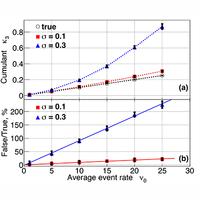
The authors perform an in-depth statistical analysis of multiparticle cumulant mapping, a statistical technique to uncover the correlations between two or more fluctuating signals, in the presence of experimental noise. Their analysis shows that the external noise is an important factor for the cumulant-mapping technique, which needs to be carefully considered in planning the experiment and in the analysis of the results.

Quenching from superfluid to free bosons in two dimensions: Entanglement, symmetries, and the quantum Mpemba effect

Shion Yamashika, Pasquale Calabrese, and Filiberto Ares

Phys. Rev. A 111, 043304 (2025) - Published 9 April, 2025

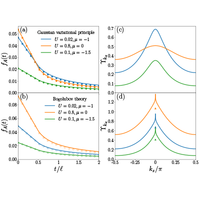
The authors present an insightful study on the quench dynamics in weakly interacting two-dimensional bosonic systems, focusing on the dynamics of entanglement entropy, asymmetry, and quantum fidelity. In particular, they demonstrate the presence of the recently discovered quantum Mpemba effect, derive the microscopic conditions necessary for this effect to occur, and show that these conditions are never met in the Bogoliubov theory.

Penning-trap mass measurement of He3

O. Bezrodnova, S. Sasidharan, W. Quint, S. Sturm, and K. Blaum

Phys. Rev. A 111, L040801 (2025) - Published 9 April, 2025

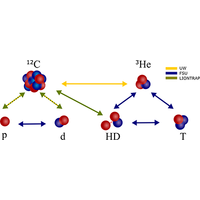
The authors experimentally determine the atomic mass of 3He to 12-parts-per-trillion relative precision from the measurement of the cyclotron frequency ratio of 3He+ and 12C4+ in a Penning trap. The result resolves discrepancies in the reported masses of light atomic nuclei from previous experiments.

Second moment of Hafnians in Gaussian boson sampling

Adam Ehrenberg, Joseph T. Iosue, Abhinav Deshpande, Dominik Hangleiter, and Alexey V. Gorshkov

Phys. Rev. A 111, 042412 (2025) - Published 8 April, 2025

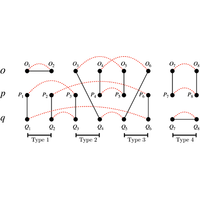
This paper addresses the question of exactly how to tell if Gaussian boson sampling gives a quantum advantage. It complements a joint PRL paper that uses a graph-theoretic method to study the output probabilities of Gaussian boson sampling. In this PRA paper, the authors dive deeper into the formalism and detail a numerical technique based on recursion.

Impact of micromotion and field-axis misalignment on the excitation of Rydberg states of ions in a Paul trap

Wilson S. Martins, Joseph W. P. Wilkinson, Markus Hennrich, and Igor Lesanovsky

Phys. Rev. A 111, 043106 (2025) - Published 7 April, 2025

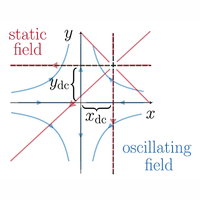
The authors theoretically investigate how micromotion influences the transition energies and laser excitation probabilities of Rydberg states of ions confined within Paul traps. The results could help understand the conditions to combine trapped ions with Rydberg interactions as a platform for quantum simulation.

Extended analysis of distillation and purification of squeezed states of light

Jaromír Fiurášek, Stephan Grebien, and Roman Schnabel

Phys. Rev. A 111, 043704 (2025) - Published 3 April, 2025

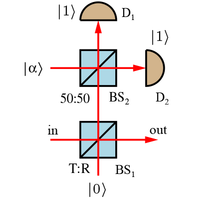
Previously, the authors experimentally used two-photon subtraction to achieve distillation of single-mode optical squeezed states. Here, they present an extended theoretical study of distillation and purification of such states by conditional photon subtraction. They find parallels between their squeezing distillation scheme and recent schemes for the generation of approximate GKP states in fault-tolerant quantum computing.

Hybrid amplitude- and frequency-modulated mode locking of singly resonant optical parametric oscillators

Ryan Hamerly, Evan Laksono, Marc Jankowski, Edwin Ng, Noah Flemens, Myoung-Gyun Suh, and Hideo Mabuchi

Phys. Rev. A 111, 033532 (2025) - Published 28 March, 2025

The authors propose and analyze a new approach for generating tunable optical frequency combs using a single resonant optical parametric oscillator. The resulting design is a promising source for stable, broadband, widely tunable frequency combs, fully harnessing the strengths of the χ(2) nonlinearity.

Optical levitation of arrays of microspheres

Benjamin Siegel, Gadi Afek, Cecily Lowe, Jiaxiang Wang, Yu-Han Tseng, T. W. Penny, and David C. Moore

Phys. Rev. A 111, 033514 (2025) - Published 17 March, 2025

The authors introduce a new method for the defect-free trapping of larger arrays of dielectric particles, allowing to address and control each of them separately. The approach presents a valuable contribution to the experimental toolbox for optomechanical experiments using dielectric particles and lays the basis for future experiments once some of the remaining experimental challenges described in the manuscript are addressed.

Excitation spectrum of a double supersolid in a trapped dipolar Bose mixture

Daniel Scheiermann, Albert Gallemí, and Luis Santos

Phys. Rev. A 111, 033310 (2025) - Published 13 March, 2025

The authors study the excitation spectrum of a double supersolid in a miscible mixture under realistic trapping conditions. They show that even a mildly asymmetric mixture results in a nontrivial spin nature of the dipolar rotons: the Higgs excitation and the Goldstone modes.

Microscopic theory of the Hubbard interaction in low-dimensional optical lattices

Haydn S. Adlong, Jesper Levinsen, and Meera M. Parish

Phys. Rev. A 111, 033307 (2025) - Published 11 March, 2025

The authors provide an exact solution to the problem of two atoms interacting in quasi-one-dimensional and quasi-two-dimensional optical lattices. Based on the solution, they develop a formalism to determine the effective Hubbard on-site interaction for an optical lattice in a quantum gas microscope, which agrees with spectroscopic measurements.

Investigating the hyperfine systematic error and relative phase in low-spin-polarization alkali-metal free-induction-decay magnetometers

D. P. Hewatt, M. Ellmeier, C. Kiehl, T. S. Menon, J. W. Pollock, C. A. Regal, and S. Knappe

Phys. Rev. A 111, 033106 (2025) - Published 10 March, 2025

The authors present model as well as experimental results for free-induction-decay magnetometer accuracy in the presence of variable ground-state spin polarization, an important step in quantifying, reducing, or removing significant systematic shifts in finite-magnetic-field sensing. The techniques described in the paper are expected to significantly improve the accuracy of such sensors under limited optical power conditions.

Momentum-entangled two-photon interference for quantum-limited transverse-displacement estimation

Danilo Triggiani and Vincenzo Tamma

Phys. Rev. A 111, 032605 (2025) - Published 7 March, 2025

The authors present a method for displacement estimation of two momentum-entangled photons interfering on a beam splitter using momentum-resolving detectors and coincidence measurements. Notably, they are able to achieve the ultimate quantum sensitivity, and the precision achieved with their scheme is independent of the value of the displacement. They also show that bucket detectors can be optimally employed for the estimation of small displacements.

Tensor networks and efficient descriptions of classical data

Sirui Lu, Márton Kanász-Nagy, Ivan Kukuljan, and J. Ignacio Cirac

Phys. Rev. A 111, 032409 (2025) - Published 6 March, 2025

Inspired by methods based on entanglement and mutual information (MI) used to characterize the representation of quantum data through tensor networks, here the authors apply a similar analysis for classical text and images. They show that text exhibits power-law scaling of MI between subsets and their complements, suggesting that tensor network methods may not be suitable to represent them. For images, scaling close to the area law seems to occur, meaning efficient tensor network methods may suffice.

Exploring the strongly interacting regime of effective multibody interactions in a trapped ultracold-atom system

Kantaro Honda, Yosuke Takasu, Yuki Haruna, Yusuke Nishida, and Yoshiro Takahashi

Phys. Rev. A 111, 033303 (2025) - Published 6 March, 2025

The authors experimentally investigate a strongly interacting few-body system consisting of ultracold bosons tightly confined in a deep optical lattice site. They obtain a clear signature of an effective four-body interaction, evidenced by the binding energies of four or more atoms in the lattice site.

Fermi resonance in the radiative vibrational cooling dynamics of N2O+

S. Harayama, S. Kuma, N. Kimura, K. C. Chartkunchand, M. Baba, T. Murakami, T. Takayanagi, K. Yagi, T. Yamaguchi, Y. Nakano, and T. Azuma

Phys. Rev. A 111, 032803 (2025) - Published 5 March, 2025

The authors experimentally study the radiative vibrational cooling processes via Fermi resonance of triatomic molecular ions N2O+ stored in a cryogenic electrostatic ion storage ring. They obtained vibrational cooling rates in the time range of a few seconds and demonstrated that the coupling of the vibrational states via Fermi resonance affects the cooling behavior.

Polarization-agnostic continuous-variable quantum key distribution

Brian P. Williams and Nicholas A. Peters

Phys. Rev. A 111, L030601 (2025) - Published 5 March, 2025

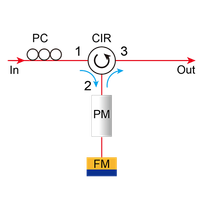
The authors introduce a polarization agnostic encoding method for continuous-variable quantum key distribution. No active optical polarization control is required and only a single receiver polarization is monitored. These simplifications reduce loss and noise.

Quantum state estimation of multipartite single-photon path entanglement via local measurements

Hikaru Shimizu, Joe Yoshimoto, Kazufumi Tanji, Aruto Hosaka, Junko Ishi-Hayase, Tomoyuki Horikiri, Rikizo Ikuta, and Masahiro Takeoka

Phys. Rev. A 111, 022619 (2025) - Published 18 February, 2025

Reconstructing the density matrix of nonlocal states is challenging because of the distance between the involved parties. This work extends a method of quantum state tomography for nonlocal bipartite single-photon states to the multipartite case. The authors present both theoretical analysis and experimental demonstration, focusing on reconstructing three-qubit W states using straightforward local measurements.

Sign In to Your Journals Account

Filter

Section

Filter

Article Lookup

Enter a citation