Highlights

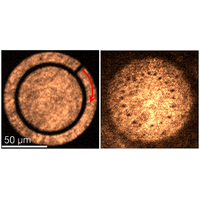
Shear-induced decaying turbulence in Bose-Einstein condensates

S. Simjanovski, G. Gauthier, H. Rubinsztein-Dunlop, M. T. Reeves, and T. W. Neely

Phys. Rev. A 111, 023314 (2025) - Published 12 February, 2025

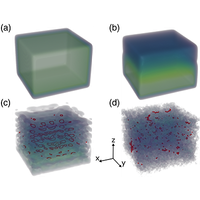
The authors experimentally study the decaying of two-dimensional quantum turbulence in a Bose-Einstein condensate. The authors show that the quantum turbulence exhibits a characteristic power-law decay of vortex cluster number, in analogy with classical two-dimensional turbulence.

Modeling the laser-pulse-induced helium trimer dynamics

Q. Guan, J. Kruse, M. Kunitski, R. Dörner, and D. Blume

Phys. Rev. A 111, 023108 (2025) - Published 11 February, 2025

The authors develop a theoretical framework for describing the dynamics of a three-body atomic system exposed to a short laser pulse, and apply it to the bosonic helium trimer, analyzing the system’s kinetic energy release and orientation dynamics. They show that a model that constructs the helium trimer dynamics from the dynamics of the helium dimer captures a number of key characteristics of the alignment signal, including the interference between different angular-momentum wave-packet components.

Unitary control of multiport wave transmission

Cheng Guo, David A. B. Miller, and Shanhui Fan

Phys. Rev. A 111, 023507 (2025) - Published 10 February, 2025

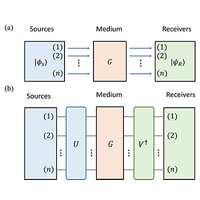
This work develops a theoretical framework for optimizing wave transmission through complex media using unitary control, which allows for simultaneous manipulation of a set of orthogonal waves. They use this theory to optimize the total power transmission and crosstalk through generic multimode scattering media. Their theorems are illustrated through simple examples and first-principles numerical simulations.

Non-Hermitian generalization of Rayleigh-Schrödinger perturbation theory

Wei-Ming Chen, Yen-Ting Lin, and Chia-Yi Ju

Phys. Rev. A 111, 022211 (2025) - Published 7 February, 2025

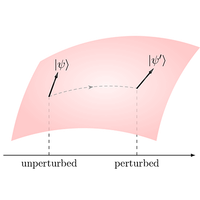
The authors develop a perturbation theory for non-Hermitian systems based on a geometric formalism that yields relatively simple recursive formulas for the perturbed eigenvectors and eigenvalues. The authors provide an example and show that the method proposed reduces to the standard Rayleigh-Schrödinger perturbation theory in the Hermitian regime.

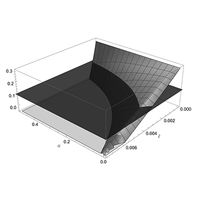
Regimes of steady-state turbulence in a quantum fluid

Tommy Z. Fischer and Ashton S. Bradley

Phys. Rev. A 111, 023308 (2025) - Published 7 February, 2025

The authors theoretically study the development of turbulence in a Bose-Einstein condensate trapped and shaken in a box potential. They identify two distinct turbulence regimes with different scalings for weak and strong forces.

Local-photon model of the momentum of light

Gabriel Waite, Daniel Hodgson, Ben Lang, Varghese Alapatt, and Almut Beige

Phys. Rev. A 111, 023703 (2025) - Published 5 February, 2025

Instead of the traditional momentum space, here the authors consider a photon wave function in position space. This local photon approach introduces an additional degree of freedom that distinguishes between positive- and negative-frequency photons, and sheds new light on the Abraham-Minkowski controversy.

Magic running- and standing-wave optical traps for Rydberg atoms

Lukas Ahlheit, Chris Nill, Daniil Svirskiy, Jan de Haan, Simon Schroers, Wolfgang Alt, Nina Stiesdal, Igor Lesanovsky, and Sebastian Hofferberth

Phys. Rev. A 111, 013115 (2025) - Published 24 January, 2025

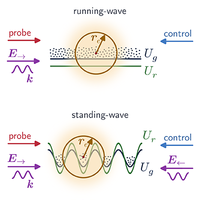
The authors present an experimental and theoretical study of how the geometry of an optical trap influences the magic wavelength for a collective Rydberg excitation, and find the magic trap wavelength where the coherence time in photon storage experiments is maximized. This magic wavelength depends not only on the Rydberg state, but also on the trap geometry due to the wave function of the almost-free Rydberg electron exploring the potential landscape surrounding the core. Hence, it is necessary to take the size of both Rydberg atom and trapping beams into account when trapping Rydberg atoms.

Competing ionization and dissociation: Extension of the energy-dependent frame transformation to the gerade symmetry of H2

Dávid Hvizdoš, Roman Čurík, and Chris H. Greene

Phys. Rev. A 111, 012805 (2025) - Published 9 January, 2025

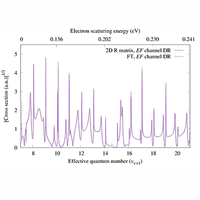
The authors develop an energy-dependent frame transformation method to tackle the problem of electron collisions with molecular cations. This theory can be used to map the body-frame scattering information, which depends on the body-frame energy and the internuclear distance, into a physical scattering matrix that varies strongly and resonantly with the total laboratory-frame energy.

Comparison of renormalized interactions using one-dimensional few-body systems as a testbed

Fabian Brauneis, Hans-Werner Hammer, Stephanie M. Reimann, and Artem G. Volosniev

Phys. Rev. A 111, 013303 (2025) - Published 3 January, 2025

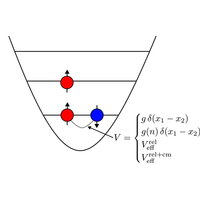
The authors present a benchmark study of different renormalization procedures for a one-dimensional ultracold few-body system made of a two-component fermionic mixture interacting via a delta contact potential. They find that using effective interactions and a running coupling constant instead of the bare interaction improves convergence significantly.

Self-aligning recirculated crossed optical dipole trap for lithium atoms

Ming Lian, Maximillian Mrozek-McCourt, Christopher K. Angyal, Dadbeh Shaddel, Zachary J. Blogg, John R. Griffin, Ian Crawley, and Ariel T. Sommer

Phys. Rev. A 110, 063121 (2024) - Published 27 December, 2024

The authors develop, numerically characterize, and experimentally test a new lens configuration that minimizes the sensitivity of a crossed-beam optical dipole trap to misalignment. This allows the trap to move and remain aligned, e.g. to bring an atomic cloud held in the trap close to a surface or field source for various applications in quantum simulation, sensing, and information processing.

Electromagnetic waves in a Lorentzian medium with periodically modulated oscillator density

M. I. Bakunov, A. V. Shirokova, M. A. Kurnikov, and A. V. Maslov

Phys. Rev. A 110, 063532 (2024) - Published 27 December, 2024

This paper critically examines the theoretical models used in the study of photonic time crystals, emphasizing the importance of taking dynamics of the medium, such as polarization, into account. The findings challenge earlier predictions of parametric amplification in a Lorentzian medium, showing that such effects do not arise when the medium’s full dynamics are properly accounted for.

Measurement of the s-wave scattering length between metastable helium isotopes

S. Kannan, Y. S. Athreya, A. H. Abbas, X. T. Yan, S. S. Hodgman, and A. G. Truscott

Phys. Rev. A 110, 063324 (2024) - Published 26 December, 2024

The authors experimentally measure the s-wave scattering length between the two metastable isotopes of helium in a harmonic trap via trap oscillations and out-coupling. The result is in good agreement with previous theoretical predictions.

Quantum error mitigation by layerwise Richardson extrapolation

Vincent Russo and Andrea Mari

Phys. Rev. A 110, 062420 (2024) - Published 17 December, 2024

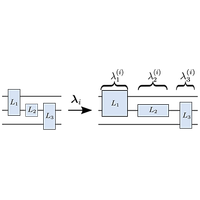
The authors present an error-mitigation scheme in which the noise from different layers of a quantum circuit can be amplified and then extrapolated to the zero-noise limit independently. In doing this they enhance the traditional Richardson extrapolation protocol with the flexibility of layerwise unitary folding schemes.

Engineering single-atom angular momentum eigenstates in an optical tweezer

Philipp Lunt, Paul Hill, Johannes Reiter, Philipp M. Preiss, Maciej Gałka, and Selim Jochim

Phys. Rev. A 110, 063315 (2024) - Published 16 December, 2024

By controlling the motion and interaction of individual atoms in a cold-atom ensemble, researchers have produced a correlated topological state of matter, called a fractional quantum Hall state.

Boundaries of universality of thermal collisions for atom-atom scattering

Xuyang Guo, Kirk W. Madison, James L. Booth, and Roman V. Krems

Phys. Rev. A 110, 063317 (2024) - Published 16 December, 2024

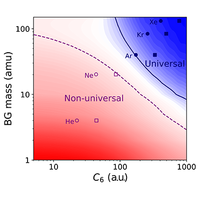
Thermal rate coefficients for some atomic collisions have been observed to be remarkably independent of the details of interatomic interactions at short range (i.e. they are universal), leading to their dependence on only the long-range interaction parameters and masses. This work examines the response of thermally averaged rate coefficients to changes in the interaction potentials in order to elucidate the origin and quantify the boundaries of this universality.

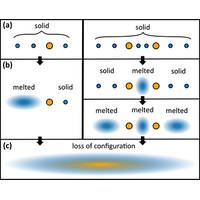
Domain formation and structural stabilities in mixed-species Coulomb crystals induced by sympathetically cooled highly charged ions

L.-A. Rüffert, E. A. Dijck, L. Timm, J. R. Crespo López-Urrutia, and T. E. Mehlstäubler

Phys. Rev. A 110, 063110 (2024) - Published 12 December, 2024

The authors theoretically and experimentally study the structural stability and dynamics of Coulomb crystals of mixed-species laser-cooled ions using temperature and trap parameters as control parameters. Such crystals are of great interest to high-precision spectroscopy and frequency metrology.

Theory of time-bin-entangled photons from quantum emitters

Thomas K. Bracht, Florian Kappe, Moritz Cygorek, Tim Seidelmann, Yusuf Karli, Vikas Remesh, Gregor Weihs, Vollrath Martin Axt, and Doris E. Reiter

Phys. Rev. A 110, 063709 (2024) - Published 12 December, 2024

The authors present the tools needed to calculate the density matrices for time-bin encoded photon pairs. Their formalism is ready to account for realistic loss or decoherence processes, allowing for better assessment of the feasibility of different entangled-pair-production schemes.

Continuous-variable quantum position verification secure against entangled attackers

Llorenç Escolà-Farràs, Arpan Akash Ray, Rene Allerstorfer, Boris Škorić, and Florian Speelman

Phys. Rev. A 110, 062605 (2024) - Published 11 December, 2024

This work develops a continuous-variable quantum position verification protocol using coherent states and n-bit classical strings, which are practical to implement in laboratories. The protocol is proven secure against attackers with fewer than cn preshared entangled qubits, even under some attenuation, excess noise, and slow quantum signal transmission.

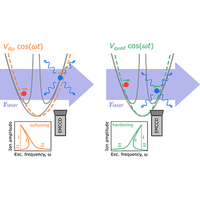
Laser-assisted motional-mode spectroscopy in a Penning trap and the generalized invariance theorem

J. Berrocal, A. Hernández, D. Porras, and D. Rodríguez

Phys. Rev. A 110, 063107 (2024) - Published 10 December, 2024

The authors experimentally study all the motional modes of a laser-cooled two-ion Coulomb crystal in a Penning trap, some of them in the nonlinear regime. They used the results to test the generalized invariance theorem relating the motional eigenfrequencies of the crystal and the individual cyclotron frequencies of each constituent.

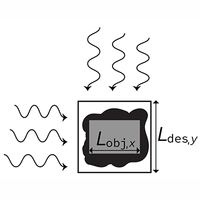
Limitations on bandwidth-integrated passive cloaking

Benjamin Strekha, Alessio Amaolo, Jewel Mohajan, Pengning Chao, Sean Molesky, and Alejandro W. Rodriguez

Phys. Rev. A 110, 063513 (2024) - Published 10 December, 2024
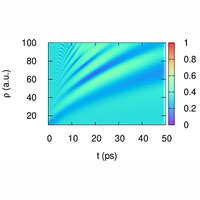
The authors lay out a framework for understanding the optimal performance of practical electromagnetic cloaking devices, providing new theoretical insights for future designs and showing how perfect cloaking is impossible even for a vanishing bandwidth for finite cloak sizes with bounded refractive index contrasts or material losses. The framework is exemplified by designing a cloak for a circular object in two dimensions.

Sign In to Your Journals Account

Filter

Section

Filter

Article Lookup

Enter a citation