Browse by Subject

Time-Reversal Symmetry Breaking Driven Topological Phase Transition in EuB6

Shun-Ye Gao, Sheng Xu, Hang Li, Chang-Jiang Yi, Si-Min Nie, Zhi-Cheng Rao, Huan Wang, Quan-Xin Hu, Xue-Zhi Chen, Wen-Hui Fan, Jie-Rui Huang, Yao-Bo Huang, Nini Pryds, Ming Shi, Zhi-Jun Wang, You-Guo Shi, Tian-Long Xia, Tian Qian, and Hong Ding

Phys. Rev. X 11, 021016 (2021) - Published 19 April, 2021

Observations of an ideal magnetic topological state in the ferromagnet EuB6 offer the promise of realizing novel electronic and magnetic states in 2D materials.

Observation of Hydrogen-Induced Dzyaloshinskii-Moriya Interaction and Reversible Switching of Magnetic Chirality

Gong Chen, MacCallum Robertson, Markus Hoffmann, Colin Ophus, André L. Fernandes Cauduro, Roberto Lo Conte, Haifeng Ding, Roland Wiesendanger, Stefan Blügel, Andreas K. Schmid, and Kai Liu

Phys. Rev. X 11, 021015 (2021) - Published 16 April, 2021

Adsorption of hydrogen onto a ferromagnetic surface induces and controls a winding arrangement of magnetic moments potentially useful in future energy-efficient information applications.

Fundamental Energy Requirement of Reversible Quantum Operations

Giulio Chiribella, Yuxiang Yang, and Renato Renner

Phys. Rev. X 11, 021014 (2021) - Published 15 April, 2021

No matter how clever the design of a quantum computer, the laws of physics demand a minimum amount of energy to produce accurate computations.

Thermodynamic bounds on coherent transport in periodically driven conductors

Elina Potanina, Christian Flindt, Michael Moskalets, and Kay Brandner

Phys. Rev. X 11, 021013 (2021) - Published 14 April, 2021

Universal bounds on dissipation offer a powerful new tool to measure and optimize the performance of thermal quantum devices.

Gapless Spin Wave Transport through a Quantum Canted Antiferromagnet

Hailong Fu, Ke Huang, Kenji Watanabe, Takashi Taniguchi, and Jun Zhu

Phys. Rev. X 11, 021012 (2021) - Published 13 April, 2021

An all-electrical technique resolves the dispersion relation of spin waves in bilayer graphene, shedding light on the magnetic order of a quantum Hall canted antiferromagnet.

Ultrafast Resonant Interatomic Coulombic Decay Induced by Quantum Fluid Dynamics

A. C. LaForge et al.

Phys. Rev. X 11, 021011 (2021) - Published 12 April, 2021

Bubbles in helium droplets form around excited atoms and greatly accelerate interatomic Coulombic decay, showing how environment enhances this biologically relevant energy-sharing process among atoms and molecules.

Quantum Information Scrambling on a Superconducting Qutrit Processor

M. S. Blok, V. V. Ramasesh, T. Schuster, K. O’Brien, J. M. Kreikebaum, D. Dahlen, A. Morvan, B. Yoshida, N. Y. Yao, and I. Siddiqi

Phys. Rev. X 11, 021010 (2021) - Published 9 April, 2021

A quantum processor based on three-level “qutrits,” as opposed to two-level qubits, successfully runs a quantum teleportation algorithm in a proof-of-concept demonstration of resource-efficient three-level systems.

Mapping the Cavity Optomechanical Interaction with Subwavelength-Sized Ultrasensitive Nanomechanical Force Sensors

Francesco Fogliano, Benjamin Besga, Antoine Reigue, Philip Heringlake, Laure Mercier de Lépinay, Cyril Vaneph, Jakob Reichel, Benjamin Pigeau, and Olivier Arcizet

Phys. Rev. X 11, 021009 (2021) - Published 8 April, 2021

A silicon carbide nanowire suspended in an optical microcavity serves to map the strength and orientation of the optomechanical interaction, down to the single-photon level.

Dynamical Freezing and Scar Points in Strongly Driven Floquet Matter: Resonance vs Emergent Conservation Laws

Asmi Haldar, Diptiman Sen, Roderich Moessner, and Arnab Das

Phys. Rev. X 11, 021008 (2021) - Published 7 April, 2021

The commonly expected infinite-temperature-like state in a periodically driven homogeneous system of interacting particles can be avoided if the system is quantum mechanical and the drive is strong enough.

Physical Origins of Extreme Cross-Polarization Extinction in Confocal Microscopy

Meryem Benelajla, Elena Kammann, Bernhard Urbaszek, and Khaled Karrai

Phys. Rev. X 11, 021007 (2021) - Published 7 April, 2021

A surprisingly large suppression of laser light in confocal microscopy studies of resonant fluorescence has its origins in a small shift of polarized light reflecting off smooth surfaces.

Publisher’s Note: Towards the Solution of the Many-Electron Problem in Real Materials: Equation of State of the Hydrogen Chain with State-of-the-Art Many-Body Methods [Phys. Rev. X 7, 031059 (2017)]

Mario Motta, David M. Ceperley, Garnet Kin-Lic Chan, John A. Gomez, Emanuel Gull, Sheng Guo, Carlos A. Jiménez-Hoyos, Tran Nguyen Lan, Jia Li, Fengjie Ma, Andrew J. Millis, Nikolay V. Prokof’ev, Ushnish Ray, Gustavo E. Scuseria, Sandro Sorella, Edwin M. Stoudenmire, Qiming Sun, Igor S. Tupitsyn, Steven R. White, Dominika Zgid, and Shiwei Zhang

Phys. Rev. X 11, 029901 (2021) - Published 6 April, 2021

Ab Initio Full Cell GW+DMFT for Correlated Materials

Tianyu Zhu and Garnet Kin-Lic Chan

Phys. Rev. X 11, 021006 (2021) - Published 6 April, 2021

A new framework for “quantum embedding methods,” which enable tractable predictions of correlated electron materials, improves accuracy by avoiding approximations used by previous approaches.

Non-Fermi Liquids as Ersatz Fermi Liquids: General Constraints on Compressible Metals

Dominic V. Else, Ryan Thorngren, and T. Senthil

Phys. Rev. X 11, 021005 (2021) - Published 6 April, 2021

By identifying how fractional electron filling manifests in effective field theory, a new analysis offers a more general way to understand certain collective behaviors of electrons in a solid.

Complete Electromagnetic Dyadic Green Function Characterization in a Complex Environment—Resonant Dipole-Dipole Interaction and Cooperative Effects

Kaizad Rustomji, Marc Dubois, Pierre Jomin, Stefan Enoch, Jérôme Wenger, C. Martijn de Sterke, and Redha Abdeddaim

Phys. Rev. X 11, 021004 (2021) - Published 5 April, 2021

The Green function is a crucial description of a system’s response to an impulse but is challenging to measure experimentally. A new measurement technique fully characterizes the function for a resonant planar cavity.

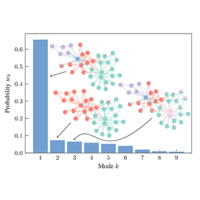
Revealing Consensus and Dissensus between Network Partitions

Tiago P. Peixoto

Phys. Rev. X 11, 021003 (2021) - Published 5 April, 2021

A new method for analyzing summaries of network structure given by clustering algorithms provides a way to characterize competing solutions and extract more meaningful results.

Nonlocal Effective Electromagnetic Wave Characteristics of Composite Media: Beyond the Quasistatic Regime

Salvatore Torquato and Jaeuk Kim

Phys. Rev. X 11, 021002 (2021) - Published 2 April, 2021

Predicting effective characteristics of electromagnetic waves in composite media is an old problem with limited solutions. A new theoretical framework overcomes those limitations.

Morphology of Active Deformable 3D Droplets

Liam J. Ruske and Julia M. Yeomans

Phys. Rev. X 11, 021001 (2021) - Published 1 April, 2021

A numerical study of 3D droplets of active matter reveals many dynamical responses to a microscopic influx of energy, such as fingerlike protrusions and surface wrinkling, offering new physics insight into life sciences.

Gapped Chiral Fermions

Shlomo S. Razamat and David Tong

Phys. Rev. X 11, 011063 (2021) - Published 31 March, 2021

New mathematical models show that it is possible for “chiral” fermions to acquire mass without the electroweak symmetry breaking that comes from the Higgs boson.

Euclidean Frustrated Ribbons

Emmanuel Siéfert, Ido Levin, and Eran Sharon

Phys. Rev. X 11, 011062 (2021) - Published 29 March, 2021

A new mechanism to engineer residually stressed thin sheets exploits the intrinsic tendency of the sheet to bend, a key insight for developing self-shaping materials.

All States are Universal Catalysts in Quantum Thermodynamics

Patryk Lipka-Bartosik and Paul Skrzypczyk

Phys. Rev. X 11, 011061 (2021) - Published 26 March, 2021

Counter to intuition, a mathematical analysis shows that any quantum state can be a “quantum catalyst”—a special reusable state that makes certain manipulations possible—as long as there are enough copies.

Sign In to Your Journals Account

Filter

Subject

Filter

Article Lookup

Enter a citation