Browse by Subject

Erratum: Coherent Multispin Exchange Coupling in a Quantum-Dot Spin Chain [Phys. Rev. X 10, 031006 (2020)]

Haifeng Qiao, Yadav P. Kandel, Kuangyin Deng, Saeed Fallahi, Geoffrey C. Gardner, Michael J. Manfra, Edwin Barnes, and John M. Nichol

Phys. Rev. X 11, 029904 (2021) - Published 11 June, 2021

Laser-Accelerated, Low-Divergence 15-MeV Quasimonoenergetic Electron Bunches at 1 kHz

F. Salehi, M. Le, L. Railing, M. Kolesik, and H. M. Milchberg

Phys. Rev. X 11, 021055 (2021) - Published 11 June, 2021

A demonstration of high-quality electron beams from a plasma accelerator driven by a low-energy, few-cycle duration laser pulse showcases a promising low-cost alternative to large traditional accelerators.

Incoherent Cooper Pairing and Pseudogap Behavior in Single-Layer FeSe/SrTiO3

B. D. Faeth, S.-L. Yang, J. K. Kawasaki, J. N. Nelson, P. Mishra, C. T. Parzyck, C. Li, D. G. Schlom, and K. M. Shen

Phys. Rev. X 11, 021054 (2021) - Published 10 June, 2021

A monolayer of FeSe atop SrTiO3 displays enhanced high-temperature superconductivity. New measurements reveal a sharp distinction between the appearance of a superconducting energy gap and true zero resistivity.

GWTC-2: Compact Binary Coalescences Observed by LIGO and Virgo during the First Half of the Third Observing Run

R. Abbott et al. (LIGO Scientific Collaboration and Virgo Collaboration)

Phys. Rev. X 11, 021053 (2021) - Published 9 June, 2021

An updated catalog of gravitational-wave detections includes 50 events consistent with a wide range of mergers among compact astrophysical objects.

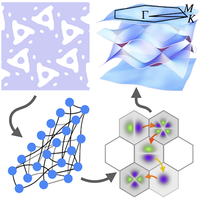
Rapid Exploration of Topological Band Structures Using Deep Learning

Vittorio Peano, Florian Sapper, and Florian Marquardt

Phys. Rev. X 11, 021052 (2021) - Published 8 June, 2021

A neural network maps arbitrary nanostructure patterns to their wave band structures and finds geometries that support desired wave propagation behavior, a key advance in tailoring wave transport in nanodevices.

Local Pairing of Feynman Histories in Many-Body Floquet Models

S. J. Garratt and J. T. Chalker

Phys. Rev. X 11, 021051 (2021) - Published 7 June, 2021

A new framework for analyzing chaotic quantum systems with local interactions identifies generic many-body interference effects, with strong implications for quantum spectra.

Thermal Metasurfaces: Complete Emission Control by Combining Local and Nonlocal Light-Matter Interactions

Adam C. Overvig, Sander A. Mann, and Andrea Alù

Phys. Rev. X 11, 021050 (2021) - Published 4 June, 2021

Theorists have shown that carefully patterned surfaces can transform the emission from a hot object into a polarized, focused light beam.

Super-Heavy Ions Acceleration Driven by Ultrashort Laser Pulses at Ultrahigh Intensity

Pengjie Wang, Zheng Gong, Seong Geun Lee, Yinren Shou, Yixing Geng, Cheonha Jeon, I Jong Kim, Hwang Woon Lee, Jin Woo Yoon, Jae Hee Sung, Seong Ku Lee, Defeng Kong, Jianbo Liu, Zhusong Mei, Zhengxuan Cao, Zhuo Pan, Il Woo Choi, Xueqing Yan, Chang Hee Nam, and Wenjun Ma

Phys. Rev. X 11, 021049 (2021) - Published 3 June, 2021

Laser ion acceleration driven by the utmost intense laser pulses pushes superheavy gold ions to unprecedented energies, key for applications ranging from nuclear physics to next-generation accelerators.

Enhancing Associative Memory Recall and Storage Capacity Using Confocal Cavity QED

Brendan P. Marsh, Yudan Guo, Ronen M. Kroeze, Sarang Gopalakrishnan, Surya Ganguli, Jonathan Keeling, and Benjamin L. Lev

Phys. Rev. X 11, 021048 (2021) - Published 2 June, 2021

Merging ideas from neuroscience, machine learning, and quantum technology, researchers propose a new information-storage device.

Quantum-Enhanced Data Classification with a Variational Entangled Sensor Network

Yi Xia, Wei Li, Quntao Zhuang, and Zheshen Zhang

Phys. Rev. X 11, 021047 (2021) - Published 1 June, 2021

Quantum machine-learning techniques speed up the task of classifying data delivered by a small network of quantum sensors.

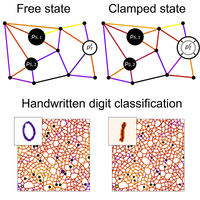
Supervised Learning in Physical Networks: From Machine Learning to Learning Machines

Menachem Stern, Daniel Hexner, Jason W. Rocks, and Andrea J. Liu

Phys. Rev. X 11, 021045 (2021) - Published 28 May, 2021

A proposed approach could allow physical networks to learn how to adapt to stimuli and gain desired functionalities, exporting a machine-learning methodology to real materials and machines.

Spinon Fermi Surface Spin Liquid in a Triangular Lattice Antiferromagnet NaYbSe2

Peng-Ling Dai, Gaoning Zhang, Yaofeng Xie, Chunruo Duan, Yonghao Gao, Zihao Zhu, Erxi Feng, Zhen Tao, Chien-Lung Huang, Huibo Cao, Andrey Podlesnyak, Garrett E. Granroth, Michelle S. Everett, Joerg C. Neuefeind, David Voneshen, Shun Wang, Guotai Tan, Emilia Morosan, Xia Wang, Hai-Qing Lin, Lei Shu, Gang Chen, Yanfeng Guo, Xingye Lu, and Pengcheng Dai

Phys. Rev. X 11, 021044 (2021) - Published 27 May, 2021

Neutron-scattering experiments provide solid evidence for the elusive quantum spin liquid state in a 2D triangular crystalline material.

Erratum: Half-Magnetic Topological Insulator with Magnetization-Induced Dirac Gap at a Selected Surface [Phys. Rev. X 11, 011039 (2021)]

Ruie Lu, Hongyi Sun, Shiv Kumar, Yuan Wang, Mingqiang Gu, Meng Zeng, Yu-Jie Hao, Jiayu Li, Jifeng Shao, Xiao-Ming Ma, Zhanyang Hao, Ke Zhang, Wumiti Mansuer, Jiawei Mei, Yue Zhao, Cai Liu, Ke Deng, Wen Huang, Bing Shen, Kenya Shimada, Eike F. Schwier, Chang Liu, Qihang Liu, and Chaoyu Chen

Phys. Rev. X 11, 029902 (2021) - Published 26 May, 2021

Quantum Inflation: A General Approach to Quantum Causal Compatibility

Elie Wolfe, Alejandro Pozas-Kerstjens, Matan Grinberg, Denis Rosset, Antonio Acín, and Miguel Navascués

Phys. Rev. X 11, 021043 (2021) - Published 26 May, 2021

Quantum inflation offers the mathematical tools to identify and quantify causal relationships among quantum systems with ready applications to entanglement theory and quantum information protocols.

Luminescence Anomaly of Dipolar Valley Excitons in Homobilayer Semiconductor Moiré Superlattices

Hongyi Yu and Wang Yao

Phys. Rev. X 11, 021042 (2021) - Published 25 May, 2021

A mathematical analysis shows how changes in the brightness and polarization of light emitted by excitons in a transition-metal dichalcogenide bilayer is a powerful probe of exciton behavior.

How Quantum Evolution with Memory is Generated in a Time-Local Way

K. Nestmann, V. Bruch, and M. R. Wegewijs

Phys. Rev. X 11, 021041 (2021) - Published 24 May, 2021

Time lag in how an environment responds to a quantum device complicates analyses of these systems, but an elegant workaround provides a way to proceed as if there were no lag at all.

Influence Matrix Approach to Many-Body Floquet Dynamics

Alessio Lerose, Michael Sonner, and Dmitry A. Abanin

Phys. Rev. X 11, 021040 (2021) - Published 21 May, 2021

A new theoretical framework provides a way to predict nonequilibrium dynamics in quantum-many body systems.

Entropy Scaling Law and the Quantum Marginal Problem

Isaac H. Kim

Phys. Rev. X 11, 021039 (2021) - Published 20 May, 2021

A new method to compute physical properties of interacting many-body quantum systems can do so exponentially faster than other techniques.

Relationship between Transport Anisotropy and Nematicity in FeSe

Jack M. Bartlett, Alexander Steppke, Suguru Hosoi, Hilary Noad, Joonbum Park, Carsten Timm, Takasada Shibauchi, Andrew P. Mackenzie, and Clifford W. Hicks

Phys. Rev. X 11, 021038 (2021) - Published 19 May, 2021

Resistive anisotropy grows then shrinks following the onset of electronic nematicity in FeSe, a key observation of how the electronic structure of FeSe changes as nematicity develops.

Symmetry Classes of Open Fermionic Quantum Matter

Alexander Altland, Michael Fleischhauer, and Sebastian Diehl

Phys. Rev. X 11, 021037 (2021) - Published 18 May, 2021

A generalization of fundamental symmetry classes of fermionic quantum matter to out-of-equilibrium systems provides a framework for engineering novel quantum phases.

Sign In to Your Journals Account

Filter

Subject

Filter

Article Lookup

Enter a citation