Browse by Subject

Nonclassical Nucleation Pathways in Stacking-Disordered Crystals

Fabio Leoni and John Russo

Phys. Rev. X 11, 031006 (2021) - Published 9 July, 2021

Layered and onionlike structures emerge solely from structural differences among competing crystalline growths in a liquid melt, according to a new deep neural network analysis.

Prediction of Toric Code Topological Order from Rydberg Blockade

Ruben Verresen, Mikhail D. Lukin, and Ashvin Vishwanath

Phys. Rev. X 11, 031005 (2021) - Published 8 July, 2021

A lattice of highly excited atoms can exhibit a topological phase, a new theoretical study shows.

Measuring Surface Tensions of Soft Solids with Huge Contact-Angle Hysteresis

Jin Young Kim, Stefanie Heyden, Dominic Gerber, Nicolas Bain, Eric R. Dufresne, and Robert W. Style

Phys. Rev. X 11, 031004 (2021) - Published 7 July, 2021

Sessile droplet shapes offer a common way to measure solid-surface properties. A new approach to this provides much greater accuracy on soft solids.

Pseudospectrum and Black Hole Quasinormal Mode Instability

José Luis Jaramillo, Rodrigo Panosso Macedo, and Lamis Al Sheikh

Phys. Rev. X 11, 031003 (2021) - Published 6 July, 2021

A new analysis of black hole vibrational spectra identifies which frequencies are stable to perturbations—information pertinent for gravitational-wave analysis and quantum gravity modeling.

Length Scales in Brownian yet Non-Gaussian Dynamics

José M. Miotto, Simone Pigolotti, Aleksei V. Chechkin, and Sándalo Roldán-Vargas

Phys. Rev. X 11, 031002 (2021) - Published 2 July, 2021

The distribution of particle displacements in certain diffusive systems takes on an unusual non-Gaussian behavior. New simulations explore how the evolution of such dynamics depends on the system’s details.

All-XUV Pump-Probe Transient Absorption Spectroscopy of the Structural Molecular Dynamics of Di-iodomethane

Marc Rebholz et al.

Phys. Rev. X 11, 031001 (2021) - Published 1 July, 2021

Experiments selectively excite and probe specific core electrons in CH2I2 to follow the molecule’s internal dynamics and also pave the way toward site-selective control of chemical reactions.

Ultrafast Control of Material Optical Properties via the Infrared Resonant Raman Effect

Guru Khalsa, Nicole A. Benedek, and Jeffrey Moses

Phys. Rev. X 11, 021067 (2021) - Published 30 June, 2021

A theoretical and computational analysis shows that it is possible to precisely control the optical properties of a material by optically exciting crystalline lattice vibrations, or phonons.

Editorial: Ten Years of PRX

Cristina Marchetti and Jean-Michel Raimond

Phys. Rev. X 11, 020001 (2021) - Published 30 June, 2021

Virus-Host Interactions Shape Viral Dispersal Giving Rise to Distinct Classes of Traveling Waves in Spatial Expansions

Michael Hunter, Nikhil Krishnan, Tongfei Liu, Wolfram Möbius, and Diana Fusco

Phys. Rev. X 11, 021066 (2021) - Published 29 June, 2021

Bacteria-infecting viruses provide a controllable platform to study the expansion of a virus in a cell population.

Coexistence of Surface Superconducting and Three-Dimensional Topological Dirac States in Semimetal KZnBi

Junseong Song, Sunghun Kim, Youngkuk Kim, Huixia Fu, Jahyun Koo, Zhen Wang, Gyubin Lee, Jouhahn Lee, Sang Ho Oh, Joonho Bang, Taku Matsushita, Nobuo Wada, Hiroki Ikegami, Jonathan D. Denlinger, Young Hee Lee, Binghai Yan, Yeongkwan Kim, and Sung Wng Kim

Phys. Rev. X 11, 021065 (2021) - Published 28 June, 2021

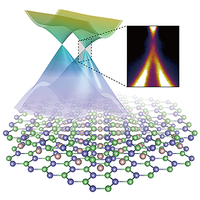
A newly discovered 3D topological Dirac semimetal exhibits surface superconductivity at ambient pressure, a key step in the development of systems sought after for quantum computation.

Transient Chaotic Dimensionality Expansion by Recurrent Networks

Christian Keup, Tobias Kühn, David Dahmen, and Moritz Helias

Phys. Rev. X 11, 021064 (2021) - Published 25 June, 2021

A framework for comparing models of neural networks provides insight into how the brain can support powerful computations despite its strongly chaotic electrical activity.

Fibonacci Turbulence

Natalia Vladimirova, Michal Shavit, and Gregory Falkovich

Phys. Rev. X 11, 021063 (2021) - Published 24 June, 2021

Two distinct classes of turbulence are studied through the lens of statistical physics, but a certain kind of discrete model bridges these classes and can describe both.

Spintronics Meets Density Matrix Renormalization Group: Quantum Spin-Torque-Driven Nonclassical Magnetization Reversal and Dynamical Buildup of Long-Range Entanglement

Marko D. Petrović, Priyanka Mondal, Adrian E. Feiguin, Petr Plecháč, and Branislav K. Nikolić

Phys. Rev. X 11, 021062 (2021) - Published 23 June, 2021

A synergy between strongly electron-correlated physics, quantum transport theory, and quantum information science provides a long-sought quantum-mechanical description of spin torque, an effect at the heart of spintronic research.

Interaction-Stabilized Topological Magnon Insulator in Ferromagnets

Alexander Mook, Kirill Plekhanov, Jelena Klinovaja, and Daniel Loss

Phys. Rev. X 11, 021061 (2021) - Published 22 June, 2021

Particle number nonconservation in interactions among magnons in ferromagnet models reveal a topological phase transition, which opens possibilities for energy-efficient magnetic information processing.

Learning and Avoiding Disorder in Multimode Fibers

Maxime W. Matthès, Yaron Bromberg, Julien de Rosny, and Sébastien M. Popoff

Phys. Rev. X 11, 021060 (2021) - Published 21 June, 2021

A machine-learning approach quickly characterizes an optical fiber, identifying transmission channels that aren’t affected by deformation.

Criticality in Spreading Processes without Timescale Separation and the Critical Brain Hypothesis

Daniel J. Korchinski, Javier G. Orlandi, Seung-Woo Son, and Jörn Davidsen

Phys. Rev. X 11, 021059 (2021) - Published 17 June, 2021

External input introduced to a spreading cascade in a network fundamentally alters the growth of that cascade—a new insight with implications for understanding brain dynamics.

Realization of High-Fidelity CZ and ZZ-Free iSWAP Gates with a Tunable Coupler

Youngkyu Sung, Leon Ding, Jochen Braumüller, Antti Vepsäläinen, Bharath Kannan, Morten Kjaergaard, Ami Greene, Gabriel O. Samach, Chris McNally, David Kim, Alexander Melville, Bethany M. Niedzielski, Mollie E. Schwartz, Jonilyn L. Yoder, Terry P. Orlando, Simon Gustavsson, and William D. Oliver

Phys. Rev. X 11, 021058 (2021) - Published 16 June, 2021

Two-qubit gate errors remain a major bottleneck on the road to robust quantum computing. A new approach to designing a key element of such gates dramatically improves their fidelity.

Thermodynamics of Active Field Theories: Energetic Cost of Coupling to Reservoirs

Tomer Markovich, Étienne Fodor, Elsen Tjhung, and Michael E. Cates

Phys. Rev. X 11, 021057 (2021) - Published 15 June, 2021

A novel thermodynamic framework extends the notion of heat to active materials as a tool to quantify the energetic cost of sustaining nonequilibrium patterns in these active systems.

Erratum: One-Way Quantum Repeater Based on Near-Deterministic Photon-Emitter Interfaces [Phys. Rev. X 10, 021071 (2020)]

Johannes Borregaard, Hannes Pichler, Tim Schröder, Mikhail D. Lukin, Peter Lodahl, and Anders S. Sørensen

Phys. Rev. X 11, 029903 (2021) - Published 14 June, 2021

Particle-Level Visualization of Hydrodynamic and Frictional Couplings in Dense Suspensions of Spherical Colloids

Taiki Yanagishima, Yanyan Liu, Hajime Tanaka, and Roel P. A. Dullens

Phys. Rev. X 11, 021056 (2021) - Published 14 June, 2021

A method for visualizing rotation of micrometer-sized spheres reveals for the first time how hydrodynamic and frictional effects affect rotational motion in particulate suspensions.

Sign In to Your Journals Account

Filter

Subject

Filter

Article Lookup

Enter a citation