Browse by Subject

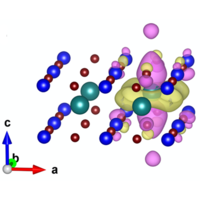
Revealing the Absolute Direction of the Dzyaloshinskii-Moriya Interaction in Prototypical Weak Ferromagnets by Polarized Neutrons

H. Thoma, V. Hutanu, H. Deng, V. E. Dmitrienko, P. J. Brown, A. Gukasov, G. Roth, and M. Angst

Phys. Rev. X 11, 011060 (2021) - Published 25 March, 2021

Experiments show that polarized neutron diffraction is an effective tool for determining the direction of a basic magnetic interaction that impacts spintronics devices and topological materials.

Doublonlike Excitations and Their Phononic Coupling in a Mott Charge-Density-Wave System

C. J. Butler, M. Yoshida, T. Hanaguri, and Y. Iwasa

Phys. Rev. X 11, 011059 (2021) - Published 24 March, 2021

By injecting electrons into the Mott state of tantalum disulfide, experiments reveal new, unexpected electronic behaviors that could shed light on the underlying interactions that create this exotic state.

Tracking the Footprints of Spin Fluctuations: A MultiMethod, MultiMessenger Study of the Two-Dimensional Hubbard Model

Thomas Schäfer et al.

Phys. Rev. X 11, 011058 (2021) - Published 23 March, 2021

An extensive assessment of the ability of many computational methods to tackle the fundamental model of interacting particles, the Hubbard model, reveals the nature and role of magnetic fluctuations.

Suppressing Dissipation in a Floquet-Hubbard System

Konrad Viebahn, Joaquín Minguzzi, Kilian Sandholzer, Anne-Sophie Walter, Manish Sajnani, Frederik Görg, and Tilman Esslinger

Phys. Rev. X 11, 011057 (2021) - Published 19 March, 2021

Floquet engineering uses periodic driving to design novel quantum matter but is limited by dissipation. Experiments show how to use interference between related drives to combat these losses.

All Holographic Four-Point Functions in All Maximally Supersymmetric CFTs

Luis F. Alday and Xinan Zhou

Phys. Rev. X 11, 011056 (2021) - Published 18 March, 2021

A mathematical framework for organizing correlators in conformal field theory (CFT) and corresponding scattering amplitudes in anti–de Sitter (AdS) space greatly enhances the computing power of AdS/CFT for analyzing quantum gravity.

Higgs-Mediated Optical Amplification in a Nonequilibrium Superconductor

Michele Buzzi, Gregor Jotzu, Andrea Cavalleri, J. Ignacio Cirac, Eugene A. Demler, Bertrand I. Halperin, Mikhail D. Lukin, Tao Shi, Yao Wang, and Daniel Podolsky

Phys. Rev. X 11, 011055 (2021) - Published 17 March, 2021

A novel technique for probing photoinduced superconductivity supports the existence of such a state in the compound K3C60 by demonstrating large Higgs mode oscillations.

Ionically Charged Topological Defects in Nematic Fluids

Jeffrey C. Everts and Miha Ravnik

Phys. Rev. X 11, 011054 (2021) - Published 16 March, 2021

Topological defects in nematic electrolytes can separate electric charges and stabilize them without the need for additional surfaces, with possible applications in microelectronics.

Intermittency of Velocity Circulation in Quantum Turbulence

Nicolás P. Müller, Juan Ignacio Polanco, and Giorgio Krstulovic

Phys. Rev. X 11, 011053 (2021) - Published 16 March, 2021

Simulations of turbulent quantum and classical fluids show that the collective behavior of vortices in quantum flows within different-sized regions is very similar to that in classical turbulence.

Deep Learning Protein Conformational Space with Convolutions and Latent Interpolations

Venkata K. Ramaswamy, Samuel C. Musson, Chris G. Willcocks, and Matteo T. Degiacomi

Phys. Rev. X 11, 011052 (2021) - Published 15 March, 2021

A trained neural network predicts intermediate shapes for proteins, opening the door to new techniques for pharmaceutical discovery and design.

From Hi-C Contact Map to Three-Dimensional Organization of Interphase Human Chromosomes

Guang Shi and D. Thirumalai

Phys. Rev. X 11, 011051 (2021) - Published 15 March, 2021

A new computational method solves a major problem in biology—how to obtain 3D coordinates of positions on chromosomes from 2D “contact maps” that encode distances between the positions.

Reply to “Comment on ‘Absence of a Dissipative Quantum Phase Transition in Josephson Junctions”’

A. Murani, N. Bourlet, H. le Sueur, F. Portier, C. Altimiras, D. Esteve, H. Grabert, J. Stockburger, J. Ankerhold, and P. Joyez

Phys. Rev. X 11, 018002 (2021) - Published 12 March, 2021

Comment on “Absence of a Dissipative Quantum Phase Transition in Josephson Junctions”

Pertti J. Hakonen and Edouard B. Sonin

Phys. Rev. X 11, 018001 (2021) - Published 12 March, 2021

Electronic Structure Trends Across the Rare-Earth Series in Superconducting Infinite-Layer Nickelates

Emily Been, Wei-Sheng Lee, Harold Y. Hwang, Yi Cui, Jan Zaanen, Thomas Devereaux, Brian Moritz, and Chunjing Jia

Phys. Rev. X 11, 011050 (2021) - Published 11 March, 2021

A complex interplay of electric and magnetic behaviors resides in the parent compound of a nickel oxide material known to host high-temperature superconductivity, a finding that may guide studies into this phenomenon.

Laplacian-Level Quantum Hydrodynamic Theory for Plasmonics

Henrikh M. Baghramyan, Fabio Della Sala, and Cristian Ciracì

Phys. Rev. X 11, 011049 (2021) - Published 11 March, 2021

A generalization of quantum hydrodynamic theory provides a new, accurate approach to calculating the optical response of a plasmonic system beyond classical electromagnetism.

Competition, Collaboration, and Optimization in Multiple Interacting Spreading Processes

Hanlin Sun, David Saad, and Andrey Y. Lokhov

Phys. Rev. X 11, 011048 (2021) - Published 10 March, 2021

To predict and control the spread of collaborative epidemics or competing marketing campaigns, new computationally efficient algorithms offer crucial insights in scenarios where multiple processes interact.

Improved Thermal Area Law and Quasilinear Time Algorithm for Quantum Gibbs States

Tomotaka Kuwahara, Álvaro M. Alhambra, and Anurag Anshu

Phys. Rev. X 11, 011047 (2021) - Published 9 March, 2021

An analysis of the “area law” for thermal states shows the presence of much weaker correlations than previously believed, providing an avenue for more efficient simulations of quantum many-body systems.

Autonomous Temporal Probability Concentration: Clockworks and the Second Law of Thermodynamics

Emanuel Schwarzhans, Maximilian P. E. Lock, Paul Erker, Nicolai Friis, and Marcus Huber

Phys. Rev. X 11, 011046 (2021) - Published 8 March, 2021

The second law of thermodynamics limits the potential for any system to serve as a clock, while the system’s complexity determines how well this can be achieved in practice.

Negative Energy Elasticity in a Rubberlike Gel

Yuki Yoshikawa, Naoyuki Sakumichi, Ung-il Chung, and Takamasa Sakai

Phys. Rev. X 11, 011045 (2021) - Published 5 March, 2021

Contrary to common belief, the softness of polymer gels is determined by negative energy elasticity and not only by entropy elasticity, a key finding for designing gels used in medical applications at various temperatures.

Optimal Evolutionary Control for Artificial Selection on Molecular Phenotypes

Armita Nourmohammad and Ceyhun Eksin

Phys. Rev. X 11, 011044 (2021) - Published 4 March, 2021

Optimal control for artificial selection offers a new paradigm for directing stochastic evolution of multivariate molecular characteristics and phenotypes toward desired targets.

Emergence of Bimodal Motility in Active Droplets

Babak Vajdi Hokmabad, Ranabir Dey, Maziyar Jalaal, Devaditya Mohanty, Madina Almukambetova, Kyle A. Baldwin, Detlef Lohse, and Corinna C. Maass

Phys. Rev. X 11, 011043 (2021) - Published 3 March, 2021

Microscopy experiments reveal how oil droplets dissolving in a water solution change up their “swimming” patterns as the viscosity of the solution changes.

Sign In to Your Journals Account

Filter

Subject

Filter

Article Lookup

Enter a citation