Browse by Subject

Magnetic Vortex Crystals in Frustrated Mott Insulator

Y. Kamiya and C. D. Batista

Phys. Rev. X 4, 011023 (2014) - Published 25 February, 2014

Large-scale ordering of nonelementary mesoscopic magnetic structures is both fundamentally fascinating and technologically relevant. A theoretical study of frustrated quantum magnets predicts the emergence of a new class of stable magnetic vortex crystals under general conditions.

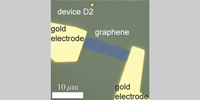
Energy Gap Induced by Friedel Oscillations Manifested as Transport Asymmetry at Monolayer-Bilayer Graphene Boundaries

Kendal W. Clark, X.-G. Zhang, Gong Gu, Jewook Park, Guowei He, R. M. Feenstra, and An-Ping Li

Phys. Rev. X 4, 011021 (2014) - Published 24 February, 2014

Friedel oscillation refers to the quantum interference phenomena where electrons in a solid form standing waves on the solid’s surface as a result of scattering by defects. A combined theoretical and experimental work shows that Friedel oscillation can open an energy gap in graphene.

Finding Unprecedentedly Low-Thermal-Conductivity Half-Heusler Semiconductors via High-Throughput Materials Modeling

Jesús Carrete, Wu Li, Natalio Mingo, Shidong Wang, and Stefano Curtarolo

Phys. Rev. X 4, 011019 (2014) - Published 19 February, 2014

Experimentally determining the lattice thermal conductivity of materials with very high or low values is expensive and time consuming. An efficient computational approach using machine-learning techniques finds a much larger range of conductivity than expected for an impressive number of half-Heusler compounds and also offers a way to rapidly evaluate other classes of materials.

Breakdown of the Arrhenius Law in Describing Vacancy Formation Energies: The Importance of Local Anharmonicity Revealed by Ab initio Thermodynamics

A. Glensk, B. Grabowski, T. Hickel, and J. Neugebauer

Phys. Rev. X 4, 011018 (2014) - Published 10 February, 2014

Point defects can significantly alter the behavior of solid-state materials, but a theoretically and experimentally consistent understanding of their formation energy has been lacking so far. Taking into account anharmonic lattice vibrations, a new state-of-the-art theoretical effort makes a very significant advance toward filling that gap and demonstrates a critical need to revise the official international point-defect database.

Editorial: A Timely Contribution to a Half-Century-Old Topic

Phys. Rev. X 4, 010001 (2014) - Published 10 February, 2014

The editors and Göran Grimvall from Royal Institute of Technology (KTH) of Sweden explain why the just-published paper by Glensk et al. [Phys. Rev. X 4, 011018 (2014)] deserves broad dissemination and special recognition.

Driven Nonlinear Dynamics of Two Coupled Exchange-Only Qubits

Arijeet Pal, Emmanuel I. Rashba, and Bertrand I. Halperin

Phys. Rev. X 4, 011012 (2014) - Published 30 January, 2014

Realization of quantum computing requires not only qubits that are robust against noise but also control over the crosstalk (entanglement) between them. Following the very recent experimental realization of quantum-dot-based “exchange” qubits, theorists propose a practically feasible method for entangling two such qubits in a controllable way.

Topological Invariants and Ground-State Wave functions of Topological Insulators on a Torus

Zhong Wang and Shou-Cheng Zhang

Phys. Rev. X 4, 011006 (2014) - Published 21 January, 2014

Topological insulators are classified by “topological invariants” characterizing their electronic structures. Identifying and computing topological invariants for insulators in which electron-electron interactions are important is, however, difficult. Theorists now present a way to accomplish this task for a wide range of topological insulators.

Transition-Metal Pentatelluride ZrTe5 and HfTe5: A Paradigm for Large-Gap Quantum Spin Hall Insulators

Hongming Weng, Xi Dai, and Zhong Fang

Phys. Rev. X 4, 011002 (2014) - Published 15 January, 2014

Quantum spin Hall (QSH) insulators, with their insulating interior and conducting edges, have great potential for technological applications. But, scarcity and difficulty in fabrication are major obstacles to their wide applications. Theorists now predict that single sheets that can be exfoliated from two well-known layered thermoelectric compounds, ZrTe5 and HfTe5, are the most promising QSH insulator candidates to date.

Longitudinal Spin Excitations and Magnetic Anisotropy in Antiferromagnetically Ordered BaFe2As2

Chong Wang, Rui Zhang, Fa Wang, Huiqian Luo, L. P. Regnault, Pengcheng Dai, and Yuan Li

Phys. Rev. X 3, 041036 (2013) - Published 30 December, 2013

The proximity of an antiferromagnetic phase to the superconducting phase in iron pnictides raises the tantalizing possibility of a fundamental connection between magnetism and superconductivity. With an experiment of unprecedented precision, scientists find unequivocal evidence that puts that possibility on a firmer footing.

Examining Electron-Boson Coupling Using Time-Resolved Spectroscopy

Michael Sentef, Alexander F. Kemper, Brian Moritz, James K. Freericks, Zhi-Xun Shen, and Thomas P. Devereaux

Phys. Rev. X 3, 041033 (2013) - Published 26 December, 2013

Pump-probe spectroscopy based on ultrashort laser pulses is gaining a surging interest as a method for probing electronic dynamics in solid-state materials. But how to make sense of the spectroscopic measurements remains a fundamental challenge. Theorists now report a timely development of a concrete and general understanding of pump-probe spectroscopy studies of electron-phonon coupling.

Realization and Modeling of Metamaterials Made of rf Superconducting Quantum-Interference Devices

M. Trepanier, Daimeng Zhang, Oleg Mukhanov, and Steven M. Anlage

Phys. Rev. X 3, 041029 (2013) - Published 18 December, 2013

A radio receiver that can tune to and digitize millions of frequencies per second, even if the signals are very weak, requires isolating the desired signal from stronger, unwanted noise. Scientists demonstrate a new kind of metamaterial, built with individual radio-frequency superconducting quantum-interference devices (rf SQUIDs), that allows such fast and long-range tuning by exploiting the large tunability of the nonlinear effective inductance of the Josephson junction in each SQUID.

Kondo Hybridization and the Origin of Metallic States at the (001) Surface of SmB6

E. Frantzeskakis, N. de Jong, B. Zwartsenberg, Y. K. Huang, Y. Pan, X. Zhang, J. X. Zhang, F. X. Zhang, L. H. Bao, O. Tegus, A. Varykhalov, A. de Visser, and M. S. Golden

Phys. Rev. X 3, 041024 (2013) - Published 9 December, 2013

Whether SmB6 is a true Kondo insulator has been a 40-year-old puzzle, as its unexpected finite low-temperature electric conductance defies that simple stereotyping. Using angle-resolved photoelectron spectroscopy, scientists find an important piece of the puzzle in the material’s electronic band structure, including the signature of topological surface conducting states.

Thermally Activated Contact Strengthening Explains Nonmonotonic Temperature and Velocity Dependence of Atomic Friction

Mykhaylo Evstigneev and Peter Reimann

Phys. Rev. X 3, 041020 (2013) - Published 26 November, 2013

Recent experiments on friction between a moving atomic-scale tip and a smooth surface have shown that the friction has a nonmonotonic dependence on temperature and decreases with the tip’s velocity. No single theoretical model provides consistent rationalizations of all these experimental data. A new theory based on the notion of “contact aging”—a thermally activated process of the tip-surface contact strengthening—correctly predicts all these recent results.

Boosting Majorana Zero Modes

Torsten Karzig, Gil Refael, and Felix von Oppen

Phys. Rev. X 3, 041017 (2013) - Published 22 November, 2013

Realization of Majorana fermions in solid-state systems offers a promising candidate for qubits in fault-tolerant quantum computing. How fast such qubits can be manipulated without loss in their quantum coherence motivates the need to understand the dynamics of solid-state Majorana fermions. Scientists discover that the dynamics is actually described by an effective variation of the original Dirac equation for the simpler relativistic free Majorana fermions and establish the speed limit for basic qubit manipulation.

Measurement of the Electronic Thermal Conductance Channels and Heat Capacity of Graphene at Low Temperature

Kin Chung Fong, Emma E. Wollman, Harish Ravi, Wei Chen, Aashish A. Clerk, M. D. Shaw, H. G. Leduc, and K. C. Schwab

Phys. Rev. X 3, 041008 (2013) - Published 29 October, 2013

At ambient temperatures, graphene conducts heat via lattice vibrations called phonons, but at very low temperatures, electron-phonon coupling becomes weak and thermal conductance is mostly due to electron diffusion. High-sensitivity measurements across a wide temperature range provide new, state-of-the-art data on electron-phonon coupling, and reveal intriguing deviations from theoretical predictions regarding electron-based thermal and electric transport.

Do Cloaked Objects Really Scatter Less?

Francesco Monticone and Andrea Alù

Phys. Rev. X 3, 041005 (2013) - Published 21 October, 2013

Known metamaterial-based “invisibility cloaks” have been observed to work only for narrow ranges of electromagnetic waves, for example, making an object invisible to red light, but highly visible to blue light. With a comprehensive and quantitative theoretical analysis, researchers now provide a concrete understanding of the observations and also propose a design for broadband cloaks using diamagnetic or superconducting thin cloaking layers.

All-Optical Switching and Router via the Direct Quantum Control of Coupling between Cavity Modes

Keyu Xia (夏可宇) and Jason Twamley

Phys. Rev. X 3, 031013 (2013) - Published 5 September, 2013

Classical optical communication and quantum information processing based on photonic networks require photonics signals to be switched on and off or routed via optical cavities and waveguides in the networks. Large-bandwidth and nearly perfect switching as well as low-loss, multiport routing remains challenging. A new proposal achieves these goals, relying on controlling the coupling between two neighboring cavities in a transmission path with a three-level atomic scatter of photons.

Gate-Defined Wires in HgTe Quantum Wells: From Majorana Fermions to Spintronics

Johannes Reuther, Jason Alicea, and Amir Yacoby

Phys. Rev. X 3, 031011 (2013) - Published 26 August, 2013

Materials allowing precise control over the response of spins to electric and magnetic fields are highly desirable in spintronics. Scientists demonstrate that electrical-gate-defined wires in HgTe quantum wells offer great potential as such a material platform with their extraordinary tunability of the electronic spin-orbit coupling and g factors. They explore a particularly enticing application where such wires are used in the detection of Majorana fermions and in Majorana-fermion-based topological quantum computing.

Deterministic Many-Resonator W Entanglement of Nearly Arbitrary Microwave States via Attractive Bose-Hubbard Simulation

A. A. Gangat, I. P. McCulloch, and G. J. Milburn

Phys. Rev. X 3, 031009 (2013) - Published 21 August, 2013

Recent advances in fabricating superconducting circuits have allowed large numbers of microwave resonators and superconducting qubits to be employed in such circuits, but shared quantum entanglement among the photonics states of the resonators has not been attempted. Theorists now present a proposal that uses superconducting circuits to simulate a particular many-body quantum model that until now has been experimentally inaccessible and to create a type of shared quantum entanglement with the simulation.

Anyons in Integer Quantum Hall Magnets

Armin Rahmani, Rodrigo A. Muniz, and Ivar Martin

Phys. Rev. X 3, 031008 (2013) - Published 21 August, 2013

Anyons—particles with fractional electron charge that exist only in two-dimensional systems—are known to occur in materials exhibiting the fractional quantum Hall effect but were not expected in those exhibiting the integer quantum Hall effect. Now, a new study shows that chiral magnets with itinerant electrons, which exhibit the integer quantum Hall effect, can in fact host anyons, thus opening a new avenue for the search for these exotic particles.

Sign In to Your Journals Account

Filter

Subject

Filter

Article Lookup

Enter a citation