Browse by Subject

Hall Effect Gyrators and Circulators

Giovanni Viola and David P. DiVincenzo

Phys. Rev. X 4, 021019 (2014) - Published 2 May, 2014

Microwave circulators, which perform one-way routing of microwave signals in ultralow-temperature devices, are essential in quantum technology; but currently used circulators are too bulky for future quantum computer applications. A fundamentally different approach based on an innovative use of the Hall effect promises excellent performance at much smaller scales.

Non-Abelian Majorana Doublets in Time-Reversal-Invariant Topological Superconductors

Xiong-Jun Liu, Chris L. M. Wong, and K. T. Law

Phys. Rev. X 4, 021018 (2014) - Published 29 April, 2014

Isolated Majorana fermions have been known to obey non-Abelian particle statistics. Pairs of bound Majorana fermions are now predicted to exist in topological superconductors with time-reversal symmetry. What type of statistics do such pairs obey? Theorists show for the first time that, “protected” by time-reversal symmetry, they obey a new type of non-Abelian statistics.

Fluctuations of Imbalanced Fermionic Superfluids in Two Dimensions Induce Continuous Quantum Phase Transitions and Non-Fermi-Liquid Behavior

Philipp Strack and Pawel Jakubczyk

Phys. Rev. X 4, 021012 (2014) - Published 18 April, 2014

An ultracold mixture of two different species of fermionic atoms can turn into a quantum coherent “superfluid” at certain mixing ratios as the fermions overcome their natural repulsion to pair up. Tuning the mixing can destroy the superfluid. A theoretical study shows that the breakdown of the superfluid corresponds to a new type of quantum critical point that is experimentally accessible.

Relaxation Dynamics of an Isolated Large-Spin Fermi Gas Far from Equilibrium

Ulrich Ebling, Jasper Simon Krauser, Nick Fläschner, Klaus Sengstock, Christoph Becker, Maciej Lewenstein, and André Eckardt

Phys. Rev. X 4, 021011 (2014) - Published 16 April, 2014

How do closed quantum systems reach equilibrium? By knocking an ultracold atomic gas out of its spin-state equilibrium and imaging its approach to equilibrium, scientists bring this process to light.

Perturbative Field-Theoretical Renormalization Group Approach to Driven-Dissipative Bose-Einstein Criticality

Uwe C. Täuber and Sebastian Diehl

Phys. Rev. X 4, 021010 (2014) - Published 16 April, 2014

Fundamental understanding of nonequilibrium phase transitions in quantum many-body systems is still in its infancy but is urgently needed given the recent surge in exploration of light-matter interactions in a variety of quantum systems. A field-theoretical renormalization group study of a light-driven, dissipative model system of bosons contributes an important piece.

Glassy Chimeras Could Be Blind to Quantum Speedup: Designing Better Benchmarks for Quantum Annealing Machines

Helmut G. Katzgraber, Firas Hamze, and Ruben S. Andrist

Phys. Rev. X 4, 021008 (2014) - Published 10 April, 2014

Recent benchmarking of the computational speedup of quantum “annealing” machines of the D-Wave-2 type shows that they do not perform faster than a standard desktop computer. A timely theoretical study of the computational tests used in the benchmarking explains why that may be the case.

Dynamical Conductivity across the Disorder-Tuned Superconductor-Insulator Transition

Mason Swanson, Yen Lee Loh, Mohit Randeria, and Nandini Trivedi

Phys. Rev. X 4, 021007 (2014) - Published 9 April, 2014

State-of-the-art quantum Monte Carlo simulations of the electrodynamic properties of disordered superconductors lead to many new insights about the disorder-driven superconductor-insulator transition.

Polaronic Transport Induced by Competing Interfacial Magnetic Order in a La0.7Ca0.3MnO3/BiFeO3 Heterostructure

Y. M. Sheu, S. A. Trugman, L. Yan, J. Qi, Q. X. Jia, A. J. Taylor, and R. P. Prasankumar

Phys. Rev. X 4, 021001 (2014) - Published 2 April, 2014

Composite thin films composed of ferromagnetic metallic manganite La0.7Ca0.3MnO3 (LCMO) and multiferroic BiFeO3 (BFO) host a novel magnetotransport phenomenon at the interface that can be controlled by switching the ferroelectric polarization in BFO. A new experiment reveals that suppression by BFO of the polaronic coupling between electrons and Mn ions in LCMO frees the electron and enables the transport.

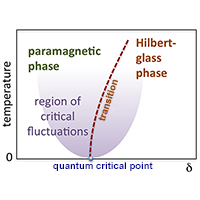
Hilbert-Glass Transition: New Universality of Temperature-Tuned Many-Body Dynamical Quantum Criticality

David Pekker, Gil Refael, Ehud Altman, Eugene Demler, and Vadim Oganesyan

Phys. Rev. X 4, 011052 (2014) - Published 31 March, 2014

Conventional phase transitions are usually characterized by a change in a fundamental thermodynamic observable, e.g., in density when liquid changes to vapor. A theoretical study of a one-dimensional disordered quantum spin chain reveals a new class of quantum phase transitions that leave no such signatures and pins down their origin.

Strain-Induced Enhancement of the Electron Energy Relaxation in Strongly Correlated Superconductors

C. Gadermaier, V. V. Kabanov, A. S. Alexandrov, L. Stojchevska, T. Mertelj, C. Manzoni, G. Cerullo, N. D. Zhigadlo, J. Karpinski, Y. Q. Cai, X. Yao, Y. Toda, M. Oda, S. Sugai, and D. Mihailovic

Phys. Rev. X 4, 011056 (2014) - Published 28 March, 2014

A new ultrafast optical spectroscopy experiment establishes, for both cuprates and pnictides, a remarkable systematic, nonmonotonic variation of their highest superconducting critical temperature with the strength of the electron-phonon interaction in them.

Error Correction for Non-Abelian Topological Quantum Computation

James R. Wootton, Jan Burri, Sofyan Iblisdir, and Daniel Loss

Phys. Rev. X 4, 011051 (2014) - Published 28 March, 2014

Topological quantum computation using non-Abelian anyons—exotic particlelike excitations that are neither bosons nor fermions—as qubits has been thought to be in no need of error correction. Theorists now show that active error correction is in fact necessary and offer a method for performing it.

Soliton Attenuation and Emergent Hydrodynamics in Fragile Matter

N. Upadhyaya, L. R. Gómez, and V. Vitelli

Phys. Rev. X 4, 011045 (2014) - Published 26 March, 2014

A system of loosely packed little solid balls is an intriguing sonic material in which sound travels always as shock waves. A new theoretical investigation reveals a number of interesting findings about the inner workings of such shock waves, including the emergence of a fluidlike state in the wake of a shock wave.

Charge Scattering and Mobility in Atomically Thin Semiconductors

Nan Ma and Debdeep Jena

Phys. Rev. X 4, 011043 (2014) - Published 18 March, 2014

Atomically thin semiconductors, e.g., MoS2, may be an alternative to silicon in transistor electronics, but their electron mobilities as measured are apparently rather low. A theoretical study shows that the low mobilities are caused by the scattering of electrons by charged impurities and points to high-κ dielectric coatings as a way to boost the mobilities of high-impurity samples.

Short-Range Correlations in Magnetite above the Verwey Temperature

Alexey Bosak, Dmitry Chernyshov, Moritz Hoesch, Przemysław Piekarz, Mathieu Le Tacon, Michael Krisch, Andrzej Kozłowski, Andrzej M. Oleś, and Krzysztof Parlinski

Phys. Rev. X 4, 011040 (2014) - Published 17 March, 2014

Magnetite, discovered in ancient Greece, transitions from a simple cubic lattice to a monoclinic one with much greater resistivity when cooled to 124 K. The fundamental nature of the transition has remained a puzzle. A new experimental study shows that, despite their apparent differences in structure and electronic transport, the two phases across the transition are linked by a persistent presence of electronic correlations.

Evidence of Distributed Robust Surface Current Flow in 3D Topological Insulators

Janghee Lee, Jae-Hyeong Lee, Joonbum Park, Jun Sung Kim, and Hu-Jong Lee

Phys. Rev. X 4, 011039 (2014) - Published 13 March, 2014

Topologically nontrivial surface current is the hallmark of a topological insulator (TI). Its unambiguous identification is, however, plagued by presence of trivial current channels. Using simultaneous local and nonlocal transport measurements, scientists make high-precision identification of genuine TI-related surface current.

Reentrant Superspin Glass Phase in a La0.82Ca0.18MnO3 Ferromagnetic Insulator

P. Anil Kumar, R. Mathieu, P. Nordblad, Sugata Ray, Olof Karis, Gabriella Andersson, and D. D. Sarma

Phys. Rev. X 4, 011037 (2014) - Published 12 March, 2014

Pure LaMnO3 is an antiferromagnetic insulator but when doped with additional charge carriers, it can become a ferromagnetic conductor, with a seemingly ferromagnetic insulating phase intervening in between. An experimental investigation reveals that the intervening phase is a new state that may be characterized as a “superspin glass.”

Universal Topological Quantum Computation from a Superconductor-Abelian Quantum Hall Heterostructure

Roger S. K. Mong, David J. Clarke, Jason Alicea, Netanel H. Lindner, Paul Fendley, Chetan Nayak, Yuval Oreg, Ady Stern, Erez Berg, Kirill Shtengel, and Matthew P. A. Fisher

Phys. Rev. X 4, 011036 (2014) - Published 12 March, 2014

Topological quantum computing avoids the problem of decoherence by using noise-resistant non-Abelian anyons to carry quantum information. Materials hosting these exotic particles are scarce, however. Scientists now show that Fibonacci anyons—the holy grail for topological quantum computing—can be realized in a heterostructure composed of a simple fractional quantum Hall material and a conventional superconductor.

Room-Temperature Ferrimagnet with Frustrated Antiferroelectricity: Promising Candidate Toward Multiple-State Memory

P. S. Wang and H. J. Xiang

Phys. Rev. X 4, 011035 (2014) - Published 11 March, 2014

Multiferroics, complex materials with exotic collective ordering of their intrinsic microscopic magnetic and electric dipoles, are highly sought after. BaFe12O19 is now predicted to be the first multiferroic material hosting both ferrimagnetism and antiferroelectricity—an ideal candidate for realizing room-temperature multiple-state memory devices.

Spin-Orbit Coupling, Quantum Dots, and Qubits in Monolayer Transition Metal Dichalcogenides

Andor Kormányos, Viktor Zólyomi, Neil D. Drummond, and Guido Burkard

Phys. Rev. X 4, 011034 (2014) - Published 11 March, 2014

Quantum dots in a monolayer transition metal dichalcogenide such as MoS2 hold the promises of low dimensionality and dual electrical and optical functionality. Scientists provide the first and necessary theoretical framework for studying such quantum dots, laying the basis for further theoretical and experimental investigations.

Proximity Effect between Two Superconductors Spatially Resolved by Scanning Tunneling Spectroscopy

V. Cherkez, J. C. Cuevas, C. Brun, T. Cren, G. Ménard, F. Debontridder, V. S. Stolyarov, and D. Roditchev

Phys. Rev. X 4, 011033 (2014) - Published 11 March, 2014

How does a superconductor in contact with another through an atomic-scale junction influence the electronic properties in the latter? Investigating a submicron superconducting island of single-crystal Pb embedded in a pre-superconducting Pb crystalline monolayer, scientists reveal a giant region of induced superconductivity in the monolayer and also offer a theory for describing such proximity effects.

Sign In to Your Journals Account

Filter

Subject

Filter

Article Lookup

Enter a citation