Browse by Subject

Demonstration of Efficient Nonreciprocity in a Microwave Optomechanical Circuit

G. A. Peterson, F. Lecocq, K. Cicak, R. W. Simmonds, J. Aumentado, and J. D. Teufel

Phys. Rev. X 7, 031001 (2017) - Published 6 July, 2017

Nonreciprocal devices, in which electrical or optical signals travel in one direction only, are essential for telecommunication and quantum applications, but they are often both lossy and bulky to implement. A prototype device demonstrates nonreciprocity in a microwave optomechanical circuit that allows for dynamic isolation control while avoiding the need for large magnetic fields.

Pulse Duration of Seeded Free-Electron Lasers

Paola Finetti et al.

Phys. Rev. X 7, 021043 (2017) - Published 16 June, 2017

FERMI is a novel class of free-electron laser that is capable of producing femtosecond pulses of ultraviolet and x-ray light, essential to studying ultrafast processes in matter. A new investigation characterizes FERMI’s pulse shape and confirms that it routinely generates Gaussian pulses lasting a few tens of femtoseconds.

Engineering Matter Interactions Using Squeezed Vacuum

Sina Zeytinoğlu, Ataç İmamoğlu, and Sebastian Huber

Phys. Rev. X 7, 021041 (2017) - Published 13 June, 2017

The ability to control matter at the quantum level is essential for many applications. A new analysis shows that an exotic state known as a squeezed vacuum can provide unprecedented control over interactions between quantum entities.

Topological Superconductivity in a Planar Josephson Junction

Falko Pientka, Anna Keselman, Erez Berg, Amir Yacoby, Ady Stern, and Bertrand I. Halperin

Phys. Rev. X 7, 021032 (2017) - Published 30 May, 2017

The search for topological superconductors—superconductors where the bulk accommodates only electron pairs while the surface also allows for motion of single electrons—largely relies on tweaking environmental knobs to create the desired characteristics. A proposed experimental setup uses the phase difference between two superconductors to create a topological phase.

Glassy Spin Dynamics in Geometrically Frustrated Buckled Colloidal Crystals

Di Zhou, Feng Wang, Bo Li, Xiaojie Lou, and Yilong Han

Phys. Rev. X 7, 021030 (2017) - Published 25 May, 2017

Some crystalline materials show indirect evidence of glasslike behavior, which is surprising because a crystal is highly ordered whereas a glass is not. By using colloidal crystals composed of micrometer-sized spheres suspended in water, a new experiment mimics such phenomena and provides a novel way of understanding this behavior.

Excitonic Linewidth Approaching the Homogeneous Limit in MoS2-Based van der Waals Heterostructures

F. Cadiz, E. Courtade, C. Robert, G. Wang, Y. Shen, H. Cai, T. Taniguchi, K. Watanabe, H. Carrere, D. Lagarde, M. Manca, T. Amand, P. Renucci, S. Tongay, X. Marie, and B. Urbaszek

Phys. Rev. X 7, 021026 (2017) - Published 18 May, 2017

Transition-metal dichalcogenides are a class of two-dimensional materials that offer potential for developing flat and flexible transistors and optoelectronics, but their quality is often hindered by traditional methods for depositing these atomically flat materials. An experiment demonstrates a new technique that leads to higher quality crystals and better access to studying their properties.

Designing Nanostructures for Phonon Transport via Bayesian Optimization

Shenghong Ju, Takuma Shiga, Lei Feng, Zhufeng Hou, Koji Tsuda, and Junichiro Shiomi

Phys. Rev. X 7, 021024 (2017) - Published 17 May, 2017

Phonon transport—the movement of vibrational wave packets in a solid—in nanostructures is a key element in controlling solid heat conduction, but it remains a complex design challenge. A new framework uses informatics and phonon transport calculations to greatly accelerate the design process and reveals nonintuitive structures that are more effective than their traditional counterparts.

Quantum Entanglement in Neural Network States

Dong-Ling Deng, Xiaopeng Li, and S. Das Sarma

Phys. Rev. X 7, 021021 (2017) - Published 11 May, 2017

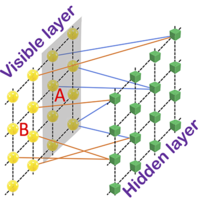
Machine learning has recently gained attention as a possible way to understand phase transitions in many-body quantum systems. A new entanglement analysis reveals crucial properties of the data structures that encode quantum states in a neural network, opening new inroads in applying machine learning to quantum many-body physics.

Predicted Realization of Cubic Dirac Fermion in Quasi-One-Dimensional Transition-Metal Monochalcogenides

Qihang Liu and Alex Zunger

Phys. Rev. X 7, 021019 (2017) - Published 9 May, 2017

Cubically dispersed Dirac fermions are proposed exotic quasiparticles that have no analog in the standard model of particle physics, and they have not yet been identified in any compound. A design methodology quickly identifies one group of compounds as an ideal candidate and shows promise for realizing other novel types of fermions.

Efficient Representation of Fully Many-Body Localized Systems Using Tensor Networks

Thorsten B. Wahl, Arijeet Pal, and Steven H. Simon

Phys. Rev. X 7, 021018 (2017) - Published 8 May, 2017

Many-body-localized (MBL) phases are an intriguing state of matter where quantum systems fail to thermalize and retain their initial conditions for an indefinite amount of time. A new proposal for how to mathematically encode the dynamics of large, one-dimensional MBL systems shows an exponential decrease in computational time for analyzing the energy spectrum.

Wannier-Bloch Approach to Localization in High-Harmonics Generation in Solids

Edyta N. Osika, Alexis Chacón, Lisa Ortmann, Noslen Suárez, Jose Antonio Pérez-Hernández, Bartłomiej Szafran, Marcelo F. Ciappina, Fernando Sols, Alexandra S. Landsman, and Maciej Lewenstein

Phys. Rev. X 7, 021017 (2017) - Published 8 May, 2017

High harmonic generation can produce attosecond-long pulses of light, which are a useful probe of physical processes that require extremely high time resolution. A new mathematical analysis shows how electron delocalization contributes to this emission in a solid.

Hot Electrons Regain Coherence in Semiconducting Nanowires

Jonathan Reiner, Abhay Kumar Nayak, Nurit Avraham, Andrew Norris, Binghai Yan, Ion Cosma Fulga, Jung-Hyun Kang, Torsten Karzig, Hadas Shtrikman, and Haim Beidenkopf

Phys. Rev. X 7, 021016 (2017) - Published 5 May, 2017

Understanding the behavior of electrons in semiconducting nanowires is hindered by difficulties in probing these delicate structures. Development of a portable chamber, which keeps the nanowires under ultrahigh vacuum from growth to measurement, allows for the first thorough study of electron phase coherence in a semiconducting nanowire.

Critical Properties of the Many-Body Localization Transition

Vedika Khemani, S. P. Lim, D. N. Sheng, and David A. Huse

Phys. Rev. X 7, 021013 (2017) - Published 25 April, 2017

Some quantum systems can enter a many-body localized (MBL) phase, where the particles do not settle into thermal equilibrium but remain stuck in some initial state. A new theoretical analysis explores the transition between MBL and thermal phases and finds that the transition is driven by the growth of a network of quantum entanglement.

Josephson Radiation from Gapless Andreev Bound States in HgTe-Based Topological Junctions

R. S. Deacon, J. Wiedenmann, E. Bocquillon, F. Domínguez, T. M. Klapwijk, P. Leubner, C. Brüne, E. M. Hankiewicz, S. Tarucha, K. Ishibashi, H. Buhmann, and L. W. Molenkamp

Phys. Rev. X 7, 021011 (2017) - Published 20 April, 2017

Majorana particles, which are their own antiparticles, offer great potential for future quantum computers, but significant experimental challenges hamper proof of their existence and properties. New measurements of electrical supercurrents in an HgTe quantum well provide a way to gain insight into the induced superconductivity required for these experiments.

Exact Critical Exponents for the Antiferromagnetic Quantum Critical Metal in Two Dimensions

Andres Schlief, Peter Lunts, and Sung-Sik Lee

Phys. Rev. X 7, 021010 (2017) - Published 20 April, 2017

Strange metals, which exhibit unusual changes in physical properties such as electrical resistance and heat capacity in response to temperature, are difficult to understand with current theoretical tools. A new analysis provides the exact solution to a theory that describes two-dimensional strange metals that arise as a metal transitions to a magnet.

Energy as a Detector of Nonlocality of Many-Body Spin Systems

J. Tura, G. De las Cuevas, R. Augusiak, M. Lewenstein, A. Acín, and J. I. Cirac

Phys. Rev. X 7, 021005 (2017) - Published 10 April, 2017

Nonlocal correlations—correlations among atomic particles that cannot be described classically and that are stronger than those accounted for by entanglement—are of fundamental interest to physicists, but remain difficult to characterize in many-body systems. A new theoretical analysis shows that the ground states of spin Hamiltonians in some systems can exhibit nonlocal correlations.

Signatures of Many-Body Localization in a Controlled Open Quantum System

Henrik P. Lüschen, Pranjal Bordia, Sean S. Hodgman, Michael Schreiber, Saubhik Sarkar, Andrew J. Daley, Mark H. Fischer, Ehud Altman, Immanuel Bloch, and Ulrich Schneider

Phys. Rev. X 7, 011034 (2017) - Published 21 March, 2017

In an isolated many-body localized system, initial quantum correlations can remain local rather than spread throughout the system. But experimental studies of such systems are difficult because of unavoidable interactions with the environment, which ultimately spoil the effect. A new method for controlling a photon bath demonstrates a first step toward understanding the effects of this coupling and extrapolating to fully isolated systems.

Heavy Weyl Fermion State in CeRu4Sn6

Yuanfeng Xu, Changming Yue, Hongming Weng, and Xi Dai

Phys. Rev. X 7, 011027 (2017) - Published 7 March, 2017

Weyl semimetals have highly mobile charged particles that may make them useful in electronic devices, but only a few of them have been identified thus far. Computational analysis reveals that the compound CeRu4Sn6 exhibits Weyl-like behavior and may be a new type of material known as a heavy Weyl fermion state.

Prethermal Phases of Matter Protected by Time-Translation Symmetry

Dominic V. Else, Bela Bauer, and Chetan Nayak

Phys. Rev. X 7, 011026 (2017) - Published 7 March, 2017

In systems driven by time-varying fields, new phases of matter might exist that do not appear when the system is static. A mathematical formulation shows that novel phases of matter also exist in prethermal states, where the system exchanges heat with its environment very slowly.

Band Alignment and Charge Transfer in Complex Oxide Interfaces

Zhicheng Zhong and Philipp Hansmann

Phys. Rev. X 7, 011023 (2017) - Published 3 March, 2017

Intrinsic limitations of semiconductors have spurred a search for new materials that can be used in next generation electronics, and transition-metal oxides (TMOs) are attractive candidates. A new scheme for predicting the electrical and magnetic behavior of TMOs shows promise for helping design future components.

Sign In to Your Journals Account

Filter

Subject

Filter

Article Lookup

Enter a citation