Browse by Subject

Non-Fermi Liquid at (2+1)D Ferromagnetic Quantum Critical Point

Xiao Yan Xu, Kai Sun, Yoni Schattner, Erez Berg, and Zi Yang Meng

Phys. Rev. X 7, 031058 (2017) - Published 27 September, 2017

The behavior of electrons near quantum critical points, such as magnetic phase transitions at temperatures approaching absolute zero, are of vital interest but are extremely challenging to understand. New computer simulations solve this problem, exactly, for one example of these strange metals and reveal a new type of quantum critical point.

Bulk Rotational Symmetry Breaking in Kondo Insulator SmB6

Z. Xiang, B. Lawson, T. Asaba, C. Tinsman, Lu Chen, C. Shang, X. H. Chen, and Lu Li

Phys. Rev. X 7, 031054 (2017) - Published 25 September, 2017

Kondo insulators exhibit strong electronic interactions and topological protection, making them a good platform for studying connections between these two fields. New experiments show that a type of magnetic oscillation (the de Hass-van Alphen effect) originates in the surface of a Kondo insulator, bolstering evidence for topologically protected surface states.

Polaron-Driven Surface Reconstructions

Michele Reticcioli, Martin Setvin, Xianfeng Hao, Peter Flauger, Georg Kresse, Michael Schmid, Ulrike Diebold, and Cesare Franchini

Phys. Rev. X 7, 031053 (2017) - Published 25 September, 2017

Surface reconstructions in cleaved crystals are generally thought to be driven by charge transfer between surface atoms. New calculations and experiments with rutile titanium dioxide exhibit a radically different mechanism based on charge trapping, which could open up novel ways of designing crystal surfaces for a range of applications.

Duality between the Deconfined Quantum-Critical Point and the Bosonic Topological Transition

Yan Qi Qin, Yuan-Yao He, Yi-Zhuang You, Zhong-Yi Lu, Arnab Sen, Anders W. Sandvik, Cenke Xu, and Zi Yang Meng

Phys. Rev. X 7, 031052 (2017) - Published 22 September, 2017

Proving an equivalence between two theories—one that describes a transition between two kinds of insulating states and another that models changes between spin states—would offer a step toward a unified theoretical understanding of different condensed-matter systems. New computer simulations provide evidence for this duality by showing that the critical points of these two theories have identical properties.

Deconfined Quantum Critical Points: Symmetries and Dualities

Chong Wang, Adam Nahum, Max A. Metlitski, Cenke Xu, and T. Senthil

Phys. Rev. X 7, 031051 (2017) - Published 22 September, 2017

Different theories can be used to describe the same behavior in quantum matter, a concept known as duality. A new analysis uses duality to connect ideas in quantum electrodynamics with a type of quantum magnet known as a deconfined quantum critical point and reveal new properties of both.

Combining Topological Hardware and Topological Software: Color-Code Quantum Computing with Topological Superconductor Networks

Daniel Litinski, Markus S. Kesselring, Jens Eisert, and Felix von Oppen

Phys. Rev. X 7, 031048 (2017) - Published 15 September, 2017

Preserving the delicate states that store information in a quantum computer when dealing with a noisy environment is a considerable challenge, and many researchers are turning to hardware- and software-based topological protection as a solution. A new paradigm based on error-correcting color codes combines the advantages of both hardware and software and enables a scalable approach to fault-tolerant quantum computing.

Quantum Butterfly Effect in Weakly Interacting Diffusive Metals

Aavishkar A. Patel, Debanjan Chowdhury, Subir Sachdev, and Brian Swingle

Phys. Rev. X 7, 031047 (2017) - Published 14 September, 2017

Chaos in quantum systems of many interacting particles leads to information scrambling, which underlies diverse fields from black holes to entanglement production. A new analysis determines a fundamental speed at which information spreads in a common example of a quantum many-body system, which could lead to broader insights into information dynamics.

Flat Engineered Multichannel Reflectors

V. S. Asadchy, A. Díaz-Rubio, S. N. Tcvetkova, D.-H. Kwon, A. Elsakka, M. Albooyeh, and S. A. Tretyakov

Phys. Rev. X 7, 031046 (2017) - Published 14 September, 2017

Diffractive optical components play a huge role in many applications, but they only work optimally when incident radiation hits them at a specific preordained angle. A new concept known as a multichannel metasurfaces, however, promises to control light coming and going from multiple directions at the same time, opening up intriguing possibilities for a range of novel optical devices.

Anisotropy of the Seebeck Coefficient in the Cuprate Superconductor YBa2Cu3Oy: Fermi-Surface Reconstruction by Bidirectional Charge Order

O. Cyr-Choinière, S. Badoux, G. Grissonnanche, B. Michon, S. A. A. Afshar, S. Fortier, D. LeBoeuf, D. Graf, J. Day, D. A. Bonn, W. N. Hardy, R. Liang, N. Doiron-Leyraud, and Louis Taillefer

Phys. Rev. X 7, 031042 (2017) - Published 12 September, 2017

Reconstruction of the Fermi surface in the cuprate YBa2Cu3Oy is thought to be caused by one of two types of charge-density waves. Identifying which one is responsible could help researchers understand the high-temperature superconductivity that cuprates exhibit. New experiments show that short-range two-dimensional waves lead to Fermi surface reconstruction.

Deterministic Enhancement of Coherent Photon Generation from a Nitrogen-Vacancy Center in Ultrapure Diamond

Daniel Riedel, Immo Söllner, Brendan J. Shields, Sebastian Starosielec, Patrick Appel, Elke Neu, Patrick Maletinsky, and Richard J. Warburton

Phys. Rev. X 7, 031040 (2017) - Published 7 September, 2017

Nitrogen-vacancy centers—a type of atom-sized defect in diamonds—have potential for use as quantum bits in quantum information technologies. However, low rates of entanglement between the defect spin and the photons they produce hamper the mediation of long-distance connections. A new experiment shows a way around this limitation by employing a tunable, miniaturized Fabry-Pérot microcavity.

Machine Learning Phases of Strongly Correlated Fermions

Kelvin Ch’ng, Juan Carrasquilla, Roger G. Melko, and Ehsan Khatami

Phys. Rev. X 7, 031038 (2017) - Published 30 August, 2017

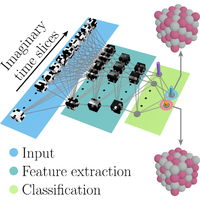
Machine learning has strong potential as a tool for understanding how to classify phases in condensed matter physics. A new investigation shows that an artificial neural network can be trained to identify changes in the collective magnetic properties of electrons on a lattice and predict trends in the transition when some of the electrons are removed.

Polariton Pattern Formation and Photon Statistics of the Associated Emission

C. E. Whittaker, B. Dzurnak, O. A. Egorov, G. Buonaiuto, P. M. Walker, E. Cancellieri, D. M. Whittaker, E. Clarke, S. S. Gavrilov, M. S. Skolnick, and D. N. Krizhanovskii

Phys. Rev. X 7, 031033 (2017) - Published 21 August, 2017

New experiments reveal a diverse family of polygon patterns forming spontaneously in a fluid of polaritons—quasiparticles comprised of photons coupled to electric dipoles. The observations could lead to new insights in pattern formation in nonlinear optical systems as well as in quantum statistics.

High-Resolution Two-Dimensional Optical Spectroscopy of Electron Spins

M. Salewski, S. V. Poltavtsev, I. A. Yugova, G. Karczewski, M. Wiater, T. Wojtowicz, D. R. Yakovlev, I. A. Akimov, T. Meier, and M. Bayer

Phys. Rev. X 7, 031030 (2017) - Published 14 August, 2017

Multidimensional coherent optical spectroscopy is currently one of the most powerful tools for investigating complex quantum-mechanical systems, but resolving energy splitting on megahertz scales remains a challenge. A new investigation shows how two-dimensional Fourier transform spectroscopy can be adapted to evaluate spin splitting of ground-state electrons.

Particle-Hole Symmetry in the Fermion-Chern-Simons and Dirac Descriptions of a Half-Filled Landau Level

Chong Wang, Nigel R. Cooper, Bertrand I. Halperin, and Ady Stern

Phys. Rev. X 7, 031029 (2017) - Published 14 August, 2017

Multiple descriptions of the half-filled Landau level, an exotic phase of matter seen in two-dimensional electron gases, have led to incompatible pictures that are widely believed to represent two distinct phases of matter. A new analysis suggests that this is not the case and that these descriptions are functionally equivalent.

Signatures of Dirac Cones in a DMRG Study of the Kagome Heisenberg Model

Yin-Chen He, Michael P. Zaletel, Masaki Oshikawa, and Frank Pollmann

Phys. Rev. X 7, 031020 (2017) - Published 28 July, 2017

Realizing an exotic phase of matter known as a quantum spin liquid has long eluded condensed-matter physicists. Now strong evidence is found that a particular class of exotic states of matter called a Dirac spin liquid is realized in a popular model of numerous magnets.

Quantum Entanglement Growth under Random Unitary Dynamics

Adam Nahum, Jonathan Ruhman, Sagar Vijay, and Jeongwan Haah

Phys. Rev. X 7, 031016 (2017) - Published 24 July, 2017

Physicists have long sought to understand how quantum dynamics generates the nonlocal correlations known as entanglement. Theoretical models are proposed to explain the growth of entanglement over time in different numbers of spatial dimensions.

Fork Tensor-Product States: Efficient Multiorbital Real-Time DMFT Solver

Daniel Bauernfeind, Manuel Zingl, Robert Triebl, Markus Aichhorn, and Hans Gerd Evertz

Phys. Rev. X 7, 031013 (2017) - Published 20 July, 2017

Theoretically characterizing materials that are strongly correlated has been a long-standing challenge. A new method models the atomic excitations of such materials with high resolution at all energies

Stretchable Persistent Spin Helices in GaAs Quantum Wells

Florian Dettwiler, Jiyong Fu, Shawn Mack, Pirmin J. Weigele, J. Carlos Egues, David D. Awschalom, and Dominik M. Zumbühl

Phys. Rev. X 7, 031010 (2017) - Published 18 July, 2017

Controlling the electron spin could be an effective way to store and manipulate information in quantum devices, but it is challenging because spins randomize over time. A novel technique demonstrates, experimentally, a way to manipulate spin as an electron travels across a chip while being protected from randomization.

Pairing in Luttinger Liquids and Quantum Hall States

Charles L. Kane, Ady Stern, and Bertrand I. Halperin

Phys. Rev. X 7, 031009 (2017) - Published 18 July, 2017

Theories for understanding two-dimensional electronic systems, such as certain exotic states that could be useful for quantum computing, are not as well developed as their one-dimensional counterparts. A new mathematical analysis extends a successful theory for one-dimensional conductors—Luttinger liquid theory—to two dimensions, revealing novel properties of these systems.

Black Hole on a Chip: Proposal for a Physical Realization of the Sachdev-Ye-Kitaev model in a Solid-State System

D. I. Pikulin and M. Franz

Phys. Rev. X 7, 031006 (2017) - Published 13 July, 2017

General relativity and quantum mechanics are at odds in the extreme environments of black holes, but black holes can only be observed from large distances. Scientists propose a solid-state “black hole on a chip” using the interface between a three-dimensional topological insulator and an ordinary superconductor.

Sign In to Your Journals Account

Filter

Subject

Filter

Article Lookup

Enter a citation