Browse by Subject

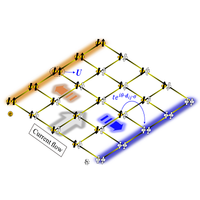
General Theory of Josephson Diodes

Yi Zhang, Yuhao Gu, Pengfei Li, Jiangping Hu, and Kun Jiang

Phys. Rev. X 12, 041013 (2022) - Published 2 November, 2022

Josephson diodes, in which current flows with no resistance in one direction but normally in the other, come in two types based on whether a voltage or a current realizes this unique diode effect.

Wigner Formulation of Thermal Transport in Solids

Michele Simoncelli, Nicola Marzari, and Francesco Mauri

Phys. Rev. X 12, 041011 (2022) - Published 31 October, 2022

A formulation for heat conduction discusses how particle- and wavelike thermal transport mechanisms can emerge and coexist and provides a criterion to assess their relative strength and the crossover where one or the other dominates.

Optically Probing the Asymmetric Interlayer Coupling in Rhombohedral-Stacked MoS2 Bilayer

Jing Liang, Dongyang Yang, Jingda Wu, Jerry I. Dadap, Kenji Watanabe, Takashi Taniguchi, and Ziliang Ye

Phys. Rev. X 12, 041005 (2022) - Published 14 October, 2022

Optical spectroscopy reveals that a unique switchable spontaneous electric polarization in a type of transition-metal dichalcogenide arises from an asymmetric interlayer coupling.

Dynamics of Visons and Thermal Hall Effect in Perturbed Kitaev Models

Aprem P. Joy and Achim Rosch

Phys. Rev. X 12, 041004 (2022) - Published 12 October, 2022

A new theoretical study unravels the dynamic properties of a vison—the elementary excitation of an emergent gauge field—and may help detect them in real materials.

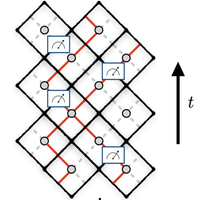
Entanglement and Charge-Sharpening Transitions in U(1) Symmetric Monitored Quantum Circuits

Utkarsh Agrawal, Aidan Zabalo, Kun Chen, Justin H. Wilson, Andrew C. Potter, J. H. Pixley, Sarang Gopalakrishnan, and Romain Vasseur

Phys. Rev. X 12, 041002 (2022) - Published 7 October, 2022

In a model of quantum spins, the identification of phase transitions triggered by differing measurement rates provides new insight into the scrambling of quantum information in systems with symmetry.

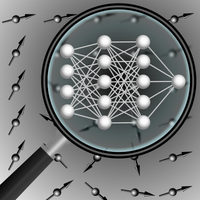
Replacing Neural Networks by Optimal Analytical Predictors for the Detection of Phase Transitions

Julian Arnold and Frank Schäfer

Phys. Rev. X 12, 031044 (2022) - Published 28 September, 2022

A new theory for how neural networks detect phase transitions from data reveals that popular methods rely on detecting changes in probability distributions rather than recognizing prevalent patterns.

Beyond Conventional Ferromagnetism and Antiferromagnetism: A Phase with Nonrelativistic Spin and Crystal Rotation Symmetry

Libor Šmejkal, Jairo Sinova, and Tomas Jungwirth

Phys. Rev. X 12, 031042 (2022) - Published 23 September, 2022

Magnetic phases are traditionally ferromagnetic or antiferromagnetic. An analysis of spin symmetries reveals a third phase, dubbed altermagnetism, that opens new fronts in magnetism and spintronics research.

Emergence of Gapless Quantum Spin Liquid from Deconfined Quantum Critical Point

Wen-Yuan Liu, Juraj Hasik, Shou-Shu Gong, Didier Poilblanc, Wei-Qiang Chen, and Zheng-Cheng Gu

Phys. Rev. X 12, 031039 (2022) - Published 19 September, 2022

An analysis of a common theoretical model of antiferromagnetic interactions reveals the deep relationship between two pillars of condensed-matter physics: quantum spin liquids and deconfined quantum critical points.

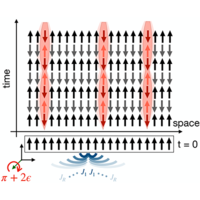
Discrete Time-Crystalline Response Stabilized by Domain-Wall Confinement

Mario Collura, Andrea De Luca, Davide Rossini, and Alessio Lerose

Phys. Rev. X 12, 031037 (2022) - Published 14 September, 2022

A proposal for stabilizing time-crystalline states of matter avoids hard-to-control features required by current experimental methods, introducing a new idea in the effort to stabilize nonequilibrium phases in general.

Controlling Atom-Photon Bound States in an Array of Josephson-Junction Resonators

Marco Scigliuzzo, Giuseppe Calajò, Francesco Ciccarello, Daniel Perez Lozano, Andreas Bengtsson, Pasquale Scarlino, Andreas Wallraff, Darrick Chang, Per Delsing, and Simone Gasparinetti

Phys. Rev. X 12, 031036 (2022) - Published 12 September, 2022

Two superconducting qubits coupled to an array of resonators are dressed by two photonic clouds that mediate their interaction and create two atom-photon bound states, an architecture that could be used for quantum simulation of spin models.

Generation of a Single-Cycle Acoustic Pulse: A Scalable Solution for Transport in Single-Electron Circuits

Junliang Wang, Shunsuke Ota, Hermann Edlbauer, Baptiste Jadot, Pierre-André Mortemousque, Aymeric Richard, Yuma Okazaki, Shuji Nakamura, Arne Ludwig, Andreas D. Wieck, Matias Urdampilleta, Tristan Meunier, Tetsuo Kodera, Nobu-Hisa Kaneko, Shintaro Takada, and Christopher Bäuerle

Phys. Rev. X 12, 031035 (2022) - Published 7 September, 2022

Like a surfer riding a wave, a single electron is transported by an acoustic pulse traveling along the surface of a microchip.

Direct X-Ray Detection of the Spin Hall Effect in CuBi

Sandra Ruiz-Gómez, Rubén Guerrero, Muhammad W. Khaliq, Claudia Fernández-González, Jordi Prat, Andrés Valera, Simone Finizio, Paolo Perna, Julio Camarero, Lucas Pérez, Lucía Aballe, and Michael Foerster

Phys. Rev. X 12, 031032 (2022) - Published 1 September, 2022

X-ray spectromicroscopy provides a direct measurement of the spin accumulation due to the spin Hall effect in the surface of a copper-bismuth alloy electrode.

Probing Transport and Slow Relaxation in the Mass-Imbalanced Fermi-Hubbard Model

N. Darkwah Oppong, G. Pasqualetti, O. Bettermann, P. Zechmann, M. Knap, I. Bloch, and S. Fölling

Phys. Rev. X 12, 031026 (2022) - Published 16 August, 2022

Experiments reveal a particularly slow relaxation timescale when a mixture of heavy and light particles is brought out of equilibrium.

Formation of an Electron-Phonon Bifluid in Bulk Antimony

Alexandre Jaoui, Adrien Gourgout, Gabriel Seyfarth, Alaska Subedi, Thomas Lorenz, Benoît Fauqué, and Kamran Behnia

Phys. Rev. X 12, 031023 (2022) - Published 5 August, 2022

In elemental antimony at cryogenic temperatures, experiments show that electron-electron collisions dominate the degradation of charge and heat flow thanks in part to a tight phonon-electron coupling.

Topological Multipartite Entanglement in a Fermi Liquid

Pok Man Tam, Martin Claassen, and Charles L. Kane

Phys. Rev. X 12, 031022 (2022) - Published 2 August, 2022

Theoretical work establishes a connection for the many-electron quantum states of metals between topology and entanglement, two powerful principles for characterizing complex quantum states.

Skyrmions in Twisted Bilayer Graphene: Stability, Pairing, and Crystallization

Yves H. Kwan, Glenn Wagner, Nick Bultinck, Steven H. Simon, and S. A. Parameswaran

Phys. Rev. X 12, 031020 (2022) - Published 29 July, 2022

When charges are added to correlated insulators in twisted bilayer graphene, spin and pseudospin textures called skyrmions can appear and even pair up to create an exotic superconductor.

Valley Isospin Controlled Fractional Quantum Hall States in Bilayer Graphene

Ke Huang, Hailong Fu, Danielle Reifsnyder Hickey, Nasim Alem, Xi Lin, Kenji Watanabe, Takashi Taniguchi, and Jun Zhu

Phys. Rev. X 12, 031019 (2022) - Published 28 July, 2022

A demonstration of fine control over the valley isospin in bilayer graphene leads to evidence of an unusual type of fractional quantum Hall effect and uncovers properties of its many-body wave function.

Quasi-Two-Dimensional Anomalous Hall Mott Insulator of Topologically Engineered Jeff=1/2 Electrons

Junyi Yang, Hidemaro Suwa, Derek Meyers, Han Zhang, Lukas Horak, Zhaosheng Wang, Gilberto Fabbris, Yongseong Choi, Jenia Karapetrova, Jong-Woo Kim, Daniel Haskel, Philip J. Ryan, M. P. M. Dean, Lin Hao, and Jian Liu

Phys. Rev. X 12, 031015 (2022) - Published 22 July, 2022

An experiment that realizes hallmarks of both weak- and strong-coupling between electrons at the same time offers a novel platform for exploring the rich physics connecting these two limits of quantum materials.

Optimal Purification of a Spin Ensemble by Quantum-Algorithmic Feedback

Daniel M. Jackson, Urs Haeusler, Leon Zaporski, Jonathan H. Bodey, Noah Shofer, Edmund Clarke, Maxime Hugues, Mete Atatüre, Claire Le Gall, and Dorian A. Gangloff

Phys. Rev. X 12, 031014 (2022) - Published 21 July, 2022

A new method for cooling a collection of spins reveals their state to within one spin flip and could be used to create exciting new quantum states.

Anomalous Dimensions of Monopole Operators at the Transitions between Dirac and Topological Spin Liquids

Éric Dupuis, Rufus Boyack, and William Witczak-Krempa

Phys. Rev. X 12, 031012 (2022) - Published 19 July, 2022

A theoretical analysis reveals how monopoles in quantum spin liquids behave at quantum phase transitions and supports a duality that connects unrelated transitions.

Sign In to Your Journals Account

Filter

Subject

Filter

Article Lookup

Enter a citation