Browse by Subject

Many-Body Quantum Chaos: Analytic Connection to Random Matrix Theory

Pavel Kos, Marko Ljubotina, and Tomaž Prosen

Phys. Rev. X 8, 021062 (2018) - Published 8 June, 2018

A new theory explains observed connections between the thermal phase in many-body quantum systems and random matrix theory, paving the way to a deeper understanding of this phase.

Verification of Many-Qubit States

Yuki Takeuchi and Tomoyuki Morimae

Phys. Rev. X 8, 021060 (2018) - Published 7 June, 2018

New protocols for verifying quantum states offer a robust and versatile way to check on the accuracy of quantum computing products in the presence of any type of noise and for a variety of quantum states.

Optimal Control for One-Qubit Quantum Sensing

F. Poggiali, P. Cappellaro, and N. Fabbri

Phys. Rev. X 8, 021059 (2018) - Published 7 June, 2018

A novel approach to quantum sensor control demonstrates experimentally verified improvements in sensitivity over other approaches when tasked to detect and characterize weak, time-varying magnetic fields in a noisy environment.

High-Threshold Fault-Tolerant Quantum Computation with Analog Quantum Error Correction

Kosuke Fukui, Akihisa Tomita, Atsushi Okamoto, and Keisuke Fujii

Phys. Rev. X 8, 021054 (2018) - Published 25 May, 2018

A type of quantum bit known as the Gottesman-Kitaev-Preskill qubit could be a key ingredient for practical, fault-tolerant quantum computers, but it has stringent requirements that are beyond current capabilities. New calculations propose a way to reduce these requirements to be achievable in near-term setups.

Displacemon Electromechanics: How to Detect Quantum Interference in a Nanomechanical Resonator

K. E. Khosla, M. R. Vanner, N. Ares, and E. A. Laird

Phys. Rev. X 8, 021052 (2018) - Published 24 May, 2018

A proposed device could detect quantum interference patterns in objects containing roughly one million atoms, increasing by nearly 3 orders of magnitude the size of objects for which researchers could observe quantum superpositions.

Disjointness of Stabilizer Codes and Limitations on Fault-Tolerant Logical Gates

Tomas Jochym-O’Connor, Aleksander Kubica, and Theodore J. Yoder

Phys. Rev. X 8, 021047 (2018) - Published 21 May, 2018

A new analysis quantifies computational limitations on stabilizer codes (codes that correct errors in quantum information) for practical operations and provides insight into how to design stabilizer codes for useful and interesting applications.

Thermalization near Integrability in a Dipolar Quantum Newton’s Cradle

Yijun Tang, Wil Kao, Kuan-Yu Li, Sangwon Seo, Krishnanand Mallayya, Marcos Rigol, Sarang Gopalakrishnan, and Benjamin L. Lev

Phys. Rev. X 8, 021030 (2018) - Published 2 May, 2018

Experiments involving a magnetic quantum Newton’s cradle provide insights into how interacting quantum particles achieve thermal equilibrium.

Quantum Simulation of the Quantum Rabi Model in a Trapped Ion

Dingshun Lv, Shuoming An, Zhenyu Liu, Jing-Ning Zhang, Julen S. Pedernales, Lucas Lamata, Enrique Solano, and Kihwan Kim

Phys. Rev. X 8, 021027 (2018) - Published 30 April, 2018

A quantum simulation of the quantum Rabi model (a simple, fundamental model of light-matter interactions) in a single trapped ion enables a detailed exploration of the model, including phenomena not previously accessible to experiments.

Does a Single Eigenstate Encode the Full Hamiltonian?

James R. Garrison and Tarun Grover

Phys. Rev. X 8, 021026 (2018) - Published 30 April, 2018

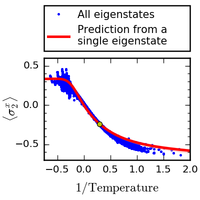
New calculations show that a single stationary state of an isolated quantum system encodes physical properties of the entire system at all temperatures, which provides new, fundamental insight into the quantum nature of thermalization.

At the Limits of Criticality-Based Quantum Metrology: Apparent Super-Heisenberg Scaling Revisited

Marek M. Rams, Piotr Sierant, Omyoti Dutta, Paweł Horodecki, and Jakub Zakrzewski

Phys. Rev. X 8, 021022 (2018) - Published 19 April, 2018

Contrary to claims that a fundamental limit of precision in quantum metrology can be broken in certain circumstances, a new analysis shows that this is not the case once one takes into account the time needed to perform the needed operations.

A Rapidly Expanding Bose-Einstein Condensate: An Expanding Universe in the Lab

S. Eckel, A. Kumar, T. Jacobson, I. B. Spielman, and G. K. Campbell

Phys. Rev. X 8, 021021 (2018) - Published 19 April, 2018

The rapid expansion of a Bose-Einstein condensate can mimic the expansion of the Universe.

Classical Causal Models for Bell and Kochen-Specker Inequality Violations Require Fine-Tuning

Eric G. Cavalcanti

Phys. Rev. X 8, 021018 (2018) - Published 13 April, 2018

A new analysis puts quantum nonlocality and contextuality—key resources for quantum computing—on equal theoretical footing as violations of classical causality.

Quantum Optical Realization of Arbitrary Linear Transformations Allowing for Loss and Gain

N. Tischler, C. Rockstuhl, and K. Słowik

Phys. Rev. X 8, 021017 (2018) - Published 13 April, 2018

New theoretical work shows how to implement nonunitary transformations on photons using simple optical building blocks, a key element for sophisticated quantum information networks and novel optical technologies.

Operator Spreading in Random Unitary Circuits

Adam Nahum, Sagar Vijay, and Jeongwan Haah

Phys. Rev. X 8, 021014 (2018) - Published 11 April, 2018

A new analysis obtains hydrodynamic descriptions for the spreading of quantum information through many body-systems and for the “quantum butterfly effect.”

Observation of Entangled States of a Fully Controlled 20-Qubit System

Nicolai Friis, Oliver Marty, Christine Maier, Cornelius Hempel, Milan Holzäpfel, Petar Jurcevic, Martin B. Plenio, Marcus Huber, Christian Roos, Rainer Blatt, and Ben Lanyon

Phys. Rev. X 8, 021012 (2018) - Published 10 April, 2018

Two new methods for detecting quantum entanglement—a critical ingredient for useful quantum technologies—successfully do so in a system of 20 qubits, the largest fully controllable entangled system to date.

Architectures for Quantum Simulation Showing a Quantum Speedup

Juan Bermejo-Vega, Dominik Hangleiter, Martin Schwarz, Robert Raussendorf, and Jens Eisert

Phys. Rev. X 8, 021010 (2018) - Published 9 April, 2018

A proposed architecture for quantum simulators offers a way to verifiably demonstrate the speedup of quantum computing protocols compared to classical devices using present experimental setups.

Coherent Oscillations inside a Quantum Manifold Stabilized by Dissipation

S. Touzard, A. Grimm, Z. Leghtas, S. O. Mundhada, P. Reinhold, C. Axline, M. Reagor, K. Chou, J. Blumoff, K. M. Sliwa, S. Shankar, L. Frunzio, R. J. Schoelkopf, M. Mirrahimi, and M. H. Devoret

Phys. Rev. X 8, 021005 (2018) - Published 4 April, 2018

New experiments present experimental evidence for the dynamical quantum Zeno effect, in which a stabilizing friction leads to a continuous phase change among degenerate states in a quantum superposition.

Single-Shot Quantum Nondemolition Detection of Individual Itinerant Microwave Photons

Jean-Claude Besse, Simone Gasparinetti, Michele C. Collodo, Theo Walter, Philipp Kurpiers, Marek Pechal, Christopher Eichler, and Andreas Wallraff

Phys. Rev. X 8, 021003 (2018) - Published 3 April, 2018

A new approach to detecting single microwave photons offers nondestructive detection and a high detection fidelity, paving the way to novel applications in remote entanglement and quantum computation.

Sequential Modular Position and Momentum Measurements of a Trapped Ion Mechanical Oscillator

C. Flühmann, V. Negnevitsky, M. Marinelli, and J. P. Home

Phys. Rev. X 8, 021001 (2018) - Published 2 April, 2018

Simultaneous knowledge of position and momentum is traditionally forbidden in quantum mechanics. New experiments demonstrate a way around this in a quantum oscillator, a key requirement for certain proposals for quantum computing.

Band and Correlated Insulators of Cold Fermions in a Mesoscopic Lattice

Martin Lebrat, Pjotrs Grišins, Dominik Husmann, Samuel Häusler, Laura Corman, Thierry Giamarchi, Jean-Philippe Brantut, and Tilman Esslinger

Phys. Rev. X 8, 011053 (2018) - Published 29 March, 2018

Experiments and simulations demonstrate local control over quantum-coherent transport by creating an insulating phase of ultracold atoms in a one-dimensional quantum wire, providing a novel test bed for nonequilibrium many-body physics.

Sign In to Your Journals Account

Filter

Filter

Article Lookup

Enter a citation