Recent Articles

Polariton Laser in the Bardeen-Cooper-Schrieffer Regime

Jiaqi Hu, Zhaorong Wang, Seonghoon Kim, Hui Deng, Sebastian Brodbeck, Christian Schneider, Sven Höfling, Nai H. Kwong, and Rolf Binder

Phys. Rev. X 11, 011018 (2021) - Published 28 January, 2021

Experiments show signatures of a long-sought-after condensed quantum phase—the so-called Bardeen-Cooper-Schrieffer state—in a semiconductor microcavity, laying the foundation for future efficient semiconductor lasers.

Erratum: Depolarization of Electronic Spin Qubits Confined in Semiconductor Quantum Dots [Phys. Rev. X 8, 041050 (2018)]

Dan Cogan, Oded Kenneth, Netanel H. Lindner, Giora Peniakov, Caspar Hopfmann, Dan Dalacu, Philip J. Poole, Pawel Hawrylak, and David Gershoni

Phys. Rev. X 11, 019901 (2021) - Published 27 January, 2021

Evidence for Dominant Phonon-Electron Scattering in Weyl Semimetal WP2

Gavin B. Osterhoudt, Yaxian Wang, Christina A. C. Garcia, Vincent M. Plisson, Johannes Gooth, Claudia Felser, Prineha Narang, and Kenneth S. Burch

Phys. Rev. X 11, 011017 (2021) - Published 27 January, 2021

Unusual interactions occur between phonons and electrons in the topological semimetal tungsten diphosphide, a finding that could explain some of the material’s strange properties.

Acoustic Realization of a Four-Dimensional Higher-Order Chern Insulator and Boundary-Modes Engineering

Ze-Guo Chen, Weiwei Zhu, Yang Tan, Licheng Wang, and Guancong Ma

Phys. Rev. X 11, 011016 (2021) - Published 26 January, 2021

A new type of 4D higher-order topological system demonstrated in an acoustic crystal offers a powerful and novel approach to wave-steering applications.

Quantum Electrodynamics in a Topological Waveguide

Eunjong Kim, Xueyue Zhang, Vinicius S. Ferreira, Jash Banker, Joseph K. Iverson, Alp Sipahigil, Miguel Bello, Alejandro González-Tudela, Mohammad Mirhosseini, and Oskar Painter

Phys. Rev. X 11, 011015 (2021) - Published 25 January, 2021

A metamaterial waveguide with embedded qubits offers a new platform for probing and controlling topological phenomena.

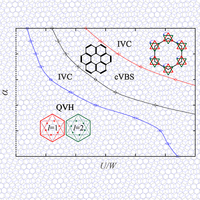
Correlation-Induced Insulating Topological Phases at Charge Neutrality in Twisted Bilayer Graphene

Yuan Da Liao, Jian Kang, Clara N. Breiø, Xiao Yan Xu, Han-Qing Wu, Brian M. Andersen, Rafael M. Fernandes, and Zi Yang Meng

Phys. Rev. X 11, 011014 (2021) - Published 22 January, 2021

Quantum Monte Carlo simulations of so-called “magic angle” twisted bilayer graphene reveal three novel insulating phases that may help elucidate the origin of unusual electronic behaviors in this material.

Heart of Entanglement: Chiral, Nematic, and Incommensurate Phases in the Kitaev-Gamma Ladder in a Field

Erik S. Sørensen, Andrei Catuneanu, Jacob S. Gordon, and Hae-Young Kee

Phys. Rev. X 11, 011013 (2021) - Published 21 January, 2021

A novel analysis of a leading model of quantum spin liquids reveals an incredibly rich phase diagram with 15 distinct phases, a finding that will guide searches for spin liquids in 2D honeycomb materials.

Emergence of Polarized Ideological Opinions in Multidimensional Topic Spaces

Fabian Baumann, Philipp Lorenz-Spreen, Igor M. Sokolov, and Michele Starnini

Phys. Rev. X 11, 011012 (2021) - Published 20 January, 2021

By embedding opinions in a nonorthogonal topic space, a new model shows that a reinforcement mechanism driven by homophilic social interactions reproduces extreme and correlated opinion states found in surveys.

Glassy Dynamics in a Disordered Heisenberg Quantum Spin System

A. Signoles, T. Franz, R. Ferracini Alves, M. Gärttner, S. Whitlock, G. Zürn, and M. Weidemüller

Phys. Rev. X 11, 011011 (2021) - Published 19 January, 2021

Experiments reveal relaxation behavior in an isolated quantum system similar to that observed in classical glasses, hinting at an overarching framework for slow relaxation dynamics.

Universal Fast-Flux Control of a Coherent, Low-Frequency Qubit

Helin Zhang, Srivatsan Chakram, Tanay Roy, Nathan Earnest, Yao Lu, Ziwen Huang, D. K. Weiss, Jens Koch, and David I. Schuster

Phys. Rev. X 11, 011010 (2021) - Published 15 January, 2021

A set of protocols for initializing, controlling, and reading out a qubit design known as “heavy fluxonium,” operated in a previously unexplored regime, provides excellent coherence times and fast high-fidelity gates.

Fingerprints of High-Dimensional Coexistence in Complex Ecosystems

Matthieu Barbier, Claire de Mazancourt, Michel Loreau, and Guy Bunin

Phys. Rev. X 11, 011009 (2021) - Published 14 January, 2021

If many mechanisms ensure coexistence of species in an ecosystem, characteristic statistical patterns in interactions between species’ populations should arise, allowing for tests of theories about biodiversity persistence.

Continuous Protection of a Collective State from Inhomogeneous Dephasing

R. Finkelstein, O. Lahad, I. Cohen, O. Davidson, S. Kiriati, E. Poem, and O. Firstenberg

Phys. Rev. X 11, 011008 (2021) - Published 13 January, 2021

A new technique for continuously mitigating decoherence among the various parts of a quantum system offers a novel low-noise approach to maintaining qubit stability.

Evolution of Charge and Pair Density Modulations in Overdoped Bi2Sr2CuO6+δ

Xintong Li, Changwei Zou, Ying Ding, Hongtao Yan, Shusen Ye, Haiwei Li, Zhenqi Hao, Lin Zhao, Xingjiang Zhou, and Yayu Wang

Phys. Rev. X 11, 011007 (2021) - Published 12 January, 2021

Checkerboard charge patterns in a cuprate give way to glassy “charge puddles” as doping density increases, a finding that may help connect the emergence of charge orders with high-temperature superconductivity of these materials.

Electronically Driven 1D Cooperative Diffusion in a Simple Cubic Crystal

Yong Wang, Junjie Wang, Andreas Hermann, Cong Liu, Hao Gao, Erio Tosatti, Hui-Tian Wang, Dingyu Xing, and Jian Sun

Phys. Rev. X 11, 011006 (2021) - Published 11 January, 2021

Simulations show that thanks to a clear electronic mechanism, even the simplest crystal structure—the simple cubic phase of calcium—exhibits “chain melting,” in which 1D chains of atoms within a solid begin to move in concert as temperature increases.

Superluminal Motion-Assisted Four-Dimensional Light-in-Flight Imaging

Kazuhiro Morimoto, Ming-Lo Wu, Andrei Ardelean, and Edoardo Charbon

Phys. Rev. X 11, 011005 (2021) - Published 8 January, 2021

Using a megapixel high-speed camera, researchers reconstructed the trajectory of a laser pulse in time and 3D space.

Stochasticity Triggers Activation of the S-phase Checkpoint Pathway in Budding Yeast

Peijie Zhou, Xin Gao, Xiaoli Li, Linxi Li, Caoyuan Niu, Qi Ouyang, Huiqiang Lou, Tiejun Li, and Fangting Li

Phys. Rev. X 11, 011004 (2021) - Published 7 January, 2021

Experiments on single cells of different budding yeast mutation strains reveal details about activation of a key genetic regulation mechanism, underlining the important role of noise in cell signaling pathways.

Odd-Even Layer-Number Effect and Layer-Dependent Magnetic Phase Diagrams in MnBi2Te4

Shiqi Yang, Xiaolong Xu, Yaozheng Zhu, Ruirui Niu, Chunqiang Xu, Yuxuan Peng, Xing Cheng, Xionghui Jia, Yuan Huang, Xiaofeng Xu, Jianming Lu, and Yu Ye

Phys. Rev. X 11, 011003 (2021) - Published 6 January, 2021

Experiments reveal a host of unusual magnetic behaviors in the recently discovered layered magnetic topological insulator MnBi2Te4, paving the way for further study of its quantum properties.

Selective Orbital Imaging of Excited States with X-Ray Spectroscopy: The Example of α-MnS

A. Amorese, B. Leedahl, M. Sundermann, H. Gretarsson, Z. Hu, H.-J. Lin, C. T. Chen, M. Schmidt, H. Borrmann, Yu. Grin, A. Severing, M. W. Haverkort, and L. H. Tjeng

Phys. Rev. X 11, 011002 (2021) - Published 5 January, 2021

A novel experimental method provides direct images of excited states in a transition-metal compound without the need for complex calculations, a major step in understanding the rich physics of these materials.

Chiral Photocurrent in Parity-Violating Magnet and Enhanced Response in Topological Antiferromagnet

Hikaru Watanabe and Youichi Yanase

Phys. Rev. X 11, 011001 (2021) - Published 4 January, 2021

A new classification of photocurrent responses in light of symmetry violations in the presence of magnetic order unveils two new types of photocurrent that can be readily tuned and enhanced by topological electronic structure in solids.

Interaction of Ultraintense Radially-Polarized Laser Pulses with Plasma Mirrors

N. Zaïm, D. Guénot, L. Chopineau, A. Denoeud, O. Lundh, H. Vincenti, F. Quéré, and J. Faure

Phys. Rev. X 10, 041064 (2020) - Published 31 December, 2020

Spatially shaping a femtosecond laser to produce radially polarized pulses produces an electric field that pushes electrons in vacuum to relativistic speeds in the direction of laser propagation.

Sign In to Your Journals Account

Filter

Recent Issues

Vol. 16, Iss. 4
October - December 2026
Vol. 16, Iss. 3
July - September 2026
Vol. 16, Iss. 2
April - June 2026
Vol. 16, Iss. 1
January - March 2026
Category
Article Type

Filter

Article Lookup

Enter a citation