Recent Articles

Consistent Quantization of Nearly Singular Superconducting Circuits

Martin Rymarz and David P. DiVincenzo

Phys. Rev. X 13, 021017 (2023) - Published 1 May, 2023

An analysis of a common approach to describing singular superconducting circuits quantum mechanically shows that it can lead to wrong predictions of the system’s dynamics.

Observation of Spin-Wave Moiré Edge and Cavity Modes in Twisted Magnetic Lattices

Hanchen Wang, Marco Madami, Jilei Chen, Hao Jia, Yu Zhang, Rundong Yuan, Yizhan Wang, Wenqing He, Lutong Sheng, Yuelin Zhang, Jinlong Wang, Song Liu, Ka Shen, Guoqiang Yu, Xiufeng Han, Dapeng Yu, Jean-Philippe Ansermet, Gianluca Gubbiotti, and Haiming Yu

Phys. Rev. X 13, 021016 (2023) - Published 28 April, 2023

The first experimental demonstration of magnons, or spin waves, in a nanostructured moiré lattice sets the stage for exploring the potential role of such systems in novel magnonic devices for information processing.

Multiscale Space-Time Ansatz for Correlation Functions of Quantum Systems Based on Quantics Tensor Trains

Hiroshi Shinaoka, Markus Wallerberger, Yuta Murakami, Kosuke Nogaki, Rihito Sakurai, Philipp Werner, and Anna Kauch

Phys. Rev. X 13, 021015 (2023) - Published 27 April, 2023

A new way of encoding multipoint correlation functions—key to representing complex correlations among particles—greatly reduces their computation time and storage requirements.

Kinetic Turbulence in Collisionless High-β Plasmas

Lev Arzamasskiy, Matthew W. Kunz, Jonathan Squire, Eliot Quataert, and Alexander A. Schekochihin

Phys. Rev. X 13, 021014 (2023) - Published 26 April, 2023

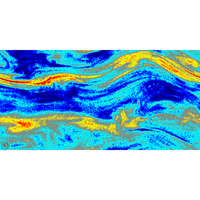
New computer simulations show that wave-particle interactions endow thin plasmas with an effective viscosity that regulates their turbulent motions and heating.

Emergent s-Wave Interactions between Identical Fermions in Quasi-One-Dimensional Geometries

Kenneth G. Jackson, Colin J. Dale, Jeff Maki, Kevin G. S. Xie, Ben A. Olsen, Denise J. M. Ahmed-Braun, Shizhong Zhang, and Joseph H. Thywissen

Phys. Rev. X 13, 021013 (2023) - Published 25 April, 2023

The wave function of fermions always acquires a minus sign when particles trade places. But an experiment shows that fermions confined to a quasi-one-dimensional space seem to circumvent this exchange symmetry.

Symmetries as the Guiding Principle for Flattening Bands of Dirac Fermions

Yarden Sheffer, Raquel Queiroz, and Ady Stern

Phys. Rev. X 13, 021012 (2023) - Published 24 April, 2023

A new criterion for determining what materials can be fine-tuned to have very slowly moving electrons could lead to new platforms for studying novel phenomena arising from electron correlation.

Erratum: Hierarchy of Linear Light Cones with Long-Range Interactions [Phys. Rev. X 10, 031009 (2020)]

Minh C. Tran, Chi-Fang Chen, Adam Ehrenberg, Andrew Y. Guo, Abhinav Deshpande, Yifan Hong, Zhe-Xuan Gong, Alexey V. Gorshkov, and Andrew Lucas

Phys. Rev. X 13, 029901 (2023) - Published 21 April, 2023

Limits and Performances of Algorithms Based on Simulated Annealing in Solving Sparse Hard Inference Problems

Maria Chiara Angelini and Federico Ricci-Tersenghi

Phys. Rev. X 13, 021011 (2023) - Published 20 April, 2023

A new theory, supported by large-scale numerical simulations, explores the conditions under which two Monte Carlo–based optimization algorithms can extract a signal from noisy data.

Single-Molecule Structure and Topology of Kinetoplast DNA Networks

Pinyao He, Allard J. Katan, Luca Tubiana, Cees Dekker, and Davide Michieletto

Phys. Rev. X 13, 021010 (2023) - Published 19 April, 2023

This high-resolution imaging study investigates a unique interlinked DNA found in certain single-cell parasites and reveals the genome’s unusual structure and topology at single-molecule resolution.

Uncovering Conformal Symmetry in the 3D Ising Transition: State-Operator Correspondence from a Quantum Fuzzy Sphere Regularization

Wei Zhu, Chao Han, Emilie Huffman, Johannes S. Hofmann, and Yin-Chen He

Phys. Rev. X 13, 021009 (2023) - Published 18 April, 2023

A new theoretical scheme of studying the 3D Ising transition—a celebrated phase transition in a model of ferromagnetism—provides insights into the conformal symmetry long conjectured to emerge.

Superconducting Fluctuations Observed Far above Tc in the Isotropic Superconductor K3C60

Gregor Jotzu, Guido Meier, Alice Cantaluppi, Andrea Cavalleri, Daniele Pontiroli, Mauro Riccò, Arzhang Ardavan, and Moon-Sun Nam

Phys. Rev. X 13, 021008 (2023) - Published 17 April, 2023

Precursors of superconductivity well above the critical temperature in K3C60 imply the presence of Cooper pairs at high temperature, which may help explain why light can raise the critical temperature of this material.

Entanglement Phase Transition Induced by the Non-Hermitian Skin Effect

Kohei Kawabata, Tokiro Numasawa, and Shinsei Ryu

Phys. Rev. X 13, 021007 (2023) - Published 12 April, 2023

In open quantum systems, a macroscopic flow of particles and concomitant anomalous localization play an important role in the entanglement dynamics.

Weight versus Node Perturbation Learning in Temporally Extended Tasks: Weight Perturbation Often Performs Similarly or Better

Paul Züge, Christian Klos, and Raoul-Martin Memmesheimer

Phys. Rev. X 13, 021006 (2023) - Published 11 April, 2023

In neural networks, a reward-based rule that relies on perturbing network weights can perform as well as or better than the more commonly studied node perturbation approach.

Demon in the Machine: Learning to Extract Work and Absorb Entropy from Fluctuating Nanosystems

Stephen Whitelam

Phys. Rev. X 13, 021005 (2023) - Published 10 April, 2023

A deep neural network learns feedback-control protocols that convert information obtained from measuring a fluctuating nanosystem into heat or work.

Protecting the Quantum Interference of Cat States by Phase-Space Compression

Xiaozhou Pan, Jonathan Schwinger, Ni-Ni Huang, Pengtao Song, Weipin Chua, Fumiya Hanamura, Atharv Joshi, Fernando Valadares, Radim Filip, and Yvonne Y. Gao

Phys. Rev. X 13, 021004 (2023) - Published 7 April, 2023

Compressing the spectral content of quantum interference features in Schrödinger cat states to lower frequencies protects them against photon loss and preserves the most valuable characteristics that enable many quantum technologies.

Disentangling Representations in Restricted Boltzmann Machines without Adversaries

Jorge Fernandez-de-Cossio-Diaz, Simona Cocco, and Rémi Monasson

Phys. Rev. X 13, 021003 (2023) - Published 5 April, 2023

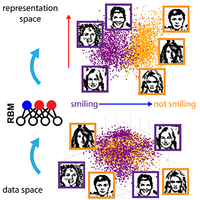
A new way for machine learning to disentangle representations of complex data relies on a single, simple model rather than adversarial training of two competing neural networks.

Quantitatively Visualizing Bipartite Datasets

Tal Einav, Yuehaw Khoo, and Amit Singer

Phys. Rev. X 13, 021002 (2023) - Published 4 April, 2023

A new tool transforms pairwise interactions within a dataset into a cohesive global picture that predicts how the system can behave.

Nonlocal Temporal Interferometry for Highly Resilient Free-Space Quantum Communication

Lukas Bulla, Matej Pivoluska, Kristian Hjorth, Oskar Kohout, Jan Lang, Sebastian Ecker, Sebastian P. Neumann, Julius Bittermann, Robert Kindler, Marcus Huber, Martin Bohmann, and Rupert Ursin

Phys. Rev. X 13, 021001 (2023) - Published 3 April, 2023

High-dimensional entanglement among photons allows for a roughly 10-km free-space quantum communication link in an urban environment that is robust to noise.

Laboratory Constraints on the Neutron-Spin Coupling of feV-Scale Axions

Junyi Lee, Mariangela Lisanti, William A. Terrano, and Michael Romalis

Phys. Rev. X 13, 011050 (2023) - Published 31 March, 2023

A new analysis methodology of K-3He comagnetometer data provides vastly improved constraints on axion neutron-spin coupling, shrinking the parameter search space for this proposed constituent of dark matter.

Measuring Arbitrary Physical Properties in Analog Quantum Simulation

Minh C. Tran, Daniel K. Mark, Wen Wei Ho, and Soonwon Choi

Phys. Rev. X 13, 011049 (2023) - Published 30 March, 2023

A new protocol for measuring the state of a quantum simulator allows for the extraction of arbitrary physical information by relying on ancillary degrees of freedom and the natural randomness of quantum dynamics.

Sign In to Your Journals Account

Filter

Recent Issues

Vol. 16, Iss. 4
October - December 2026
Vol. 16, Iss. 3
July - September 2026
Vol. 16, Iss. 2
April - June 2026
Vol. 16, Iss. 1
January - March 2026
Category
Article Type

Filter

Article Lookup

Enter a citation