Recent Articles

Demonstrating Scalable Randomized Benchmarking of Universal Gate Sets

Jordan Hines, Marie Lu, Ravi K. Naik, Akel Hashim, Jean-Loup Ville, Brad Mitchell, John Mark Kriekebaum, David I. Santiago, Stefan Seritan, Erik Nielsen, Robin Blume-Kohout, Kevin Young, Irfan Siddiqi, Birgitta Whaley, and Timothy Proctor

Phys. Rev. X 13, 041030 (2023) - Published 14 November, 2023

A new approach to benchmarking large-scale quantum devices overcomes existing hurdles, scales to thousands of qubit, and can test a variety of universal gate sets.

Crumpled Polymer with Loops Recapitulates Key Features of Chromosome Organization

Kirill E. Polovnikov, Hugo B. Brandão, Sergey Belan, Bogdan Slavov, Maxim Imakaev, and Leonid A. Mirny

Phys. Rev. X 13, 041029 (2023) - Published 13 November, 2023

A new model of a polymer folded into loops shows how such loops leave a distinct signature in experimental data and change chromosome topology, aiding understanding of how chromosomes fold themselves into the small volume of a cell nucleus.

Majorana Loop Models for Measurement-Only Quantum Circuits

Kai Klocke and Michael Buchhold

Phys. Rev. X 13, 041028 (2023) - Published 9 November, 2023

A connection between a subclass of quantum circuits and existing frameworks of statistical mechanics allows one to extract genuine quantum-mechanical properties from the boundary of a classical model.

Emergence of Classical Magnetic Order from Anderson Towers: Quantum Darwinism in Action

O. M. Sotnikov, E. A. Stepanov, M. I. Katsnelson, F. Mila, and V. V. Mazurenko

Phys. Rev. X 13, 041027 (2023) - Published 8 November, 2023

In certain magnetic systems, one superposition of quantum eigenstates leads to a particular classical order, demonstrating that quantum-classical connections can be made via not only observables but also quantum states.

Interaction-Driven Topological Phase Diagram of Twisted Bilayer MoTe2

Wen-Xuan Qiu, Bohao Li, Xun-Jiang Luo, and Fengcheng Wu

Phys. Rev. X 13, 041026 (2023) - Published 7 November, 2023

A theoretical analysis of twisted bilayer MoTe2, a model system for exploring the interplay between electron interactions and band topology, predicts cascading quantum phase transitions tuned by the twist angle between the layers.

Simultaneous Enantiomer-Resolved Ramsey Spectroscopy Scheme for Chiral Molecules

Itay Erez, Eliana Ruth Wallach, and Yuval Shagam

Phys. Rev. X 13, 041025 (2023) - Published 6 November, 2023

A proposed technique to test for slight differences in symmetry between the mirror-image arrangements of chiral molecules opens the door to probe for tiny parity violations.

Loss Compensation and Superresolution in Metamaterials with Excitations at Complex Frequencies

Seunghwi Kim, Yu-Gui Peng, Simon Yves, and Andrea Alù

Phys. Rev. X 13, 041024 (2023) - Published 3 November, 2023

Illuminating a high-resolution lens with waves whose intensity diminishes over time can improve the image quality.

Quantum Many-Body Jarzynski Equality and Dissipative Noise on a Digital Quantum Computer

Dominik Hahn, Maxime Dupont, Markus Schmitt, David J. Luitz, and Marin Bukov

Phys. Rev. X 13, 041023 (2023) - Published 2 November, 2023

The Jarzynski equality is a fundamental law connecting equilibrium processes with nonequilibrium fluctuations. Experiments, for the first time, test it in the quantum many-body regime.

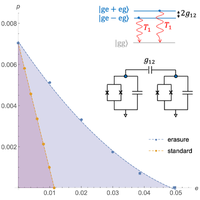
Erasure Qubits: Overcoming the T1 Limit in Superconducting Circuits

Aleksander Kubica, Arbel Haim, Yotam Vaknin, Harry Levine, Fernando Brandão, and Alex Retzker

Phys. Rev. X 13, 041022 (2023) - Published 1 November, 2023

A simple scheme to convert amplitude-damping noise in superconducting circuits to easier-to-correct heralded erasure noise overcomes conventional limits on quantum information fidelity.

Broadband Quantum Enhancement of the LIGO Detectors with Frequency-Dependent Squeezing

D. Ganapathy et al. (LIGO O4 Detector Collaboration)

Phys. Rev. X 13, 041021 (2023) - Published 30 October, 2023

The LIGO experiment has demonstrated a noise-squeezing technique for its entire frequency-detection range—a feat that could boost the detection rate of black hole mergers by up to 65%.

Tackling Sampling Noise in Physical Systems for Machine Learning Applications: Fundamental Limits and Eigentasks

Fangjun Hu, Gerasimos Angelatos, Saeed A. Khan, Marti Vives, Esin Türeci, Leon Bello, Graham E. Rowlands, Guilhem J. Ribeill, and Hakan E. Türeci

Phys. Rev. X 13, 041020 (2023) - Published 30 October, 2023

A framework to quantify the computational capacity of arbitrary physical systems in the presence of sampling noise provides a tool for best harnessing them for machine learning.

Fate of Time-Reversal Symmetry Breaking in UTe2

M. O. Ajeesh, M. Bordelon, C. Girod, S. Mishra, F. Ronning, E. D. Bauer, B. Maiorov, J. D. Thompson, P. F. S. Rosa, and S. M. Thomas

Phys. Rev. X 13, 041019 (2023) - Published 27 October, 2023

Experiments on very clean crystals of the actinide superconductor UTe2 find no evidence of spontaneous time-reversal symmetry breaking that has been suggested in previous studies.

Bootstrapped Dimensional Crossover of a Spin Density Wave

Anjana M. Samarakoon, J. Strempfer, Junjie Zhang, Feng Ye, Yiming Qiu, J.-W. Kim, H. Zheng, S. Rosenkranz, M. R. Norman, J. F. Mitchell, and D. Phelan

Phys. Rev. X 13, 041018 (2023) - Published 27 October, 2023

In a layered transition-metal oxide, 3D magnetic order emerges as two 2D magnetic sheets intertwine and irreversibly imprint a new metastable sublattice magnetization.

Path Weight Sampling: Exact Monte Carlo Computation of the Mutual Information between Stochastic Trajectories

Manuel Reinhardt, Gašper Tkačik, and Pieter Rein ten Wolde

Phys. Rev. X 13, 041017 (2023) - Published 26 October, 2023

The information transmission rate of a system can usually be calculated only approximately. A new Monte Carlo simulation scheme makes it possible, for the first time, to do so exactly for a large class of systems.

Observation of a Prethermal U(1) Discrete Time Crystal

Andrew Stasiuk and Paola Cappellaro

Phys. Rev. X 13, 041016 (2023) - Published 26 October, 2023

Observation of a time crystal—a periodically driven state that breaks time-translation symmetry—at room temperature bolsters the case for using the state as a near-term robust quantum memory.

Hotter is Easier: Unexpected Temperature Dependence of Spin Qubit Frequencies

Brennan Undseth, Oriol Pietx-Casas, Eline Raymenants, Mohammad Mehmandoost, Mateusz T. Mądzik, Stephan G. J. Philips, Sander L. de Snoo, David J. Michalak, Sergey V. Amitonov, Larysa Tryputen, Brian Paquelet Wuetz, Viviana Fezzi, Davide Degli Esposti, Amir Sammak, Giordano Scappucci, and Lieven M. K. Vandersypen

Phys. Rev. X 13, 041015 (2023) - Published 25 October, 2023

Control signals can shift the frequency of spin-based qubits. New experiments show that this effect corresponds to a temperature increase and can be counterintuitively suppressed by operating at a higher temperature than normal.

How Criticality Meets Bifurcation in Compressive Failure of Disordered Solids

Ashwij Mayya, Estelle Berthier, and Laurent Ponson

Phys. Rev. X 13, 041014 (2023) - Published 25 October, 2023

Compression experiments of 2D cellular materials shed light on a long-standing debate on the nature of compressive failure and show how precursors to failure can be harnessed for assessing the mechanical health of a material.

High-Threshold Codes for Neutral-Atom Qubits with Biased Erasure Errors

Kaavya Sahay, Junlan Jin, Jahan Claes, Jeff D. Thompson, and Shruti Puri

Phys. Rev. X 13, 041013 (2023) - Published 24 October, 2023

A new model of qubit noise that is motivated by neutral atom qubits leads to much higher rates of error correction in tailored error-correcting codes.

Fabry-Pérot Interferometry at the ν=2/5 Fractional Quantum Hall State

J. Nakamura, S. Liang, G. C. Gardner, and M. J. Manfra

Phys. Rev. X 13, 041012 (2023) - Published 23 October, 2023

Fabry-Perot interferometry can observe anyon behavior at complex fractional states—a key requirement for analyzing non-abelian states that are sought after for intrinsically fault-tolerant qubits.

Simple Reaction-Diffusion Modeling Predicts Inconspicuous Neighborhood-Dependent Color Subclustering of Lizard Scales

Szabolcs Zakany and Michel C. Milinkovitch

Phys. Rev. X 13, 041011 (2023) - Published 20 October, 2023

Researchers have predicted—and confirmed—a secondary pattern on the ocellated lizard’s scales that is too subtle for our eyes to see.

Sign In to Your Journals Account

Filter

Recent Issues

Vol. 16, Iss. 4
October - December 2026
Vol. 16, Iss. 3
July - September 2026
Vol. 16, Iss. 2
April - June 2026
Vol. 16, Iss. 1
January - March 2026
Category
Article Type

Filter

Article Lookup

Enter a citation