Recent Articles

Thermalization near Integrability in a Dipolar Quantum Newton’s Cradle

Yijun Tang, Wil Kao, Kuan-Yu Li, Sangwon Seo, Krishnanand Mallayya, Marcos Rigol, Sarang Gopalakrishnan, and Benjamin L. Lev

Phys. Rev. X 8, 021030 (2018) - Published 2 May, 2018

Experiments involving a magnetic quantum Newton’s cradle provide insights into how interacting quantum particles achieve thermal equilibrium.

Two-Stage Dynamics of In Vivo Bacteriophage Genome Ejection

Yi-Ju Chen, David Wu, William Gelbart, Charles M. Knobler, Rob Phillips, and Willem K. Kegel

Phys. Rev. X 8, 021029 (2018) - Published 1 May, 2018

Analysis of the dynamics of a virus injecting its host with DNA reveals new insight into the underlying physical mechanisms responsible for viral infection in bacteria.

Optical Trapping of Ion Coulomb Crystals

Julian Schmidt, Alexander Lambrecht, Pascal Weckesser, Markus Debatin, Leon Karpa, and Tobias Schaetz

Phys. Rev. X 8, 021028 (2018) - Published 1 May, 2018

A single laser ion trap confines six ions without additional confinement fields, paving the way for studies of the dynamics within Coulomb crystals that are masked by traditional trapping techniques.

Quantum Simulation of the Quantum Rabi Model in a Trapped Ion

Dingshun Lv, Shuoming An, Zhenyu Liu, Jing-Ning Zhang, Julen S. Pedernales, Lucas Lamata, Enrique Solano, and Kihwan Kim

Phys. Rev. X 8, 021027 (2018) - Published 30 April, 2018

A quantum simulation of the quantum Rabi model (a simple, fundamental model of light-matter interactions) in a single trapped ion enables a detailed exploration of the model, including phenomena not previously accessible to experiments.

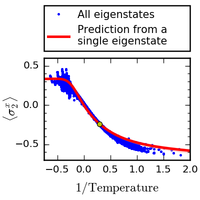
Does a Single Eigenstate Encode the Full Hamiltonian?

James R. Garrison and Tarun Grover

Phys. Rev. X 8, 021026 (2018) - Published 30 April, 2018

New calculations show that a single stationary state of an isolated quantum system encodes physical properties of the entire system at all temperatures, which provides new, fundamental insight into the quantum nature of thermalization.

Cell Growth Rate Dictates the Onset of Glass to Fluidlike Transition and Long Time Superdiffusion in an Evolving Cell Colony

Abdul N. Malmi-Kakkada, Xin Li, Himadri S. Samanta, Sumit Sinha, and D. Thirumalai

Phys. Rev. X 8, 021025 (2018) - Published 27 April, 2018

Numerical simulations describe cell dynamics in the early stages of tumor development and find surprising connections to soft glassy materials, providing insight that aids in understanding not just tumor growth but a host of abiotic systems evolving far from equilibrium.

Blue Energy and Desalination with Nanoporous Carbon Electrodes: Capacitance from Molecular Simulations to Continuous Models

Michele Simoncelli, Nidhal Ganfoud, Assane Sene, Matthieu Haefele, Barbara Daffos, Pierre-Louis Taberna, Mathieu Salanne, Patrice Simon, and Benjamin Rotenberg

Phys. Rev. X 8, 021024 (2018) - Published 26 April, 2018

Salinity gradients could be a clean source of energy, but models used to analyze capacitors that harness this energy fail when used on nanoporous carbon, a promising design material. A new analysis shows that molecular simulations can provide reasonable predictions of performance under realistic conditions.

Statistics of Shared Components in Complex Component Systems

Andrea Mazzolini, Marco Gherardi, Michele Caselle, Marco Cosentino Lagomarsino, and Matteo Osella

Phys. Rev. X 8, 021023 (2018) - Published 20 April, 2018

A mathematical analysis explores the statistics of shared components in complex systems and demonstrates what can be learned about the system based on those statistics, a result that impacts a wide range of contexts from LEGO sets to genomic analysis.

At the Limits of Criticality-Based Quantum Metrology: Apparent Super-Heisenberg Scaling Revisited

Marek M. Rams, Piotr Sierant, Omyoti Dutta, Paweł Horodecki, and Jakub Zakrzewski

Phys. Rev. X 8, 021022 (2018) - Published 19 April, 2018

Contrary to claims that a fundamental limit of precision in quantum metrology can be broken in certain circumstances, a new analysis shows that this is not the case once one takes into account the time needed to perform the needed operations.

A Rapidly Expanding Bose-Einstein Condensate: An Expanding Universe in the Lab

S. Eckel, A. Kumar, T. Jacobson, I. B. Spielman, and G. K. Campbell

Phys. Rev. X 8, 021021 (2018) - Published 19 April, 2018

The rapid expansion of a Bose-Einstein condensate can mimic the expansion of the Universe.

Plasmon Geometric Phase and Plasmon Hall Shift

Li-kun Shi and Justin C. W. Song

Phys. Rev. X 8, 021020 (2018) - Published 17 April, 2018

Calculations of the current density within collective charge oscillations called plasmons reveal a complicated structure that could affect how plasmons reflect off a boundary.

Optimal Search for an Astrophysical Gravitational-Wave Background

Rory Smith and Eric Thrane

Phys. Rev. X 8, 021019 (2018) - Published 16 April, 2018

A new analysis technique would allow the gravitational-wave “background” from distant black hole mergers to be detected in days instead of years.

Classical Causal Models for Bell and Kochen-Specker Inequality Violations Require Fine-Tuning

Eric G. Cavalcanti

Phys. Rev. X 8, 021018 (2018) - Published 13 April, 2018

A new analysis puts quantum nonlocality and contextuality—key resources for quantum computing—on equal theoretical footing as violations of classical causality.

Quantum Optical Realization of Arbitrary Linear Transformations Allowing for Loss and Gain

N. Tischler, C. Rockstuhl, and K. Słowik

Phys. Rev. X 8, 021017 (2018) - Published 13 April, 2018

New theoretical work shows how to implement nonunitary transformations on photons using simple optical building blocks, a key element for sophisticated quantum information networks and novel optical technologies.

Experimental Demonstration of Quantum Stationary Light Pulses in an Atomic Ensemble

Kwang-Kyoon Park, Young-Wook Cho, Young-Tak Chough, and Yoon-Ho Kim

Phys. Rev. X 8, 021016 (2018) - Published 13 April, 2018

A new experiment demonstrates a quantum stationary light pulse—a nonclassical approach to stopping light—in a cold atomic ensemble, which could pave the way toward novel quantum materials, optics, and devices.

Aerodynamics and Percolation: Unfolding Laminar Separation Bubble on Airfoils

Dominik Traphan, Tom T. B. Wester, Gerd Gülker, Joachim Peinke, and Pedro G. Lind

Phys. Rev. X 8, 021015 (2018) - Published 11 April, 2018

A new analysis of wind tunnel experiments shows how a class of statistical models known as percolation models can characterize the onset of turbulent flow over an airfoil with a precision higher than ever before.

Operator Spreading in Random Unitary Circuits

Adam Nahum, Sagar Vijay, and Jeongwan Haah

Phys. Rev. X 8, 021014 (2018) - Published 11 April, 2018

A new analysis obtains hydrodynamic descriptions for the spreading of quantum information through many body-systems and for the “quantum butterfly effect.”

Operator Hydrodynamics, OTOCs, and Entanglement Growth in Systems without Conservation Laws

C. W. von Keyserlingk, Tibor Rakovszky, Frank Pollmann, and S. L. Sondhi

Phys. Rev. X 8, 021013 (2018) - Published 11 April, 2018

Thermalization and information scrambling can provide insight into fields as diverse as many-body quantum physics, quantum field theory, and holography. A new theoretical analysis of one-dimensional spin chains reveals details about how information moves and entanglement grows in such systems.

Observation of Entangled States of a Fully Controlled 20-Qubit System

Nicolai Friis, Oliver Marty, Christine Maier, Cornelius Hempel, Milan Holzäpfel, Petar Jurcevic, Martin B. Plenio, Marcus Huber, Christian Roos, Rainer Blatt, and Ben Lanyon

Phys. Rev. X 8, 021012 (2018) - Published 10 April, 2018

Two new methods for detecting quantum entanglement—a critical ingredient for useful quantum technologies—successfully do so in a system of 20 qubits, the largest fully controllable entangled system to date.

Fundamental Work Cost of Quantum Processes

Philippe Faist and Renato Renner

Phys. Rev. X 8, 021011 (2018) - Published 10 April, 2018

A new theoretical analysis derives a precise fundamental lower limit to the work cost for processing information in any type of system, thereby cornering a new microscopic formulation of thermodynamics and shedding light on how far the second law can be applied.

Sign In to Your Journals Account

Filter

Recent Issues

Vol. 16, Iss. 4
October - December 2026
Vol. 16, Iss. 3
July - September 2026
Vol. 16, Iss. 2
April - June 2026
Vol. 16, Iss. 1
January - March 2026
Category
Article Type

Filter

Article Lookup

Enter a citation