Highlights

Fidelity and variability in the interlayer electronic structure of the kagome superconductor CsV3Sb5

Aurland K. Watkins, Dirk Johrendt, Vojtech Vlcek, Stephen D. Wilson, and Ram Seshadri

Phys. Rev. Materials 8, 054204 (2024) - Published 20 May, 2024

A reliable interlayer band structure of the kagome superconductor CsV3Sb5 is critical for understanding emergent phenomena like the charge density wave ordering and for classifying the topology. Here, the authors present a survey of computational techniques aimed at comparing the electronic interactions between kagome layers in CsV3Sb5. This study highlights the computational parameters and plotting methods that lead to differing band behaviors. Within conventional DFT, the parameters employed during structural relaxation are critical in determining the electronic structure between kagome layers. However, higher levels of computational theory contrast these results and point to the increased role of interlayer interactions.

Disorder-driven localization and electron interactions in BixTeI thin films

Paul Corbae, Nicolai Taufertshöfer, Ellis Kennedy, Mary Scott, and Frances Hellman

Phys. Rev. Materials 8, 044204 (2024) - Published 25 April, 2024

In this work, we investigate the effect of strong disorder on BixTeI thin films, revealing a metal-insulator transition that depends on composition and the growth temperature. Understanding how disorder can be used as a parameter to alter the electronic properties of a material goes beyond the conventional understanding of crystalline material conductivity. This study therefore highlights the role of strong localization in disordered materials in shaping emerging quantum properties.

Ultrashallow heavily constrained quantum wells: The cradle for fully electrically controlled and microwave coupled quantum bits

Yiwen Zhang, Zonghu Li, Yuchen Zhou, Yuhui Ren, Jiahan Ke, Jiale Su, Yanpeng Song, Jun Deng, Yang Liu, Runze Zhang, Haiou Li, Baochuan Wang, Zhenhua Wu, Jun Luo, Zhenzhen Kong, Gang Cao, Guoping Guo, Chao Zhao, and Guilei Wang

Phys. Rev. Materials 8, 046203 (2024) - Published 25 April, 2024

The study focuses on the systematic growth and characterization of material properties, as well as the low-temperature transport properties, of ultrashallow heavily strained quantum wells. A new characterization method, called Density of Stress Accumulation Points, has been introduced for assessing quantum well strain. An ultrashallow heavily constrained quantum well with a remarkable mobility of 3.382×105 cm2/Vs was successfully achieved. This achievement serves as the foundation for the development of fully electrically controlled and microwave cavity-coupled quantum dot materials.

High-throughput hybrid-functional DFT calculations of bandgaps and formation energies and multifidelity learning with uncertainty quantification

Mohan Liu, Abhijith Gopakumar, Vinay Ishwar Hegde, Jiangang He, and Chris Wolverton

Phys. Rev. Materials 8, 043803 (2024) - Published 16 April, 2024

The authors computed bandgaps and formation energy values of more than 1100 crystalline materials‬ using Density Functional Theory (DFT) with HSE‬ and PBE approximations of the pseudopotentials. They analyzed accuracies of HSE and PBE approximations among different classes of materials. They also built a multi-fidelity machine learning model to predict the bandgap at HSE accuracy when a material’s PBE bandgap‬ is known. The new high-throughput DFT (HSE, PBE) data of more than 1100 materials and the predicted‬ HSE bandgap data of more than 21,000 materials are available publicly via a dedicated web app.

Confinement of magnetic solitons and edge states in a van der Waals material: FeOCl

Martin Panthöfer, Stefanie Berinskat, Fabian Predelli, Peter Lemmens, and Angela Möller

Phys. Rev. Materials 8, 044003 (2024) - Published 15 April, 2024

This paper reports that domain-wall-like modes govern the magnetic response of the van der Waals material FeOCl. Due to boundaries, these excitations condense into an unconventional magnetic order with a diffusional dynamics as probed by Mössbauer spectroscopy and Raman scattering. These results have implications for a better understanding of fundamental aspects of soliton-like excitations as well as topological magnetism and related information storage. The authors highlight that the observed phenomenology and proposed condensation of solitons into topological edge states is a generic feature of non-linear systems with confinement.

Growth and characterization of α-Sn thin films on In- and Sb-rich reconstructions of InSb(001)

Aaron N. Engel, Connor P. Dempsey, Hadass S. Inbar, Jason T. Dong, Shinichi Nishihaya, Yuhao Chang, Alexei V. Fedorov, Makoto Hashimoto, Donghui Lu, and Christopher J. Palmstrøm

Phys. Rev. Materials 8, 044202 (2024) - Published 15 April, 2024

α-Sn, the inversion symmetric analogue of HgTe, can be tuned through various topologically non-trivial phases by a combination of strain and/or confinement effects. In addition, thin films of α-Sn have demonstrated very efficient spin-charge conversion. However, α-Sn thin films grown on InSb have been plagued by heavy incorporation of the p-type dopant indium. To better study and make use of the topological phases in α-Sn, this indium doping must be minimized. The authors realize this reduction by tuning the surface reconstruction of InSb(001) on which molecular beam epitaxy growth of α-Sn is initiated. The low indium doping is verified by both photoemission and magnetotransport measurements. The accessibility of the surface Dirac node in angle-resolved photoemission spectroscopy—made possible by the substrate preparation procedure—allows direct measurements of the effect of confinement and epitaxial strain on the topological phase in this system.

Polarizability models for simulations of finite temperature Raman spectra from machine learning molecular dynamics

Ethan Berger and Hannu-Pekka Komsa

Phys. Rev. Materials 8, 043802 (2024) - Published 12 April, 2024

While the efficacy of machine learning (ML) force fields in simulating molecular dynamics (MD) trajectories has already been well established, simulating Raman spectra from them requires polarizability models which are much less explored. In this work, three polarizability models are compared using three widely different materials, namely boron arsenide, 2D molybdenum disulfide and inorganic halide perovskites. The Raman spectra are obtained in combination with ML MD and compared to experiments, allowing us to highlight the advantages and shortcomings of each model.

Molecular beam epitaxy of superconducting FeSexTe1−x thin films interfaced with magnetic topological insulators

Yuki Sato, Soma Nagahama, Ilya Belopolski, Ryutaro Yoshimi, Minoru Kawamura, Atsushi Tsukazaki, Naoya Kanazawa, Kei S. Takahashi, Masashi Kawasaki, and Yoshinori Tokura

Phys. Rev. Materials 8, L041801 (2024) - Published 11 April, 2024

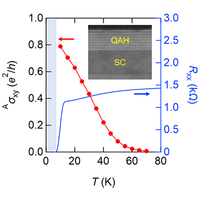
The observation of Majorana anyons is a long-sought challenge in physics, but has been hindered by lack of high-quality materials. The authors fabricate a heterostructure with an atomically sharp interface between a quantum anomalous Hall insulator and superconductor, for the first time. This unique quantum material should enable the unambiguous observation of chiral Majorana edge states and braiding of non-Abelian anyons without magnetic field.

Piezomagnetic properties in altermagnetic MnTe

Takuya Aoyama and Kenya Ohgushi

Phys. Rev. Materials 8, L041402 (2024) - Published 1 April, 2024

This study presents experimental results of the piezomagnetic effect in MnTe, one of the candidate materials for altermagnets. The piezomagnetic effect is a cross-correlation between magnetization and stress that is allowed in materials with broken time-reversal symmetry. The authors observed magnetization proportional to the stress below the antiferromagnetic transition temperature, indicating that MnTe has characteristics of altermagnets. They also demonstrated that the altermagnetic domains can be controlled via the piezomagnetic effect.

Models of polaron fluctuations in LuFe2O4

Kristoffer Andreas Holm Støckler, Nikolaj Roth, Anders Agentoft Feidenhans'l, Seiya Takahashi, Eiji Nishibori, and Bo Brummerstedt Iversen

Phys. Rev. Materials 8, 034409 (2024) - Published 29 March, 2024

Above its charge ordering temperature, LuFe2O4 becomes disordered with local order governed by polarons originating from the mixed valence Fe sublattice. The hidden order of the Fe valence is not easily probed by conventional scattering methods. However, the correlated ion displacements associated with the polaron fluctuations extracted by 3D-ΔPDF informed Monte Carlo modeling expose aspects of this hidden order hinting at a Jahn-Teller polaronic nature of the charge carriers.

Polar discontinuity governs surface segregation and interface termination: A case study of LaInO3/BaSnO3

Martina Zupancic, Wahib Aggoune, Alexandre Gloter, Georg Hoffmann, Franz-Philipp Schmidt, Zbigniew Galazka, Daniel Pfützenreuter, Aysha A. Riaz, Christoph Schlueter, Houari Amari, Anna Regoutz, Jutta Schwarzkopf, Thomas Lunkenbein, Oliver Bierwagen, Claudia Draxl, and Martin Albrecht

Phys. Rev. Materials 8, 034602 (2024) - Published 29 March, 2024

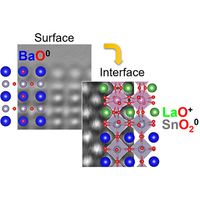
Interfacial polar discontinuities play a crucial role in promoting unique two-dimensional electron gases in perovskite systems such as LaInO3/BaSnO3. This study sheds light on the intricate relationship between polar discontinuity compensation and surface segregation, pivotal factors in formation of interfaces. Transmission electron microscopy and density functional theory (DFT) confirm the surface of BaSnO3 (001) are BaO terminated. In contrast, the LaInO3/BaSnO3 interface is found to terminate with SnO2, accompanied by Ba surface segregation as confirmed by electron energy loss spectroscopy and x-ray photoelectron spectroscopy. DFT calculations highlight the significant influence of the polar discontinuity in driving Ba segregation. This study advances our understanding of oxide interfaces by highlighting the critical role of polar discontinuity compensation in shaping the structure of interfaces in perovskite systems.

Predicting failure locations in model end-linked polymer networks

Han Zhang (张菡) and Robert A. Riggleman

Phys. Rev. Materials 8, 035604 (2024) - Published 27 March, 2024

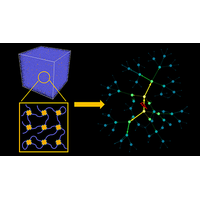
Understanding the relationship between the macroscopic behaviors of polymer networks and their molecular structures is a challenging and long-standing problem in polymer physics and soft matter research. Combining molecular dynamics simulations and network analysis techniques, this study sheds light on the topological and geometric features governing the fracture process of model end-linked polymer networks. Geodesic edge betweenness centrality, local defect concentration and the orientation of network strands, extracted from the initial undeformed network conformations, are found to be served as effective predictors for identifying failure locations under uniaxial deformation. This work demonstrates the potential of a universal approach utilizing network analysis tools to address outstanding questions in soft matter society and to design the next generation of network materials with exceptional properties.

Disorder and diffuse scattering in single-chirality (TaSe4)2I crystals

Jacob A. Christensen, Simon Bettler, Kejian Qu, Jeffrey Huang, Soyeun Kim, Yinchuan Lu, Chengxi Zhao, Jin Chen, Matthew J. Krogstad, Toby J. Woods, Fahad Mahmood, Pinshane Y. Huang, Peter Abbamonte, and Daniel P. Shoemaker

Phys. Rev. Materials 8, 034202 (2024) - Published 20 March, 2024

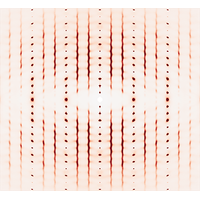
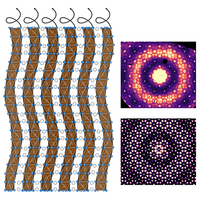
The chiral charge density wave material (TaSe4)2I contains a half-filled Ta d-orbital, which creates Weyl points in a metallic band structure. However, historical measurements show insulating electrical transport. The authors use single-crystal diffraction and transmission electron microscopy to show that large single crystals have pristine chirality: they can exhibit a single enantiomer over millimeters. They resolve the contradiction in transport by showing a consistent iodine deficiency of more than 10%. These vacancies produce structural modulations visible in diffuse scattering and represent a new competing interaction in a class of materials with fragile electronic states.

Optical tuning of the diamond Fermi level measured by correlated scanning probe microscopy and quantum defect spectroscopy

Christian Pederson, Rajiv Giridharagopal, Fang Zhao, Scott T. Dunham, Yevgeny Raitses, David S. Ginger, and Kai-Mei C. Fu

Phys. Rev. Materials 8, 036201 (2024) - Published 14 March, 2024

Precise control of diamond’s surface termination is crucial for electronic devices and the charge stability of shallow, implanted color centers for quantum devices, such as the nitrogen-vacancy (NV) and silicon-vacancy (SiV) center. Previously, such surface control relied on aggressive treatments, such as annealing, plasma exposure, or strong acids, but here the authors demonstrate a novel technique utilizing a laser under ambient conditions. This technique is demonstrated on NV and SiV centers, with optical spatial resolution and continuous optical feedback. They are able to image the change in the diamond’s work function through Kelvin probe force microscopy, and determine the mechanism as laser-assisted oxidation.

Temperature-induced structural and electronic phase transitions in λ-phase Ti3O5

K. Yoshimatsu, H. Nakao, and H. Kumigashira

Phys. Rev. Materials 8, 035002 (2024) - Published 13 March, 2024

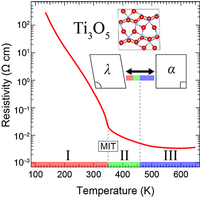
Metastable λ-Ti3O5, which undergoes phase transition to other polymorphs by external stimuli such as light, pressure, and temperature, is a candidate material for optolectronic and heat-storage devices. Here, the authors investigate the changes in the electrical and structural properties of λ-Ti3O5 with a single-crystalline thin film form across the temperature-induced phase transition. Resistivity and synchrotron X-ray diffraction measurements unveils a complex phase diagram divided into three temperature regions, which is composed of metal-insulator transition and second-order structural phase transition.

Chemomechanics in alloy phase stability

Sesha Sai Behara, John C. Thomas, Brian Puchala, and Anton Van der Ven

Phys. Rev. Materials 8, 033801 (2024) - Published 12 March, 2024

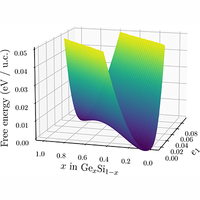
This work introduces a first-principles statistical mechanics method to calculate the free energies of crystalline alloys, including dependence on temperature, composition, and strain. The approach extends the alloy cluster expansion to include an explicit dependence on homogeneous strain in addition to site occupation variables that track chemical ordering. The method is applied to the Si-Ge binary alloy and is used to analyze phase stability under arbitrary epitaxial constraints. As a surrogate model, the new cluster expansion is a convenient compromise between the more restrictive configuration-only cluster expansions and machine-learned interatomic potentials, which require a substantially larger effort to train.

Nanoscale electronic inhomogeneities in 1T-TaS2

B. Campbell, J. V. Riffle, A. de la Torre, Q. Wang, K. W. Plumb, and S. M. Hollen

Phys. Rev. Materials 8, 034002 (2024) - Published 6 March, 2024

In 1T-TaS2, native defects create electronic inhomogeneities spanning 5-10 nanometers that coexist with a well-formed commensurate charge density wave with a 1.3 nm period. Over these inhomogeneities, the band center shifts by up to 60meV and the gap varies by more than 100 meV. Surprisingly, the charge density wave order is unperturbed. These results reopen questions of how disorder affects charge density wave phases in correlated systems and emphasize the importance of real-space measurements in resolving the structural and electronic properties of quantum materials.

Lateral solid phase epitaxy of yttrium iron garnet

Sebastian Sailler, Darius Pohl, Heike Schlörb, Bernd Rellinghaus, Andy Thomas, Sebastian T. B. Goennenwein, and Michaela Lammel

Phys. Rev. Materials 8, L020402 (2024) - Published 29 February, 2024

Yttrium iron garnet (YIG) is a prototypical material in the fields of spintronics and magnonics due to its exceptional magnetic properties. However, up to now, the focus has been on planar YIG thin films owing to the challenges associated with manufacturing non-planar structures. Here, the authors demonstrate the fabrication of single crystalline YIG via lateral solid phase epitaxy on top of an artificially defined SiOx mesa over micrometer length scales. The reported results lay the foundation for the development of non-planar, epitaxial YIG thin films as well as free standing YIG structures, while still maintaining complete control over the crystal orientation.

Guiding diamond spin qubit growth with computational methods

Jonathan C. Marcks, Mykyta Onizhuk, Nazar Delegan, Yu-Xin Wang (王语馨), Masaya Fukami, Maya Watts, Aashish A. Clerk, F. Joseph Heremans, Giulia Galli, and David D. Awschalom

Phys. Rev. Materials 8, 026204 (2024) - Published 28 February, 2024

Spin defects in semiconductors play a major role in quantum technologies. Synthesizing high-quality spin qubits relies on controlling the incorporation of noise sources, such as other, unwanted spin defects, into the host crystal. In this work, the authors provide quantitative calculations of the coherence properties of spin qubits in diamond. They incorporate these results into an existing materials synthesis platform to develop predictive models and in situ feedback for more reliable creation of qubits tailored to applications.

Large-scale characterization of Cu2O monocrystals via Rydberg excitons

Kerwan Morin, Delphine Lagarde, Angélique Gillet, Xavier Marie, and Thomas Boulier

Phys. Rev. Materials 8, 026202 (2024) - Published 27 February, 2024

This research introduces a novel experimental technique to characterize Rydberg excitons in copper oxide (Cu2O) crystals with sub-micron resolution. By employing spatially resolved resonant absorption spectroscopy and photoluminescence imaging, the study unveils the influence of optically-active charged oxygen vacancies on Rydberg excitons. This approach yields comprehensive spatial maps of exciton properties, including energy, linewidth, and peak absorption without any mobile part, providing valuable insights into crystal quality. The findings highlight the predominant role of charged oxygen vacancies in influencing Rydberg excitons in Cu2O and offer a reliable method for assessing crystal quality in view of solid-state Rydberg physics.

Sign In to Your Journals Account

Filter

Section

Filter

Article Lookup

Enter a citation