Highlights

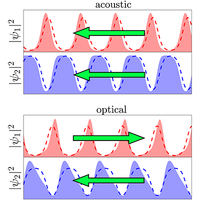
Quantum Nonlinear Optics on the Edge of a Few-Particle Fractional Quantum Hall Fluid in a Small Lattice

Alberto Nardin, Daniele De Bernardis, Rifat Onur Umucalılar, Leonardo Mazza, Matteo Rizzi, and Iacopo Carusotto

Phys. Rev. Lett. 133, 183401 (2024) - Published 29 October, 2024

Nonlinear chiral Luttinger liquid theory is able to describe the dynamics of a fractional quantum Hall fluid even on the small lattices that are available to experiments.

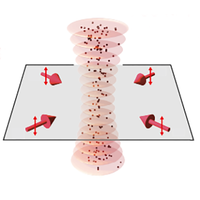
Observation of Space-Dependent Rotational Doppler Shifts with a Single Ion Probe

Nicolás A. Nuñez Barreto, Muriel Bonetto, Marcelo A. Luda, Cecilia Cormick, and Christian T. Schmiegelow

Phys. Rev. Lett. 133, 183601 (2024) - Published 29 October, 2024

A light beam with orbital angular momentum can produce the rotational analog of the Doppler effect on an ion.

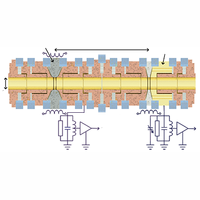
Individual-Ion Addressing and Readout in a Penning Trap

Brian J. McMahon, Kenton R. Brown, Creston D. Herold, and Brian C. Sawyer

Phys. Rev. Lett. 133, 173201 (2024) - Published 23 October, 2024

A way to address the individual ions of a rotating ion crystal could allow scientists to perform quantum simulations in which each qubit can be carefully controlled.

Three-Dimensional Moiré Crystal in Ultracold Atomic Gases

Ce Wang, Chao Gao, Jing Zhang, Hui Zhai, and Zhe-Yu Shi

Phys. Rev. Lett. 133, 163401 (2024) - Published 15 October, 2024

Overlapping two 3D lattices with a relative twist opens the door to synthesizing crystals with diverse symmetries that showcase nontrivial band structures and novel properties.

Thermal Melting of a Vortex Lattice in a Quasi-Two-Dimensional Bose Gas

Rishabh Sharma, David Rey, Laurent Longchambon, Aurélien Perrin, Hélène Perrin, and Romain Dubessy

Phys. Rev. Lett. 133, 143401 (2024) - Published 30 September, 2024

Observation of the melting of a vortex lattice in a quasi-two-dimensional Bose gas is consistent with a hexatic to liquid transition.

Cooperative Spin Amplifier for Enhanced Quantum Sensing

Minxiang Xu, Min Jiang, Yuanhong Wang, Haowen Su, Ying Huang, and Xinhua Peng

Phys. Rev. Lett. 133, 133202 (2024) - Published 26 September, 2024

Magnetic feedback causes two atomic gases to guide each other’s spins into long-lasting collective alignment.

Mott Transition for a Lieb-Liniger Gas in a Shallow Quasiperiodic Potential: Delocalization Induced by Disorder

Hepeng Yao, Luca Tanzi, Laurent Sanchez-Palencia, Thierry Giamarchi, Giovanni Modugno, and Chiara D’Errico

Phys. Rev. Lett. 133, 123401 (2024) - Published 19 September, 2024

A one-dimensional Bose-Einstein condensate’s superfluid state is surprisingly robust if the atoms are trapped in a quasiperiodic lattice.

Quectonewton Local Force Sensor

Yann Balland, Luc Absil, and Franck Pereira Dos Santos

Phys. Rev. Lett. 133, 113403 (2024) - Published 13 September, 2024

A quantum sensor with a sensitivity in the quectonewton range has probed the Casimir-Polder force in the micrometer range.

Excitations of a Binary Dipolar Supersolid

W. Kirkby, Au-Chen Lee, D. Baillie, T. Bland, F. Ferlaino, P. B. Blakie, and R. N. Bisset

Phys. Rev. Lett. 133, 103401 (2024) - Published 4 September, 2024

The excitation spectrum of a binary dipolar supersolid in a linear crystal geometry reveals three Goldstone modes.

Enantioselective One-Photon Excitation of Formic Acid

D. Tsitsonis, F. Trinter, J. B. Williams, K. Fehre, Ph. V. Demekhin, T. Jahnke, R. Dörner, and M. S. Schöffler

Phys. Rev. Lett. 133, 093002 (2024) - Published 29 August, 2024

Handedness of excited formic acid molecules is controlled by the direction of propagation of the exciting laser without the need for chiral light.

Interferometry of Non-Abelian Band Singularities and Euler Class Topology

Oliver Breach, Robert-Jan Slager, and F. Nur Ünal

Phys. Rev. Lett. 133, 093404 (2024) - Published 29 August, 2024

Two methods are proposed to experimentally probe Euler class topology in ultracold atomic systems.

Realization of a Coherent and Efficient One-Dimensional Atom

Natasha Tomm, Nadia O. Antoniadis, Marcelo Janovitch, Matteo Brunelli, Rüdiger Schott, Sascha R. Valentin, Andreas D. Wieck, Arne Ludwig, Patrick P. Potts, Alisa Javadi, and Richard J. Warburton

Phys. Rev. Lett. 133, 083602 (2024) - Published 21 August, 2024

A device that sorts photon states could lead to a basic component of an all-optical quantum computer.

Quantum Droplets in Two-Dimensional Bose Mixtures at Finite Temperature

G. Spada, S. Pilati, and S. Giorgini

Phys. Rev. Lett. 133, 083401 (2024) - Published 19 August, 2024

Quantum Monte Carlo simulations of Bose mixtures in 2D at finite temperature reveal the coexistence of liquid droplets and gas phases.

Bidirectional Cascaded Superfluorescent Lasing in Air Enabled by Resonant Third Harmonic Photon Exchange from Nitrogen to Argon

Zan Nie, Noa Nambu, Kenneth A. Marsh, Daniel Matteo, C. Kumar Patel, Chaojie Zhang, Yipeng Wu, Stefanos Carlström, Felipe Morales, Serguei Patchkovskii, Olga Smirnova, Misha Ivanov, and Chan Joshi

Phys. Rev. Lett. 133, 063201 (2024) - Published 7 August, 2024

A resonance between energy levels in argon atoms and nitrogen molecules could be used to remotely sense contaminants in air.

Local Readout and Control of Current and Kinetic Energy Operators in Optical Lattices

Alexander Impertro, Simon Karch, Julian F. Wienand, SeungJung Huh, Christian Schweizer, Immanuel Bloch, and Monika Aidelsburger

Phys. Rev. Lett. 133, 063401 (2024) - Published 5 August, 2024

A new manipulation technique could enable the realization of more versatile quantum simulators.

Orders of Magnitude Improved Cyclotron-Mode Cooling for Nondestructive Spin Quantum Transition Spectroscopy with Single Trapped Antiprotons

B. M. Latacz, M. Fleck, J. I. Jäger, G. Umbrazunas, B. P. Arndt, S. R. Erlewein, E. J. Wursten, J. A. Devlin, P. Micke, F. Abbass, D. Schweitzer, M. Wiesinger, C. Will, H. Yildiz, K. Blaum, Y. Matsuda, A. Mooser, C. Ospelkaus, C. Smorra, A. Soter, W. Quint, J. Walz, Y. Yamazaki, and S. Ulmer (BASE Collaboration)

Phys. Rev. Lett. 133, 053201 (2024) - Published 1 August, 2024

The subthermal resistive cooling of a single trapped proton to temperatures below 200 mK in particle preparation times below 500s, about 100 times faster than reported before, was achieved using a double-Penning-trap system.

Clock-Line-Mediated Sisyphus Cooling

Chun-Chia Chen (陳俊嘉), Jacob L. Siegel, Benjamin D. Hunt, Tanner Grogan, Youssef S. Hassan, Kyle Beloy, Kurt Gibble, Roger C. Brown, and Andrew D. Ludlow

Phys. Rev. Lett. 133, 053401 (2024) - Published 31 July, 2024

Sisyphus cooling applied to an ytterbium lattice clock improves atomic loading into the optical trap and the control of clock systematics.

Clock with 8×10⁻¹⁹ Systematic Uncertainty

Alexander Aeppli, Kyungtae Kim, William Warfield, Marianna S. Safronova, and Jun Ye

Phys. Rev. Lett. 133, 023401 (2024) - Published 10 July, 2024

An optical lattice clock with a 19-digit frequency accuracy results from the precise evaluation of the dynamic component of the clock transition’s blackbody radiation shift.

Mechanical Detection of Nuclear Decays

Jiaxiang Wang, T. W. Penny, Juan Recoaro, Benjamin Siegel, Yu-Han Tseng, and David C. Moore

Phys. Rev. Lett. 133, 023602 (2024) - Published 8 July, 2024

A levitating microparticle is observed to recoil when a nucleus embedded in the particle decays—opening the door to future searches of invisible decay products.

Laser Excitation of the Th229 Nuclear Isomeric Transition in a Solid-State Host

R. Elwell, Christian Schneider, Justin Jeet, J. E. S. Terhune, H. W. T. Morgan, A. N. Alexandrova, H. B. Tran Tan, Andrei Derevianko, and Eric R. Hudson

Phys. Rev. Lett. 133, 013201 (2024) - Published 2 July, 2024

Researchers have made the most precise measurement to date of the excited nuclear state of thorium-229, a candidate isotope for an ultraprecise nuclear clock.

Sign In to Your Journals Account

Filter

Section

Filter

Article Lookup

Enter a citation