Highlights

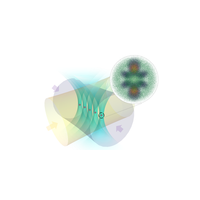
Free-Space Optical Modulation of Free Electrons in the Continuous-Wave Regime

Cruz I. Velasco and F. Javier García de Abajo

Phys. Rev. Lett. 134, 123804 (2025) - Published 26 March, 2025

Stimulated Compton scattering uses light beams to compress free-electron pulses, an approach that bypasses the need for nanostructures.

g Factor of Boronlike Tin

J. Morgner, B. Tu, M. Moretti, C. M. König, F. Heiße, T. Sailer, V. A. Yerokhin, B. Sikora, N. S. Oreshkina, Z. Harman, C. H. Keitel, S. Sturm, and K. Blaum

Phys. Rev. Lett. 134, 123201 (2025) - Published 24 March, 2025

The g factor of highly ionized tin is measured with a 0.5 parts-per-billion precision.

Microwave-Controlled Cold Chemistry

Fernanda B. V. Martins, Hansjürg Schmutz, Josef A. Agner, Valentina Zhelyazkova, and Frédéric Merkt

Phys. Rev. Lett. 134, 123401 (2025) - Published 24 March, 2025

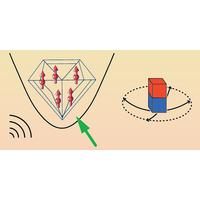
The heating effect of microwaves has long been used to accelerate reactions. A new experiment shows that microwaves can also excite molecules into a less reactive state.

Photonic Spin Hall Effect by Electro-optically Induced Pancharatnam-Berry Phases

Xingliang Xie, Hongdao Cheng, Huifeng Chen, Huadan Zheng, Yongchun Zhong, Jieyuan Tang, Jianhui Yu, Zhe Chen, and Wenguo Zhu

Phys. Rev. Lett. 134, 113805 (2025) - Published 21 March, 2025

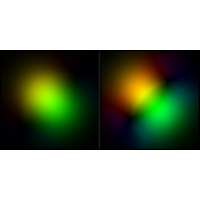
A new photonic spin Hall effect based on spatially varying Pancharatnam-Berry phases is demonstrated in a spatially homogeneous anisotropic crystal.

Chiral Resonant Modes Induced by Intrinsic Birefringence in Lithium Niobate Metasurfaces

Bo Wang, Tingyue Zhu, Yunan Liu, Haifang Yang, Ruhao Pan, and Junjie Li

Phys. Rev. Lett. 134, 113802 (2025) - Published 20 March, 2025

An achiral metasurface selectively transmits two beams of opposite chirality.

Temperature Sensitivity of a Thorium-229 Solid-State Nuclear Clock

Jacob S. Higgins, Tian Ooi, Jack F. Doyle, Chuankun Zhang, Jun Ye, Kjeld Beeks, Tomas Sikorsky, and Thorsten Schumm

Phys. Rev. Lett. 134, 113801 (2025) - Published 17 March, 2025

Researchers have characterized the temperature-induced frequency shifts of a thorium-229 nuclear transition—an important step in establishing thorium clocks as next-generation frequency standards.

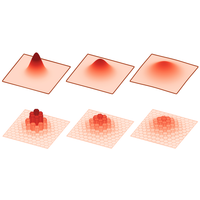
Dynamical Formation of Multiple Quantum Droplets in a Bose-Bose Mixture

L. Cavicchioli, C. Fort, F. Ancilotto, M. Modugno, F. Minardi, and A. Burchianti

Phys. Rev. Lett. 134, 093401 (2025) - Published 7 March, 2025

A single quantum droplet in a two-component bosonic mixture of ultracold atoms breaks up into multiple droplets, a behavior consistent with capillary instability.

Test of Nonlocal Energy Alteration between Two Quantum Memories

Jian-Peng Dou, Feng Lu, Hao Tang, and Xian-Min Jin

Phys. Rev. Lett. 134, 093601 (2025) - Published 3 March, 2025

Using quantum memories, it is shown that nonlocality is also inherent in the hidden variable interpretation of quantum mechanics.

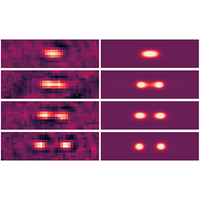
In Situ Imaging of a Single-Atom Wave Packet in Continuous Space

Joris Verstraten, Kunlun Dai, Maxime Dixmerias, Bruno Peaudecerf, Tim de Jongh, and Tarik Yefsah

Phys. Rev. Lett. 134, 083403 (2025) - Published 28 February, 2025

A new imaging technique can show the wave-like behavior of unconfined quantum particles.

Kolmogorov Scaling in Turbulent 2D Bose-Einstein Condensates

M. Zhao, J. Tao, and I. B. Spielman

Phys. Rev. Lett. 134, 083402 (2025) - Published 25 February, 2025

Researchers showed that a turbulent Bose-Einstein condensate exhibits the signs of classical turbulence, hinting at possible similarities between classical and quantum fluids.

Interaction-Induced Topological Phase Transition at Finite Temperature

Ze-Min Huang and Sebastian Diehl

Phys. Rev. Lett. 134, 053002 (2025) - Published 7 February, 2025

The one-dimensional Su-Schrieffer-Heeger model with Hubbard interactions exhibits a defect-driven topological phase transition at finite temperatures.

Cold Beam Optical Clock with Multifrequency Spectroscopy

William G. Tobias, Bryan Hemingway, and Steven Peil

Phys. Rev. Lett. 134, 043401 (2025) - Published 27 January, 2025

Multifrequency spectroscopy of a cold beam optical clock improves the long-term stability while decreasing several sources of systematic time-keeping errors.

In+115−Yb+172 Coulomb Crystal Clock with 2.5×10⁻¹⁸ Systematic Uncertainty

H. N. Hausser, J. Keller, T. Nordmann, N. M. Bhatt, J. Kiethe, H. Liu, I. M. Richter, M. von Boehn, J. Rahm, S. Weyers, E. Benkler, B. Lipphardt, S. Dörscher, K. Stahl, J. Klose, C. Lisdat, M. Filzinger, N. Huntemann, E. Peik, and T. E. Mehlstäubler

Phys. Rev. Lett. 134, 023201 (2025) - Published 16 January, 2025

Researchers have built an optical clock using an array of trapped ions—an architecture that can be scaled up to boost the clock’s precision.

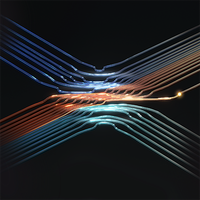
Hybridized Soliton Lasing in Coupled Semiconductor Lasers

Theodore P. Letsou, Dmitry Kazakov, Pawan Ratra, Lorenzo L. Columbo, Massimo Brambilla, Franco Prati, Cristina Rimoldi, Sandro Dal Cin, Nikola Opačak, Henry O. Everitt, Marco Piccardo, Benedikt Schwarz, and Federico Capasso

Phys. Rev. Lett. 134, 023802 (2025) - Published 13 January, 2025

An experiment demonstrates that a chip-scale coupled laser system consisting of a pair of coupled semiconductor ring lasers can exhibit complex optical states impossible to achieve in a single waveguide laser.

Continuous Collective Strong Coupling of Strontium Atoms to a High Finesse Ring Cavity

Julia R. K. Cline, Vera M. Schäfer, Zhijing Niu, Dylan J. Young, Tai Hyun Yoon, and James K. Thompson

Phys. Rev. Lett. 134, 013403 (2025) - Published 10 January, 2025

Continuous loading and transport of ultracold strontium atoms inside a high-finesse cavity is experimentally demonstrated, with implications for continuous cavity QED experiments.

Realization of a Laughlin State of Two Rapidly Rotating Fermions

Philipp Lunt, Paul Hill, Johannes Reiter, Philipp M. Preiss, Maciej Gałka, and Selim Jochim

Phys. Rev. Lett. 133, 253401 (2024) - Published 16 December, 2024

By controlling the motion and interaction of individual atoms in a cold-atom ensemble, researchers have produced a correlated topological state of matter, called a fractional quantum Hall state.

Optical Tweezer Arrays of Erbium Atoms

D. S. Grün, S. J. M. White, A. Ortu, A. Di Carli, H. Edri, M. Lepers, M. J. Mark, and F. Ferlaino

Phys. Rev. Lett. 133, 223402 (2024) - Published 26 November, 2024

Erbium and similar elements provide a wide range of electronic “handles” for manipulating atoms in many-body quantum experiments.

Nuclear Magnetic Resonance with a Levitating Microparticle

J. Voisin, A. Durand, T. Copie, M. Perdriat, and G. Hétet

Phys. Rev. Lett. 133, 213602 (2024) - Published 21 November, 2024

By manipulating and detecting nuclear spins in a tiny floating diamond, scientists have reported a record-long spin coherence time for a levitated system.

Gain-Induced Group Delay in Spontaneous Parametric Down-Conversion

Guillaume Thekkadath, Martin Houde, Duncan England, Philip Bustard, Frédéric Bouchard, Nicolás Quesada, and Ben Sussman

Phys. Rev. Lett. 133, 203601 (2024) - Published 14 November, 2024

The observation of a previously unseen photon delay in the production of quantum light has implications for the development of quantum technologies.

Autodetachment of Diatomic Carbon Anions from Long-Lived High-Rotation Quartet States

Viviane C. Schmidt, Roman Čurík, Milan Ončák, Klaus Blaum, Sebastian George, Jürgen Göck, Manfred Grieser, Florian Grussie, Robert von Hahn, Claude Krantz, Holger Kreckel, Oldřich Novotný, Kaija Spruck, and Andreas Wolf

Phys. Rev. Lett. 133, 183001 (2024) - Published 31 October, 2024

Sometimes a rotating molecule can transition to a new state only if an electron carries away some of the molecule’s angular momentum.

Sign In to Your Journals Account

Filter

Section

Filter

Article Lookup

Enter a citation