Highlights

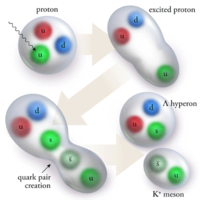
Strangeness Suppression of qq¯ Creation Observed in Exclusive Reactions

M. D. Mestayer et al. (CLAS Collaboration)

Phys. Rev. Lett. 113, 152004 (2014) - Published 10 October, 2014

Strange quark–anti-quark pairs are less likely to be produced in hadronic collisions than their light quark counterparts, providing insight into color confinement in QCD.

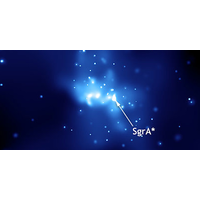
Galactic Center Gamma-Ray Excess from Dark Matter Annihilation: Is There a Black Hole Spike?

Brian D. Fields, Stuart L. Shapiro, and Jessie Shelton

Phys. Rev. Lett. 113, 151302 (2014) - Published 9 October, 2014

Simple dark matter and astrophysical models can’t explain a gamma-ray signal from our Galaxy’s center.

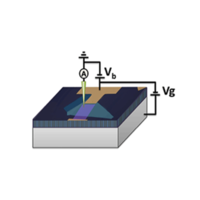
MoS2: Choice Substrate for Accessing and Tuning the Electronic Properties of Graphene

Chih-Pin Lu, Guohong Li, K. Watanabe, T. Taniguchi, and Eva Y. Andrei

Phys. Rev. Lett. 113, 156804 (2014) - Published 9 October, 2014

Molybdenum disulfide may provide an ideal substrate for supporting graphene.

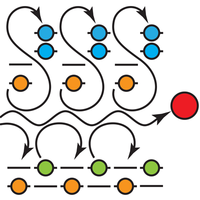
Catalytic Coherence

Johan Åberg

Phys. Rev. Lett. 113, 150402 (2014) - Published 7 October, 2014

A scheme is proposed to perform a unitary operation on a multi-level system, without degrading the coherence of the external system.

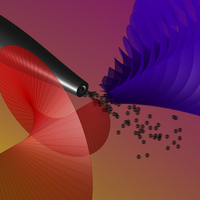
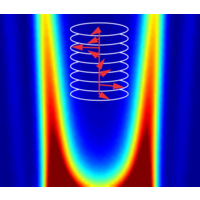
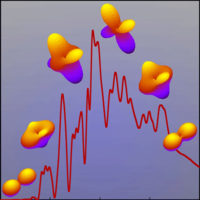
Creating High-Harmonic Beams with Controlled Orbital Angular Momentum

Genevieve Gariepy, Jonathan Leach, Kyung Taec Kim, T. J. Hammond, E. Frumker, Robert W. Boyd, and P. B. Corkum

Phys. Rev. Lett. 113, 153901 (2014) - Published 7 October, 2014

A laser field carrying orbital angular momentum can drive nonlinear high harmonic generation in a gas, potentially forming an extreme ultraviolet beam having applications in molecular scale microscopy.

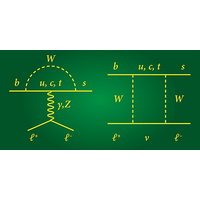
Test of Lepton Universality Using B+→K+ℓ+ℓ− Decays

R. Aaij et al. (LHCb Collaboration)

Phys. Rev. Lett. 113, 151601 (2014) - Published 6 October, 2014

The finding that electrons and muons aren’t produced equally in certain particle decays may hint at a crack in the standard model.

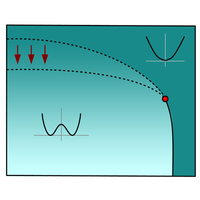
Lattice QCD Phase Diagram In and Away from the Strong Coupling Limit

Ph. de Forcrand, J. Langelage, O. Philipsen, and W. Unger

Phys. Rev. Lett. 113, 152002 (2014) - Published 6 October, 2014

A strong coupling expansion for lattice gauge theory at finite density is able to reduce the sign problem - a numerical difficulty in sampling highly oscillatory wavefunctions in Monte Carlo simulations.

Experimental Demonstration of Fusion-Relevant Conditions in Magnetized Liner Inertial Fusion

M. R. Gomez et al.

Phys. Rev. Lett. 113, 155003 (2014) - Published 6 October, 2014

The first experiments testing a new magnetic fusion concept on the Z machine at Sandia National Laboratory have achieved fusion relevant plasma conditions with a temperature of 3 keV.

Understanding Fuel Magnetization and Mix Using Secondary Nuclear Reactions in Magneto-Inertial Fusion

P. F. Schmit et al.

Phys. Rev. Lett. 113, 155004 (2014) - Published 6 October, 2014

The first experiments testing a new magnetic fusion concept on the Z machine at Sandia National Laboratory have achieved fusion relevant plasma conditions with a temperature of 3 keV.

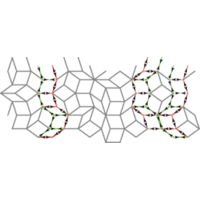
Penrose Tilings as Jammed Solids

Olaf Stenull and T. C. Lubensky

Phys. Rev. Lett. 113, 158301 (2014) - Published 6 October, 2014

The elastic and vibrational properties of randomized Penrose tilings - lattices exhibiting 5-fold symmetry - are shown to be similar to those of jammed sphere systems.

Experimental Reconstruction of Work Distribution and Study of Fluctuation Relations in a Closed Quantum System

Tiago B. Batalhão, Alexandre M. Souza, Laura Mazzola, Ruben Auccaise, Roberto S. Sarthour, Ivan S. Oliveira, John Goold, Gabriele De Chiara, Mauro Paternostro, and Roberto M. Serra

Phys. Rev. Lett. 113, 140601 (2014) - Published 3 October, 2014

A liquid-state nuclear magnetic resonance platform allows control and quantification of the non-equilibrium spin dynamics of a closed quantum system.

Evidence for Electroweak Production of W±W±jj in pp Collisions at s=8  TeV with the ATLAS Detector

G. Aad et al. (ATLAS Collaboration)

Phys. Rev. Lett. 113, 141803 (2014) - Published 3 October, 2014

The ATLAS experiment at the LHC has found evidence for the scattering of two massive vector bosons, a previously unseen process predicted by the Standard Model.

Nonlinear Ultrasonic Phased Array Imaging

J. N. Potter, A. J. Croxford, and P. D. Wilcox

Phys. Rev. Lett. 113, 144301 (2014) - Published 3 October, 2014

A new acoustic imaging technique could reveal previously invisible cracks in bridges or other infrastructure.

Competing Exchange Interactions on the Verge of a Metal-Insulator Transition in the Two-Dimensional Spiral Magnet Sr3Fe2O7

J.-H. Kim, Anil Jain, M. Reehuis, G. Khaliullin, D. C. Peets, C. Ulrich, J. T. Park, E. Faulhaber, A. Hoser, H. C. Walker, D. T. Adroja, A. C. Walters, D. S. Inosov, A. Maljuk, and B. Keimer

Phys. Rev. Lett. 113, 147206 (2014) - Published 3 October, 2014

Exchange interactions between spin pairs have been experimentally measured in spiral magnets. Both ferro- and antiferromagnetic interactions were found, indicating that the spiral magnetic state arises from a competition between nearest neighbor ferromagnetic exchange and longer-distance antiferromagnetic exchange, confirming predictions by de Gennes in 1960.

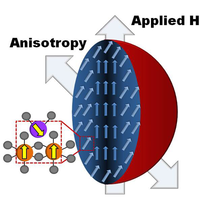
Origin of Surface Canting within Fe3O4 Nanoparticles

K. L. Krycka, J. A. Borchers, R. A. Booth, Y. Ijiri, K. Hasz, J. J. Rhyne, and S. A. Majetich

Phys. Rev. Lett. 113, 147203 (2014) - Published 2 October, 2014

Polarization analyzed small angle neutron scattering and modeling of iron oxide nanoparticles suggests that spin canting - tilting of surface spins at an angle to the applied magnetic field - arises from an interplay between interparticle coupling, Zeeman energy, magnetocrystalline anisotropy, and dipolar interactions.

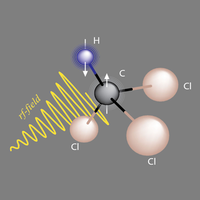
Sphaleron Rate in the Minimal Standard Model

Michela D’Onofrio, Kari Rummukainen, and Anders Tranberg

Phys. Rev. Lett. 113, 141602 (2014) - Published 1 October, 2014

The most accurate calculation of the sphaleron rate — responsible for baryon number changing processes — has been made using large scale lattice simulations and the mass of the recently discovered Higgs boson.

Search for a Light Sterile Neutrino at Daya Bay

F. P. An et al. (Daya Bay Collaboration)

Phys. Rev. Lett. 113, 141802 (2014) - Published 1 October, 2014

The Daya Bay Reactor Neutrino Experiment has placed stringent limits on a hypothetical fourth neutrino.

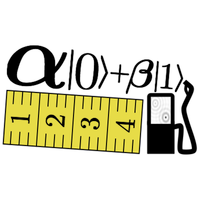
Quantifying Coherence

T. Baumgratz, M. Cramer, and M. B. Plenio

Phys. Rev. Lett. 113, 140401 (2014) - Published 29 September, 2014

A quantified measure of quantum coherence — a necessary resource of quantum information — has been proposed using a similar approach to that established for entanglement and quantum reference frames.

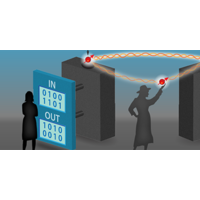
Fully Device-Independent Quantum Key Distribution

Umesh Vazirani and Thomas Vidick

Phys. Rev. Lett. 113, 140501 (2014) - Published 29 September, 2014

To fend off potential hackers, researchers have taken a theoretical step closer to realizing a device-independent quantum cryptography protocol.

Astrophysical Line Diagnosis Requires Nonlinear Dynamical Atomic Modeling

Natalia S. Oreshkina, Stefano M. Cavaletto, Christoph H. Keitel, and Zoltán Harman

Phys. Rev. Lett. 113, 143001 (2014) - Published 29 September, 2014
A discrepancy between atomic theory and laboratory astrophysics experiments measuring the x-ray emission lines from highly charged Iron ions can be resolved by including nonlinear dynamical light-atom interactions.

Sign In to Your Journals Account

Filter

Section

Filter

Article Lookup

Enter a citation