Highlights

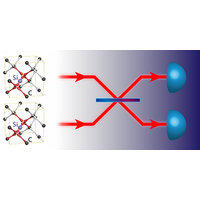
Indistinguishable Photons from Separated Silicon-Vacancy Centers in Diamond

A. Sipahigil, K. D. Jahnke, L. J. Rogers, T. Teraji, J. Isoya, A. S. Zibrov, F. Jelezko, and M. D. Lukin

Phys. Rev. Lett. 113, 113602 (2014) - Published 11 September, 2014

Two silicon-vacancy centers in diamond can emit photons that are indistinguishable—suggesting they have potential as building blocks for a diamond-based quantum computer.

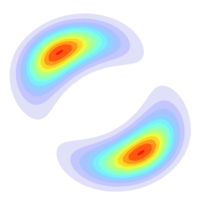
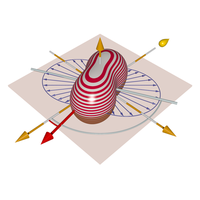
Observation of Coherence in the Time-Reversed Relativistic Photoelectric Effect

S. Tashenov, D. Banaś, H. Beyer, C. Brandau, S. Fritzsche, A. Gumberidze, S. Hagmann, P.-M. Hillenbrand, H. Jörg, I. Kojouharov, Ch. Kozhuharov, M. Lestinsky, Yu. A. Litvinov, A. V. Maiorova, H. Schaffner, V. M. Shabaev, U. Spillmann, Th. Stöhlker, A. Surzhykov, and S. Trotsenko

Phys. Rev. Lett. 113, 113001 (2014) - Published 9 September, 2014

The spin-orbit interaction has a prominent effect on the radiative recombination of a relativistic electron into the 2p shell of hydrogen-like Uranium.

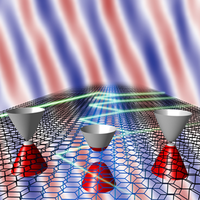
Fabry-Pérot Interference in Gapped Bilayer Graphene with Broken Anti-Klein Tunneling

Anastasia Varlet, Ming-Hao Liu (劉明豪), Viktor Krueckl, Dominik Bischoff, Pauline Simonet, Kenji Watanabe, Takashi Taniguchi, Klaus Richter, Klaus Ensslin, and Thomas Ihn

Phys. Rev. Lett. 113, 116601 (2014) - Published 8 September, 2014

Interference fringes are observed in the conductance of a gate-defined bilayer graphene cavity, showing the ballistic phase-coherent nature of transport through the cavity.

Scalable Spin Squeezing for Quantum-Enhanced Magnetometry with Bose-Einstein Condensates

W. Muessel, H. Strobel, D. Linnemann, D. B. Hume, and M. K. Oberthaler

Phys. Rev. Lett. 113, 103004 (2014) - Published 5 September, 2014

A new technique uses up to 30 Bose-Einstein condensates simultaneously to make ultraprecise measurements.

Gravitational Waves from Periodic Three-Body Systems

V. Dmitrašinović, Milovan Šuvakov, and Ana Hudomal

Phys. Rev. Lett. 113, 101102 (2014) - Published 4 September, 2014

Gravitational wave signatures from new solutions of the classic three-body problem yield luminosities that are orders of magnitude larger than their binary counterparts.

On-Chip Generation and Manipulation of Entangled Photons Based on Reconfigurable Lithium-Niobate Waveguide Circuits

H. Jin, F. M. Liu, P. Xu, J. L. Xia, M. L. Zhong, Y. Yuan, J. W. Zhou, Y. X. Gong, W. Wang, and S. N. Zhu

Phys. Rev. Lett. 113, 103601 (2014) - Published 4 September, 2014

On a single chip, sources of entangled photons are combined with optical elements that can perform complex manipulations of quantum signals.

Electric-Field-Induced Skyrmion Distortion and Giant Lattice Rotation in the Magnetoelectric Insulator Cu2OSeO3

J. S. White, K. Prša, P. Huang, A. A. Omrani, I. Živković, M. Bartkowiak, H. Berger, A. Magrez, J. L. Gavilano, G. Nagy, J. Zang, and H. M. Rønnow

Phys. Rev. Lett. 113, 107203 (2014) - Published 4 September, 2014

A combination of static electric fields and an oscillating magnetic field are used to rotate Skyrmions, topological spin features, in the chiral lattice insulator Cu2OSeO3.

Optimal Fractal-Like Hierarchical Honeycombs

Ramin Oftadeh, Babak Haghpanah, Dominic Vella, Arezki Boudaoud, and Ashkan Vaziri

Phys. Rev. Lett. 113, 104301 (2014) - Published 3 September, 2014

Fractal structures based on hexagonal honeycombs provide a route to create low-weight materials with tunable properties.

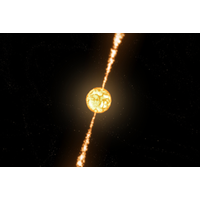
Observation of High-Energy Astrophysical Neutrinos in Three Years of IceCube Data

M. G. Aartsen et al. (IceCube Collaboration)

Phys. Rev. Lett. 113, 101101 (2014) - Published 2 September, 2014

What can high-energy neutrinos tell us about astrophysical objects beyond our galaxy?

Discovery of a Superconducting High-Entropy Alloy

P. Koželj, S. Vrtnik, A. Jelen, S. Jazbec, Z. Jagličić, S. Maiti, M. Feuerbacher, W. Steurer, and J. Dolinšek

Phys. Rev. Lett. 113, 107001 (2014) - Published 2 September, 2014

A new superconducting alloy, which behaves as a type II superconductor below 7.3 K, has been synthesized from Tantalum, Niobium, Hafnium, Zirconium and Titanium.

Soliton Turbulence in Shallow Water Ocean Surface Waves

Andrea Costa, Alfred R. Osborne, Donald T. Resio, Silvia Alessio, Elisabetta Chrivì, Enrica Saggese, Katinka Bellomo, and Chuck E. Long

Phys. Rev. Lett. 113, 108501 (2014) - Published 2 September, 2014

Analysis of sea surface height measurements during a storm in North Carolina’s Outer Banks has led to the first observation of an unusual form of turbulence.

Constraining the Equation of State of Neutron Stars from Binary Mergers

Kentaro Takami, Luciano Rezzolla, and Luca Baiotti

Phys. Rev. Lett. 113, 091104 (2014) - Published 28 August, 2014

The spectrum of gravitational waves from binary neutron star mergers can be used to discern information on the stars’ equation of state.

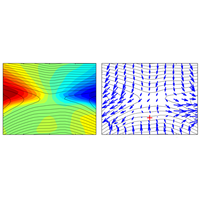
Laboratory Study of Magnetic Reconnection with a Density Asymmetry across the Current Sheet

Jongsoo Yoo, Masaaki Yamada, Hantao Ji, Jonathan Jara-Almonte, Clayton E. Myers, and Li-Jen Chen

Phys. Rev. Lett. 113, 095002 (2014) - Published 28 August, 2014

Magnetic reconnection - where magnetic energy is converted into kinetic energy and particle acceleration - is studied with a density asymmetry in a laboratory plasma for the first time.

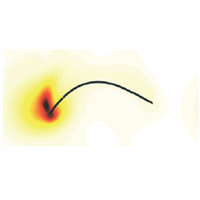
Mechanisms of Elastic Enhancement and Hindrance for Finite-Length Undulatory Swimmers in Viscoelastic Fluids

Becca Thomases and Robert D. Guy

Phys. Rev. Lett. 113, 098102 (2014) - Published 27 August, 2014

Both swimmer elasticity and stroke asymmetry can lead to faster swimming in low Reynolds number swimmers. A substantial boost is seen if these two effects work in tandem.

Proposal for the Creation and Optical Detection of Spin Cat States in Bose-Einstein Condensates

Hon Wai Lau, Zachary Dutton, Tian Wang, and Christoph Simon

Phys. Rev. Lett. 113, 090401 (2014) - Published 26 August, 2014

An experimental scheme is put forward that would allow macroscopic quantum superposition states to be created from hundreds of atoms in two-component Bose-Einstein condensates.

Matrix Product States for Gauge Field Theories

Boye Buyens, Jutho Haegeman, Karel Van Acoleyen, Henri Verschelde, and Frank Verstraete

Phys. Rev. Lett. 113, 091601 (2014) - Published 25 August, 2014

The authors demonstrate that matrix product states, a construction used in condensed matter physics to describe the quantum state of many particles, can be used for real-time simulations of a gauge theory.

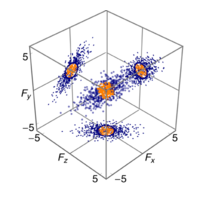
Generation of Macroscopic Singlet States in a Cold Atomic Ensemble

N. Behbood, F. Martin Ciurana, G. Colangelo, M. Napolitano, Géza Tóth, R. J. Sewell, and M. W. Mitchell

Phys. Rev. Lett. 113, 093601 (2014) - Published 25 August, 2014

A spin entangled system of more than a million laser cooled atoms has been created using spin measurements along three orthogonal axes – the first measurement-induced spin squeezing to a singlet state.

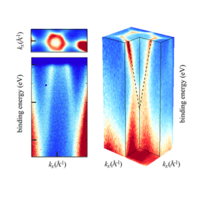
Room-Temperature High-Frequency Transport of Dirac Fermions in Epitaxially Grown Sb2Te3- and Bi2Te3-Based Topological Insulators

P. Olbrich, L. E. Golub, T. Herrmann, S. N. Danilov, H. Plank, V. V. Bel’kov, G. Mussler, Ch. Weyrich, C. M. Schneider, J. Kampmeier, D. Grützmacher, L. Plucinski, M. Eschbach, and S. D. Ganichev

Phys. Rev. Lett. 113, 096601 (2014) - Published 25 August, 2014

Terahertz radiation induces a dc electric current in 3D topological insulators, due to the asymmetric scattering of fermions by the field. The current is generated only in the surface electrons, allowing surface and bulk electron transport to be independently studied.

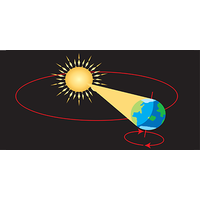
Fitting the Annual Modulation in DAMA with Neutrons from Muons and Neutrinos

Jonathan H. Davis

Phys. Rev. Lett. 113, 081302 (2014) - Published 21 August, 2014

The recently observed signal from a direct-dark-matter-detection search may instead be due to neutrons generated from solar neutrinos and atmospheric muons.

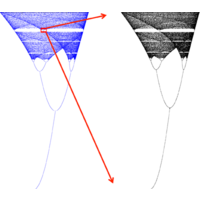
Scaling of Chaos versus Periodicity: How Certain is it that an Attractor is Chaotic?

Madhura Joglekar, Edward Ott, and James A. Yorke

Phys. Rev. Lett. 113, 084101 (2014) - Published 20 August, 2014
A small perturbation in a system’s parameter can convert its attractor from chaotic to periodic, where the probability of obtaining a chaotic regime scales as a power law with respect to the perturbation size. These results look at how and why the way in which this scaling is defined can lead to different numerical values for the exponent.

Sign In to Your Journals Account

Filter

Section

Filter

Article Lookup

Enter a citation