Highlights

Mechanism for Thermal Relic Dark Matter of Strongly Interacting Massive Particles

Yonit Hochberg, Eric Kuflik, Tomer Volansky, and Jay G. Wacker

Phys. Rev. Lett. 113, 171301 (2014) - Published 22 October, 2014

Strongly interacting light dark matter could provide a mechanism for achieving thermal relic dark matter abundances via inelastic processes at freezeout. This addresses outstanding problems in small-scale structure formation.

Nonlinear Interaction between Single Photons

T. Guerreiro, A. Martin, B. Sanguinetti, J. S. Pelc, C. Langrock, M. M. Fejer, N. Gisin, H. Zbinden, N. Sangouard, and R. T. Thew

Phys. Rev. Lett. 113, 173601 (2014) - Published 22 October, 2014

The interaction between two individual photons in a nonlinear optical waveguide offers new possibilities for quantum information processing.

Artificial Tribotactic Microscopic Walkers: Walking Based on Friction Gradients

Joshua P. Steimel, Juan L. Aragones, and Alfredo Alexander-Katz

Phys. Rev. Lett. 113, 178101 (2014) - Published 22 October, 2014

Pairs of micrometer-sized magnetic beads could “hunt” for chemicals by sensing changes in surface friction.

Strong Constraints on Sub-GeV Dark Sectors from SLAC Beam Dump E137

Brian Batell, Rouven Essig, and Ze’ev Surujon

Phys. Rev. Lett. 113, 171802 (2014) - Published 21 October, 2014

Using 30 year old electron beam-dump data, stringent new constraints are placed on the parameter space of dark photons - recently proposed hypothetical force carriers between dark matter particles.

Full Transmission and Reflection of Waves Propagating through a Maze of Disorder

Benoît Gérardin, Jérôme Laurent, Arnaud Derode, Claire Prada, and Alexandre Aubry

Phys. Rev. Lett. 113, 173901 (2014) - Published 21 October, 2014

A normally opaque medium can become fully transparent to properly tailored acoustic waves.

Phonon Localization by Mass Disorder in Dense Hydrogen-Deuterium Binary Alloy

Ross T. Howie, Ioan B. Magdău, Alexander F. Goncharov, Graeme J. Ackland, and Eugene Gregoryanz

Phys. Rev. Lett. 113, 175501 (2014) - Published 21 October, 2014

Localized vibration phonon modes are observed in a dense hydrogen-deuterium mixture, due to mass distribution disorder from the different isotope masses in the mixture.

In-Plane Magnetoresistance Obeys Kohler’s Rule in the Pseudogap Phase of Cuprate Superconductors

M. K. Chan, M. J. Veit, C. J. Dorow, Y. Ge, Y. Li, W. Tabis, Y. Tang, X. Zhao, N. Barišić, and M. Greven

Phys. Rev. Lett. 113, 177005 (2014) - Published 21 October, 2014

Kohler’s rule - that a metal’s resistivity in an applied magnetic field exhibits scaling behavior - is shown to be universally valid for the pseudogap phase of cuprate superconductors, if disorder and extrinsic influences are taken into account.

Detection of Up-converted Persistent Luminescence in the Near Infrared Emitted by the Zn3Ga2GeO8:Cr3+, Yb3+, Er3+ Phosphor

Feng Liu, Yanjie Liang, and Zhengwei Pan

Phys. Rev. Lett. 113, 177401 (2014) - Published 21 October, 2014

Persistent luminescence, lasting more than 24 hours, is generated in a new phosphor compound via an upconversion process.

Gravity Driven Instability in Elastic Solid Layers

Serge Mora, Ty Phou, Jean-Marc Fromental, and Yves Pomeau

Phys. Rev. Lett. 113, 178301 (2014) - Published 21 October, 2014

A new Rayleigh-Taylor-like instability is seen in elastic gel materials, where the instability is driven by gravity.

Scattering of Massless Particles in Arbitrary Dimensions

Freddy Cachazo, Song He, and Ellis Ye Yuan

Phys. Rev. Lett. 113, 171601 (2014) - Published 20 October, 2014

A new formula for the scattering of massless particles may simplify predictions and analyses of LHC experiments and shed new light on quantum gravity theories.

Classical Dynamical Localization

Italo Guarneri, Giulio Casati, and Volker Karle

Phys. Rev. Lett. 113, 174101 (2014) - Published 20 October, 2014

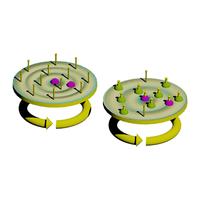
Features thought to be unique to quantum dynamical systems, such as localization of momentum, are found in a classical kicked rotor - where particles move in a ring and are ‘kicked’ periodically by an external field that changes the particle’s momentum.

Quantum Data Compression of a Qubit Ensemble

Lee A. Rozema, Dylan H. Mahler, Alex Hayat, Peter S. Turner, and Aephraim M. Steinberg

Phys. Rev. Lett. 113, 160504 (2014) - Published 17 October, 2014

A technique that packs the full content of three bits of quantum information into two may be a space saver for quantum computers.

Fractional Angular Momentum in Cold-Atom Systems

Yuhe Zhang, G. J. Sreejith, N. D. Gemelke, and J. K. Jain

Phys. Rev. Lett. 113, 160404 (2014) - Published 16 October, 2014

A method is proposed that would allow fractional statistics to be measured experimentally using a pair of atoms immersed in a specifically tailored quantum many-body state.

Solvable Relativistic Hydrogenlike System in Supersymmetric Yang-Mills Theory

Simon Caron-Huot and Johannes M. Henn

Phys. Rev. Lett. 113, 161601 (2014) - Published 16 October, 2014

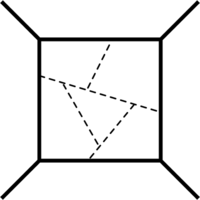
A relativistic quantum field theory extension to the classical Kepler problem provides a new method to compute the bound states of massive W bosons in planar N=4 super Yang-Mills.

New Classes of Systematic Effects in Gas Spin Comagnetometers

D. Sheng, A. Kabcenell, and M. V. Romalis

Phys. Rev. Lett. 113, 163002 (2014) - Published 16 October, 2014

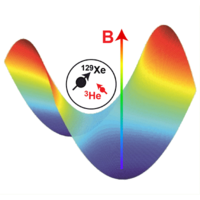
Progress has been made in understanding systematic effects from thermal and magnetic field gradients on comagnetometers – devices that compare the nuclear spin procession of two atomic species.

Trion-Induced Negative Photoconductivity in Monolayer MoS2

C. H. Lui, A. J. Frenzel, D. V. Pilon, Y.-H. Lee, X. Ling, G. M. Akselrod, J. Kong, and N. Gedik

Phys. Rev. Lett. 113, 166801 (2014) - Published 16 October, 2014

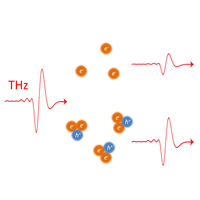
Ultrafast optical excitation of doped MoS2 causes a pronounced transient decrease in its conductivity, due to strong many-body interactions in the material that convert the 2D electron gas into a trion gas.

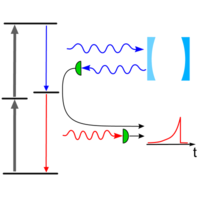
Reversing the Temporal Envelope of a Heralded Single Photon using a Cavity

Bharath Srivathsan, Gurpreet Kaur Gulati, Alessandro Cerè, Brenda Chng, and Christian Kurtsiefer

Phys. Rev. Lett. 113, 163601 (2014) - Published 15 October, 2014

The temporal pulse shape of a single photon can be engineered, from an exponential decay to an exponential rise, using a Fabry-Perot optical cavity. This ‘shaping’ would make it easier to couple photons to atoms in a cavity.

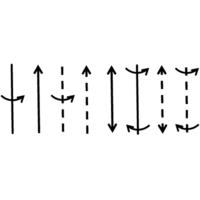
Eight Types of Symmetrically Distinct Vectorlike Physical Quantities

J. Hlinka

Phys. Rev. Lett. 113, 165502 (2014) - Published 15 October, 2014

The family of vector-like quantities is expanded from four to eight using symmetry arguments. These new vectors may be useful for describing systems including chiral objects, topological defects, or magnetic vortices.

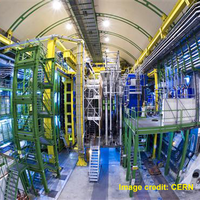
Observation of Overlapping Spin-1 and Spin-3 D¯0K− Resonances at Mass 2.86  GeV/c2

R. Aaij et al. (LHCb Collaboration)

Phys. Rev. Lett. 113, 162001 (2014) - Published 14 October, 2014

The LHCb collaboration has observed the first spin-3 resonance containing a heavy quark produced in the decay of the bottom-hadron Bs0.

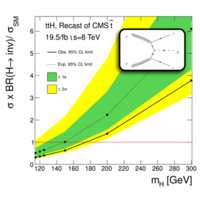
Bounds on Invisible Higgs Boson Decays Extracted from LHC tt¯H Production Data

Ning Zhou, Zepyoor Khechadoorian, Daniel Whiteson, and Tim M. P. Tait

Phys. Rev. Lett. 113, 151801 (2014) - Published 10 October, 2014

A reanalysis of LHC data from a supersymmetry search provides new constraints on the Higgs branching ratio to invisible particles, which are possibly related to dark matter.

Sign In to Your Journals Account

Filter

Section

Filter

Article Lookup

Enter a citation