Highlights

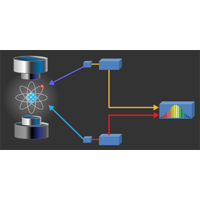
Coherent Precession of an Individual 5/2 Spin

M. Goryca, M. Koperski, P. Wojnar, T. Smoleński, T. Kazimierczuk, A. Golnik, and P. Kossacki

Phys. Rev. Lett. 113, 227202 (2014) - Published 25 November, 2014

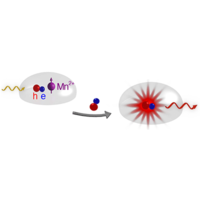
Researchers observed the precession of an individual spin-5/2 ion in a quantum dot, a system that could store multiple bits for quantum computing.

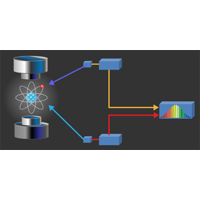
High-Fidelity Preparation, Gates, Memory, and Readout of a Trapped-Ion Quantum Bit

T. P. Harty, D. T. C. Allcock, C. J. Ballance, L. Guidoni, H. A. Janacek, N. M. Linke, D. N. Stacey, and D. M. Lucas

Phys. Rev. Lett. 113, 220501 (2014) - Published 24 November, 2014

Qubits based on trapped ions can be prepared and manipulated with record-breaking accuracy, offering a promising scalable platform for quantum computing.

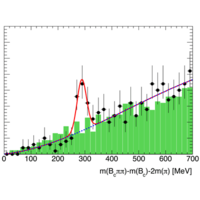
Observation of an Excited Bc± Meson State with the ATLAS Detector

G. Aad et al. (ATLAS Collaboration)

Phys. Rev. Lett. 113, 212004 (2014) - Published 21 November, 2014

The ATLAS Collaboration has observed a new excited state of the Bc± meson at 6842 MeV by reconstructing its decay. The mass and decay are consistent with QCD predictions for this excited state.

Planck’s Quantum-Driven Integer Quantum Hall Effect in Chaos

Yu Chen and Chushun Tian

Phys. Rev. Lett. 113, 216802 (2014) - Published 21 November, 2014

The kicked spin-1/2 rotor, a canonical chaotic system, is analogous to the integer quantum Hall effect.

Physics of Beer Tapping

Javier Rodríguez-Rodríguez, Almudena Casado-Chacón, and Daniel Fuster

Phys. Rev. Lett. 113, 214501 (2014) - Published 20 November, 2014

An investigation of the pub prank “beer tapping” provides a better understanding of gas-driven eruptions that occur in carbonated beverages, as well as in volcanic environments.

Evidence for a Common Physical Origin of the Landau and BEC Theories of Superfluidity

S. O. Diallo, R. T. Azuah, D. L. Abernathy, Junko Taniguchi, Masaru Suzuki, Jacques Bossy, N. Mulders, and H. R. Glyde

Phys. Rev. Lett. 113, 215302 (2014) - Published 20 November, 2014

New measurements show that Bose-Einstein condensation underlies the emergence of the characteristic Landau quasiparticle spectrum in superfluid helium-4.

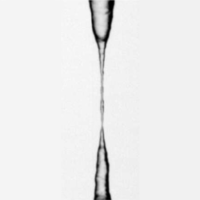
Nonuniversality in the Pinch-Off of Yield Stress Fluids: Role of Nonlocal Rheology

Nicolas Louvet, Daniel Bonn, and Hamid Kellay

Phys. Rev. Lett. 113, 218302 (2014) - Published 20 November, 2014

The behavior of neck thinning — where the liquid bridge between two droplets thins as the distance between the drops increases — is no longer believed to be universal, but depends on how the experiments are performed.

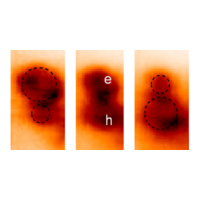
Electronic Structure Basis for the Extraordinary Magnetoresistance in WTe2

I. Pletikosić, Mazhar N. Ali, A. V. Fedorov, R. J. Cava, and T. Valla

Phys. Rev. Lett. 113, 216601 (2014) - Published 19 November, 2014

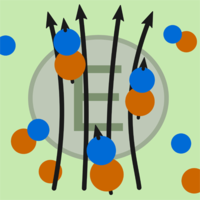
A near perfect balance between electrons and holes explains why WTe2’s huge magnetoresistence doesn’t saturate at high fields, reaching 13 million percent at 60 tesla.

Fixed-Point Quantum Search with an Optimal Number of Queries

Theodore J. Yoder, Guang Hao Low, and Isaac L. Chuang

Phys. Rev. Lett. 113, 210501 (2014) - Published 18 November, 2014

A well-known quantum search method, called Grover’s algorithm, has been modified to handle a wider variety of search problems.

Frequency Ratio of Two Optical Clock Transitions in Yb+171 and Constraints on the Time Variation of Fundamental Constants

R. M. Godun, P. B. R. Nisbet-Jones, J. M. Jones, S. A. King, L. A. M. Johnson, H. S. Margolis, K. Szymaniec, S. N. Lea, K. Bongs, and P. Gill

Phys. Rev. Lett. 113, 210801 (2014) - Published 17 November, 2014

Single-ion clocks yield new limits on how much the proton-to-electron mass ratio and the fine structure constant change over time.

Improved Limit on a Temporal Variation of mp/me from Comparisons of Yb+ and Cs Atomic Clocks

N. Huntemann, B. Lipphardt, Chr. Tamm, V. Gerginov, S. Weyers, and E. Peik

Phys. Rev. Lett. 113, 210802 (2014) - Published 17 November, 2014

Single-ion clocks yield new limits on how much the proton-to-electron mass ratio and the fine structure constant change over time.

Spacetime Curvature and the Higgs Stability During Inflation

M. Herranen, T. Markkanen, S. Nurmi, and A. Rajantie

Phys. Rev. Lett. 113, 211102 (2014) - Published 17 November, 2014

Curvature corrections to the Standard Model effective potential explain why the universe did not become unstable during cosmological inflation.

New Exact Solution of the Relativistic Boltzmann Equation and its Hydrodynamic Limit

Gabriel S. Denicol, Ulrich Heinz, Mauricio Martinez, Jorge Noronha, and Michael Strickland

Phys. Rev. Lett. 113, 202301 (2014) - Published 14 November, 2014

An exact solution of the relativistic Boltzmann equation with flow conditions relevant to heavy-ion collisions has been found.

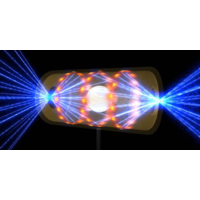
Dynamic Control of the Polarization of Intense Laser Beams via Optical Wave Mixing in Plasmas

P. Michel, L. Divol, D. Turnbull, and J. D. Moody

Phys. Rev. Lett. 113, 205001 (2014) - Published 14 November, 2014

The polarization of an intense laser beam can theoretically be controlled by mixing it with a second beam in a plasma.

Anomalous Weak Values Are Proofs of Contextuality

Matthew F. Pusey

Phys. Rev. Lett. 113, 200401 (2014) - Published 12 November, 2014

Weak measurements whose results exceed the largest eigenvalue of an operator manifest nonclassical behavior called contextuality.

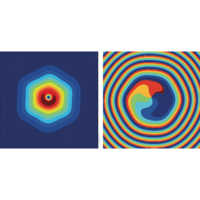
Creation of Orbital Angular Momentum States with Chiral Polaritonic Lenses

Robert Dall, Michael D. Fraser, Anton S. Desyatnikov, Guangyao Li, Sebastian Brodbeck, Martin Kamp, Christian Schneider, Sven Höfling, and Elena A. Ostrovskaya

Phys. Rev. Lett. 113, 200404 (2014) - Published 12 November, 2014

A spiral pattern of light imparts angular momentum to a quantum condensate in a semiconductor.

Peltier Cooling of Fermionic Quantum Gases

Ch. Grenier, A. Georges, and C. Kollath

Phys. Rev. Lett. 113, 200601 (2014) - Published 12 November, 2014

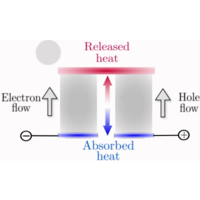
Simultaneous evaporative cooling of particles and holes would allow faster, deeper cooling of neutral Fermi gases. This new method could allow the gas to be cooled sufficiently for superfluidity and ultra-low temperature transport, amongst other things, to be studied in these systems.

Two-Dimensional Directional Proton Emission in Dissociative Ionization of H2

Xiaochun Gong, Peilun He, Qiying Song, Qinying Ji, Haifeng Pan, Jingxin Ding, Feng He, Heping Zeng, and Jian Wu

Phys. Rev. Lett. 113, 203001 (2014) - Published 12 November, 2014

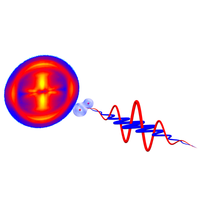
The dynamics of hydrogen photo-dissociation are controlled on an attosecond time-scale using orthogonally polarized two-color ultrashort laser pulses.

Ultracold Dense Samples of Dipolar RbCs Molecules in the Rovibrational and Hyperfine Ground State

Tetsu Takekoshi, Lukas Reichsöllner, Andreas Schindewolf, Jeremy M. Hutson, C. Ruth Le Sueur, Olivier Dulieu, Francesca Ferlaino, Rudolf Grimm, and Hanns-Christoph Nägerl

Phys. Rev. Lett. 113, 205301 (2014) - Published 12 November, 2014

A step towards a collisionally stable quantum gas of dipolar molecules has been made by cooling a dense system of RbCs molecules to their electronic and rotational-vibrational ground state.

Shear Banding of Colloidal Glasses: Observation of a Dynamic First-Order Transition

V. Chikkadi, D. M. Miedema, M. T. Dang, B. Nienhuis, and P. Schall

Phys. Rev. Lett. 113, 208301 (2014) - Published 12 November, 2014
A first-order jump is seen in the diffusion time scale of a sheared colloidal glass, as the applied shear field increases.

Sign In to Your Journals Account

Filter

Section

Filter

Article Lookup

Enter a citation