Recent Articles

Simulations of buoyant flows driven by variations in solar radiation beneath ice cover

Donovan J. M. Allum and Marek Stastna

Phys. Rev. Fluids 9, 063501 (2024) - Published 17 June, 2024

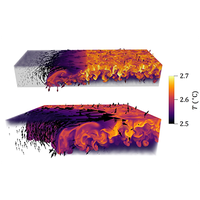
Solar radiation is known to drive vertical motion under ice-covered lakes in the late winter. Numerical studies in this context tend to neglect the effects of nonuniform solar radiation on fluid motion in the lake interior. This research provides direct numerical simulations and the subsequent analysis of the resulting gravity-current-like flow, which propagates into an inversely stratified ambient with developing convection in the form of three-dimensional Rayleigh-Taylor instabilities. We find that with the chosen parameters, typical of an ice-covered lake, geometry plays a much larger role in its development and cessation.

From weakly to strongly nonlinear viscous drop shape oscillations: An analytical and numerical study

Martin Smuda, Florian Kummer, Martin Oberlack, Dino Zrnić, and Günter Brenn

Phys. Rev. Fluids 9, 063601 (2024) - Published 17 June, 2024

Liquid drops exhibit nonspherical surface shapes with strong deformations upon pinch-off from jets or sheets. The deformed state induces shape oscillations, which are analyzed both by the weakly nonlinear approach and high-order simulations using the extended Discontinuous Galerkin method as two alternative nonlinear theories to investigate the oscillations at moderate to large deformations. The coupling of oscillation modes is found to induce quasiperiodic motion, which is shown by Fourier power spectra of the frequencies. The interconversion of kinetic and surface energies during the oscillations at strong initial deformations is quantified by the numerical simulations.

Linear stability of turbulent channel flow with one-point closure

P. V. Kashyap, Y. Duguet, and O. Dauchot

Phys. Rev. Fluids 9, 063906 (2024) - Published 17 June, 2024

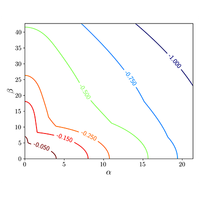
Linear stability analysis of the mean flow in turbulent plane channel flow in the large-scale pattern-forming range. Growth rate of the least stable mode as a function of streamwise and spanwise wavenumber α and β, respectively. Strict linear stability for all parameters is predicted for all parameters, suggesting that the mean flow stability does not explain pattern formation.

Dispersion control in coupled channel-heterogeneous porous media systems

Bowen Ling, Runqing Shan, and Felipe P. J. de Barros

Phys. Rev. Fluids 9, 064502 (2024) - Published 17 June, 2024

Multilayered porous media are prevalent in both natural and engineered systems, exerting significant influence on flow and transport processes. This study presents a hybrid analytical-numerical approach to compute and understand the dynamics between scalar properties and media characteristics in a coupled system with a two-dimensional free flow layer and a heterogeneous porous medium under laminar flow conditions. Our research underscores how variations in the permeability field within multilayered porous media profoundly influence and control scalar mixing behavior.

Transient internal wave excitation of resonant modes in a density staircase

Joel Bracamontes-Ramirez and Bruce R. Sutherland

Phys. Rev. Fluids 9, 064801 (2024) - Published 17 June, 2024

Vertically propagating internal wave packets incident upon a density staircase can resonantly excite natural modes of the staircase that then re-emit upward and downward propagating internal waves, changing the prediction for energy transmission of incident plane internal waves.

Neural networks in feedback for flow analysis and control

Tarcísio C. Déda, William R. Wolf, and Scott T. M. Dawson

Phys. Rev. Fluids 9, 063904 (2024) - Published 12 June, 2024

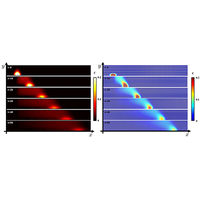
In this work we propose a machine learning methodology for flow modeling and control design based on an iterative approach for training neural networks. We demonstrate that the methodology is able to achieve stabilization of complex nonlinear plants, such as an unstable confined flow past a cylinder. We also show that, through linearization of neural network models, we can use the methodology to conduct optimal sensor selection, as well as to perform unstable equilibrium estimation and stability analysis.

Mixed mode transition in boundary layers: Helical instability

Rikhi Bose and Paul A. Durbin

Phys. Rev. Fluids 9, 063905 (2024) - Published 12 June, 2024

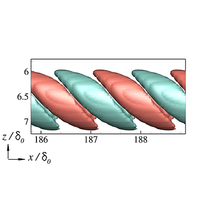
When an unstable boundary layer is perturbed by free-stream turbulence, the combination of that perturbation with two-dimensional instability waves creates a state that transitions to turbulence by an intriguing, helical breakdown. Helical breakdown is analyzed as a secondary instability; the three-dimensional structure of the eigenfunction of the secondary instability mode reveals the helical pattern. The streak configuration leading to the formation of the helical mode is different from those leading to sinuous and varicose modes reported for pure bypass transition in the absence of instability waves. The mixed mode precursor is the distinctive cause for the helical mode transition.

Aerodynamics and stability of hawkmoth forward flight with flexible wing hinge

Yujing Xue, Xuefei Cai, and Hao Liu

Phys. Rev. Fluids 9, 063101 (2024) - Published 11 June, 2024

We develop a fluid–structure interaction model that couples one-torsional-spring-based elastic wing-hinge dynamics with flapping aerodynamics to study the aerodynamics and flight stability of hawkmoth at various flight velocities. Both leading-edge vortex, body vortex, and their interactions are responsible for augmenting the vertical force production, achieving high power efficiency from the elastic storage. We verify that realistic wing-hinge stiffness leads to optimal aerodynamic performance and external disturbance-rejection is highly robust in multiple directions. This study highlights the significance of flexible wing hinges in biomimetic designs for micro-aerial vehicles.

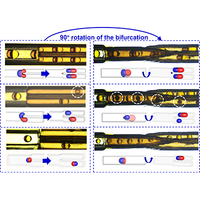
Dynamic breakup of Janus droplet in a bifurcating microchannel

Hao Wang, Shiteng Wang, Yao Mu, Qing Han, and Yi Cheng

Phys. Rev. Fluids 9, 064203 (2024) - Published 11 June, 2024

Our study combined experiments and three-dimensional lattice Boltzmann simulations to investigate the dynamic breakup of spatially asymmetric Janus droplets in microchannels under two different bifurcation orientations. We elucidated three characteristic flow regimes: (i) division into two daughter Janus droplets; (ii) breakup into a single-phase droplet and a smaller Janus droplet; and (iii) non-breakup. Unlike single-phase or double emulsion droplets, the dumbbell-shaped Janus droplets might exhibit oblique flow in the channel. The strong confinement of the main channel on mother droplets and large flow rates are essential to the symmetrical breakup of Janus droplets.

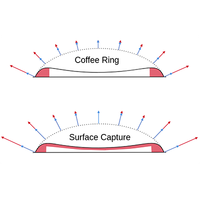
Colloidal deposits from evaporating sessile droplets: Coffee ring versus surface capture

Nathan C. J. Coombs, James E. Sprittles, and Mykyta V. Chubynsky

Phys. Rev. Fluids 9, 064304 (2024) - Published 11 June, 2024

The ubiquitous coffee ring effect, referring to the accumulation of suspended particles at the contact line of an evaporating sessile droplet, arises due to evaporation-induced capillary flow. At high evaporation rates, particle accumulation is also observed at the air-liquid interface, a phenomenon known as surface capture. While the coffee ring effect is well understood theoretically, the transition to surface capture has received less attention. Here we aim to remedy this using a simple low-dimensional model to interpolate between the pure coffee ring and pure surface capture regimes. This interpolation also provides insight into intermediate behaviors.

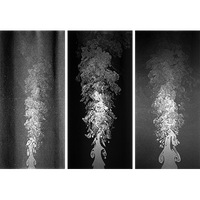
Helium plumes at moderate Reynolds number

Stefano Lanzini, Massimo Marro, Mathieu Creyssels, and Pietro Salizzoni

Phys. Rev. Fluids 9, 064501 (2024) - Published 11 June, 2024

We present the first experimental study of the turbulent entrainment in non-Boussinesq steady plumes, focusing on moderate-Reynolds helium releases issued from an axisymmetric source. Our results show that, downstream of the turbulent transition, the vertical variations of the entrainment coefficient are primarily affected by the near-field generation of turbulent kinetic energy and by a rising contribution of buoyancy effects. Both features do not exhibit a clear dependence on local variations of the density ratio.

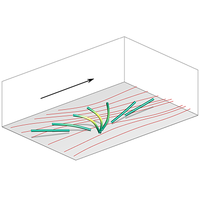
Enhanced transport of flexible fibers by pole vaulting in turbulent wall-bounded flow

Jérémie Bec, Christophe Brouzet, and Christophe Henry

Phys. Rev. Fluids 9, L062501 (2024) - Published 11 June, 2024

Long, flexible fibers in a turbulent channel flow showcase fascinating dynamics, sampling nonlinear fluid velocities along their length. Tumbling and colliding with boundaries, they bounce off like pole vaulters, propelling themselves toward the flow center. This motion depletes fibers near the walls and concentrates them in the bulk, boosting the net fiber flux beyond the initial flux of the fluid. The effect grows stronger with longer, more flexible fibers, highlighting crucial implications for transport phenomena in turbulent flows.

Stability of a liquid layer draining around a horizontal cylinder: Interplay of capillary and gravity forces

Shahab Eghbali, Simeon Djambov, and François Gallaire

Phys. Rev. Fluids 9, 063903 (2024) - Published 10 June, 2024

We study the drainage of a viscous liquid layer on a horizontal cylinder under gravity, focusing on cases where viscous effects dominate inertia. Nonlinear simulations distinguish, as a function of film thickness and Bond number, two regimes where the draining liquid either ruptures or forms a quasistatic curtain. The liquid curtain subsequently destabilizes due to capillary and gravity forces. When surface tension dominates gravity, pearls form around the cylinder, whereas when gravity dominates surface tension, hanging droplets form, as confirmed by a linear stability analysis of the curtain.

Dynamics of particle-laden turbulent suspensions: Effect of particle roughness

S. Ghosh, P. S. Goswami, and V. Kumaran

Phys. Rev. Fluids 9, 064303 (2024) - Published 10 June, 2024

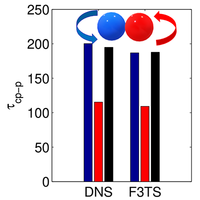
Fluctuating force, fluctuating torque simulations accurately predict the particle dynamics in particle-laden turbulent flows.

Two regimes of dilute turbulent settling suspensions under shear

Jake Langham and Andrew J. Hogg

Phys. Rev. Fluids 9, L062602 (2024) - Published 10 June, 2024

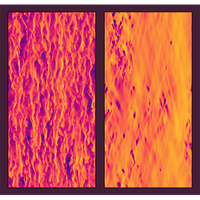
Clouds of fine particles held aloft by turbulent fluctuations are widespread in natural flows. Although these suspensions are known to inhibit the turbulence supporting them, this effect remains unstudied in many of the most basic settings, such as shear-driven flows. We trace part of the laminar-turbulent boundary for particle-laden plane Couette flow and find unexpectedly that turbulence suppression depends non-monotonically on particle settling velocity. On either side of laminar flow lie two very different states: near-homogeneous weakly stratified turbulence and a patchier regime where sediment is intermittently lifted into suspension from a highly suppressed boundary layer.

Numerical investigation on particle inertial migration in circular Poiseuille flow with thermal convection

Jingwen Fu, Wenwei Liu, Xing Jin, and Yun Huang

Phys. Rev. Fluids 9, 064302 (2024) - Published 7 June, 2024

A numerical study on the inertial migration of particle suspension in a circular pipe with thermal effect is performed by means of the Lattice Boltzmann method coupled with the discrete element method (LBM-DEM). The particle position and heat transfer for single particle as well as particle suspensions are discussed. Then, we extend the work to varied temperature conditions. It is shown that the variation of the circumferential equilibrium position can be well regressed by the Richardson number. A nonmonotonic variation of the radial equilibrium position as well as the Nusselt number is discovered, which is attributed to the particle crowding effect.

Statistical theory of passive scalar turbulence within the viscous-convective range

Taketo Ariki

Phys. Rev. Fluids 9, 064603 (2024) - Published 7 June, 2024

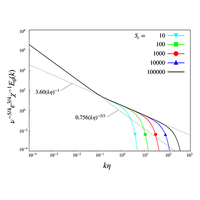
Passive scalar turbulence in the viscous-convective range is investigated via a self-consistent closure theory. Without relying on any empirical parameter the theory successfully explained the scalar-variance spectrum proportional to the inverse wavenumber k−1 from the scalar’s deformation timescale dominated by the Kolmogorov-scale eddy, which agrees with the physical viewpoint of Batchelor (1959). High Schmidt number (Sc) calculations up to Sc=100000 suggest that a clear Batchelor spectrum may appear in kη≳1 for Sc≳10000 where η is the Kolmogorov length.

Predicting the slowly converging dynamics of asymmetric vortex wakes

Qiang Zhong and Daniel B. Quinn

Phys. Rev. Fluids 9, 064702 (2024) - Published 7 June, 2024

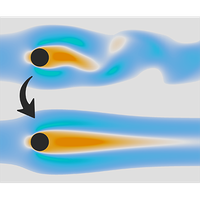
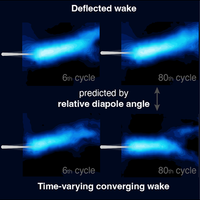
Hydrofoils with symmetric oscillations can generate asymmetric vortex wakes. This surprising asymmetry has been widely reproduced, but a simple metric to predict its onset has remained elusive. Here, using a combination of vortex modeling and water channel experiments, we show that vortex wake deflection is well-predicted by the “relative dipole angle”. In addition to offering a predictive physics-based metric, our results show that a hydrofoil’s wake can converge much more slowly than previously thought (200+ oscillation cycles), and that the wake’s asymmetry is more than a memory of the hydrofoil’s initial condition - it is an instability inherent to the vortex street.

Tunable transport in bidisperse porous materials with vascular structure

Olivier Vincent, Théo Tassin, Erik J. Huber, and Abraham D. Stroock

Phys. Rev. Fluids 9, 064202 (2024) - Published 6 June, 2024

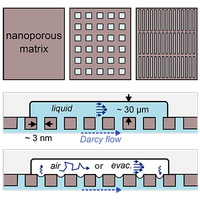
We study water transport in bi-disperse porous structures inspired by xylem tissue in vascular plants (arrays of microchannels interconnected by a nanoporous layer). With various experiments (high pressure-driven flow, spontaneous imbibition, transpiration-driven flow at negative pressure), we show that transport rates can be tuned by varying the shape of the microchannels. Even with a fixed shape, spontaneous imbibition behaves very differently depending on sample preparation (air-filled vs. evacuated), because of a dramatic change of transport mechanism in the microchannels. We provide analytical (effective medium) approaches and numerical simulations to rationalize these observations.

Opposition flow control for reducing skin-friction drag of a turbulent boundary layer

Giulio Dacome, Robin Mörsch, Marios Kotsonis, and Woutijn J. Baars

Phys. Rev. Fluids 9, 064602 (2024) - Published 6 June, 2024

With the goal of performing opposition control of large-scale drag-producing turbulence structures, we present a successful control strategy that attenuates large-scale velocity fluctuations in a turbulent boundary layer. Our control architecture consists of a wall-embedded sensor that feeds information to a real-time controller, which selectively operates a jet actuator. We quantify the performance of this single-input/single-output system with spectral statistics and direct skin-friction measurements. Additionally, we link the changes in skin-friction drag to changes in the statistical integral quantities to gauge the correlation between control output and skin-friction variation.

Sign In to Your Journals Account

Filter

Recent Issues

Vol. 11, Iss. 10
October 2026
Vol. 11, Iss. 9
September 2026
Vol. 11, Iss. 8
August 2026
Vol. 11, Iss. 7
July 2026
Category
Article Type
Section

Filter

Article Lookup

Enter a citation