Recent Articles

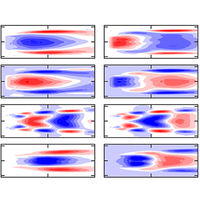
Rotation rate affects meltwater plumes below spinning ice disks

Kari Perry and Sarah Morris

Phys. Rev. Fluids 10, 110502 (2025) - Published 20 November, 2025

Bow shock instability at hypersonic speed

Adrián Antón-Álvarez and Adrián Lozano-Durán

Phys. Rev. Fluids 10, 110503 (2025) - Published 20 November, 2025

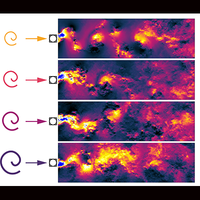
Transition to turbulence past bioprosthetic aortic valves

Karoline-Marie Bornemann and Dominik Obrist

Phys. Rev. Fluids 10, 110504 (2025) - Published 20 November, 2025

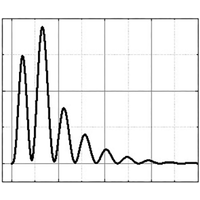
Self-excited acoustic parametric instability in downward-propagating premixed flames

Jerric R. Delfin, Nozomu Hashimoto, and Osamu Fujita

Phys. Rev. Fluids 10, 110505 (2025) - Published 20 November, 2025

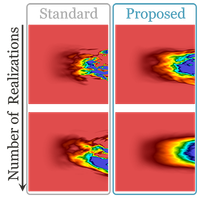
Interface-mediated gas exchange in turbulent multiphase flow

Simone Di Giorgio, Alessandro Iafrati, Sergio Pirozzoli, Francesco Zonta, and Alfredo Soldati

Phys. Rev. Fluids 10, 110506 (2025) - Published 20 November, 2025

The way bubbles gallop

Jian H. Guan, Saiful I. Tamim, Connor W. Magoon, Howard A. Stone, and Pedro J. Sáenz

Phys. Rev. Fluids 10, 110507 (2025) - Published 20 November, 2025

Mysterious case of an evaporating binary drop

Pim J. Dekker, Christian Diddens, and Detlef Lohse

Phys. Rev. Fluids 10, 110508 (2025) - Published 20 November, 2025

Exploding drops on lubricated surfaces

Marcus Lin, Fauzia Wardani, and Dan Daniel

Phys. Rev. Fluids 10, 110509 (2025) - Published 20 November, 2025

Viscoelastic vortex street

Umang N. Patel, Jonathan P. Rothstein, and Yahya Modarres-Sadeghi

Phys. Rev. Fluids 10, 110510 (2025) - Published 20 November, 2025

The crown: Rolling splash

L. Kahouadji, M. Shams, D. Panda, A. M. Abdal, S. Shin, J. Chergui, D. Juric, and O. K. Matar

Phys. Rev. Fluids 10, 110511 (2025) - Published 20 November, 2025

Interaction between counter-rotating azimuthal and axial liquid metal flows in cylindrical channel

Ilya Kolesnichenko and Vladimir Ozernykh

Phys. Rev. Fluids 10, 113701 (2025) - Published 20 November, 2025

This study examines the parameter region in which a solitary rotating vortex can form in an axial liquid metal flow. For different ratios of azimuthal and axial flow intensities, the flow pattern changes significantly. At high intensity of the axial flow the second vortex is completely suppressed by the first vortex. The rotating vortex has clear-cut boundaries. In the flow regions before and after the vortex generation, the vorticity is close to zero. After switching off electromagnetic forces, the vortex is carried by the axial flow along the channel.

Dynamic triad interactions and evolving turbulence. I. Theory: Four-dimensional modal interactions

Clara M. Velte and Preben Buchhave

Phys. Rev. Fluids 10, 114612 (2025) - Published 20 November, 2025

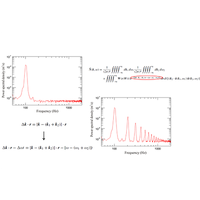
The omission of time as a parameter in the classical triad interaction analysis is shown to produce a much too simplistic picture of turbulence. Including time into the analysis shows that not only the spatial wave overlap contributes to energy exchanges between wavenumbers, but the temporal overlap is equally important. The phase match condition is thus broadened to also include temporal frequencies. This can explain much of so-called nonequilibrium turbulence. Not least fractal grid generated turbulence, which is a prime example of these effects. Part II investigates the effects on triadic analysis of practical signals with finite temporal and spatial domains and resolutions.

Dynamic triad interactions and evolving turbulence. II. Data: Implications for practical signals

Preben Buchhave and Clara M. Velte

Phys. Rev. Fluids 10, 114613 (2025) - Published 20 November, 2025

The inclusion of time as a parameter omitted in the classical triad interaction analysis was introduced in the companion paper Part I. The present work illustrates the effects of practical sampling on the resulting triad interactions. Practical sampling effects include both temporal and spatial digitization (sampling) as well as finite temporal and spatial domains. These effects are seen to broaden the interaction peaks beyond the classically expected delta-functions and the finite domains contribute to a more complex interaction evolution for domains sufficiently small in comparison to the largest scales in the flow under investigation.

Prandtl number dependence in turbulent compressible convection

Lekha Sharma, Mayank Pathak, Harshit Tiwari, and Mahendra K. Verma

Phys. Rev. Fluids 10, 114611 (2025) - Published 19 November, 2025

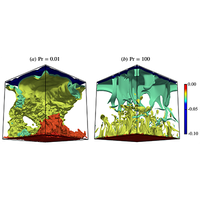
We investigate the influence of Prandtl number (Pr) on turbulent compressible convection by performing extensive numerical simulations in both two- and three-dimensions. We find that the bulk remains adiabatic across all Pr, while the global heat and momentum transport exhibits scalings similar to the incompressible Rayleigh-Bénard convection (RBC). In contrast, the boundary layers exhibit distinct scalings near the top and bottom boundaries, unlike RBC, accounting the effects of compressibility. The key image shows the flow structures at two different Pr’s.

Charged droplet manipulation by gas jets at sub-atmospheric pressures

John C. Sentmanat, Peter A. Kottke, and Andrei G. Fedorov

Phys. Rev. Fluids 10, 114303 (2025) - Published 18 November, 2025

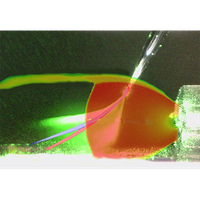
In vacuum nanoelectrospray, a stream of electrically charged nanoliter droplets moving at high speed through a rarefied space at sub-atmospheric pressure. A supersonic gas microjet in crossflow can effectively redirect the nanodroplets to control their destination. The fundamental theory predicts the droplet fate to enable applications such as high-resolution inkjet printing, trust vectoring for precise satellite control, and biochemical imaging using desorption electrospray ionization.

Tracking the rotation of light magnetic particles in turbulence

Chunlai Wu, Rudie P. J. Kunnen, Ziqi Wang, Xander M. de Wit, Federico Toschi, and Herman J. H. Clercx

Phys. Rev. Fluids 10, 114903 (2025) - Published 18 November, 2025

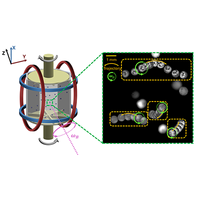
We report an experimental technique that fully resolves the three-dimensional angular velocity of magnetic particles, suspended in turbulence and actuated by an oscillating magnetic field, using only single-camera two-dimensional imaging. The particles, smaller than the Taylor microscale of the turbulent flow and less dense than water, are tracked with high accuracy to reveal their magnetically driven rotational dynamics affected by turbulence-induced hydrodynamic torque. This method to measure the rotational dynamics of small particles overcomes a key experimental limitation and the experimental apparatus enables active modulation of turbulence through external magnetic fields.

Hydrodynamic-thermoacoustic synchronization and blow-off pathways in a turbulent premixed bluff-body flame

Manikandan Balasubramaniyan, Haiqing Wang, Peijin Liu, Yu Guan, Bo Yin, and Larry K. B. Li

Phys. Rev. Fluids 10, 113201 (2025) - Published 17 November, 2025

Turbulent premixed bluff-body flames can host both hydrodynamic and self-excited thermoacoustic modes, yet their coupling remains unclear. By fixing the Reynolds number and equivalence ratio while sweeping only the combustor length, we map the route from desynchronization to two-frequency quasiperiodicity and ultimately to 1:2 mutual synchronization, accompanied by strong pressure and heat-release-rate (HRR) oscillations. Spatiotemporal analyses reveal the recirculation zone as the dominant energy-injection site. We also identify two blow-off pathways with clear, local HRR precursors.

Effects of freestream turbulence on the wakes of circular and square cylinders

Leon Li and R. Jason Hearst

Phys. Rev. Fluids 10, 114610 (2025) - Published 17 November, 2025

This study examines the effects of freestream turbulence on the wakes of circular and square cylinders, with a particular focus on the streamwise evolution of the wake properties. Four different inflow conditions are created by an active grid and are good approximations of homogeneous, isotropic turbulence, thus enabling us to isolate its effects on the wakes. Contiguous high resolution PIV data is gathered up to 1 m downstream of the cylinders. The results reveal that increasing turbulence intensity promotes early transition to self-similarity of the wake velocity deficit, and the earlier breakdown of coherent structures, leading to a reduced average number of vortices in the wake.

Techniques for improved statistical convergence in quantification of eddy diffusivity moments

Dana L. O.-L. Lavacot, Jessie Liu, Brandon E. Morgan, and Ali Mani

Phys. Rev. Fluids 10, 114904 (2025) - Published 17 November, 2025

The Macroscopic Forcing Method (MFM) is a numerical tool for determining closure operators, including turbulent closures, through forced numerical simulations. In this work, we outline and demonstrate the recommended MFM procedure to avoid slow statistical convergence of MFM measurements as well as maintain consistent boundary condition treatment. We apply the method to quantify eddy diffusivity moments in two-dimensional Rayleigh-Taylor instability to improve statistical convergence for analysis.

Transient growth in diffusive convection with and without shear

Cailei Lu, Zhenze Yao, Mengqi Zhang, Kang Luo, and Hongliang Yi

Phys. Rev. Fluids 10, 113902 (2025) - Published 14 November, 2025

A linear nonmodal analysis is performed to investigate the transient growth of diffusive convection in the absence/presence of a bounded Couette flow. The results first examine the properties of transient growth of the pure diffusive convection and interpret the mechanism to cause this growth. Then, the transient growth of diffusive convection with a Couette flow is investigated. Three nonmodal instability regimes regarding the transient growth of the mixed convection are identified, and two mechanisms of the double diffusion to enhance the lift-up mechanism are revealed.

Sign In to Your Journals Account

Filter

Recent Issues

Vol. 11, Iss. 10
October 2026
Vol. 11, Iss. 9
September 2026
Vol. 11, Iss. 8
August 2026
Vol. 11, Iss. 7
July 2026
Category
Article Type
Section

Filter

Article Lookup

Enter a citation