Recent Articles

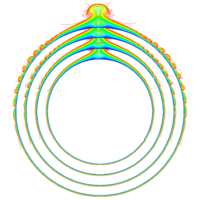
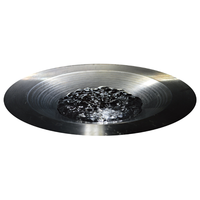
Leidenfrost phenomenon on conical surfaces

S. Hidalgo-Caballero, Y. Escobar-Ortega, and F. Pacheco-Vázquez

Phys. Rev. Fluids 1, 051902(R) (2016) - Published 26 September, 2016

Experiments on leidenfrost dynamics of water deposited in conical bowls reveal a maximum evaporation time for a given angle of confinement. The drop profile is numerically computed and the different observed regimes are explained as a result of two mechanisms of vapor release: chimneys, suppressed when confinement increases, and lateral flow along the walls.

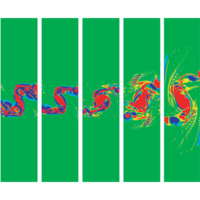
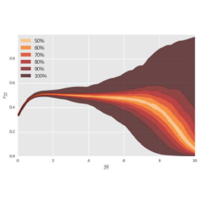
Sensitivity of flow evolution on turbulence structure

Aashwin A. Mishra, Gianluca Iaccarino, and Karthik Duraisamy

Phys. Rev. Fluids 1, 052402(R) (2016) - Published 26 September, 2016

Starting from one value of the Reynolds stress, the variability of its evolution is measured in different mean flows by ensembles of 5000 simulations of 20,000 Fourier modes.

High-frequency instabilities of stationary crossflow vortices in a hypersonic boundary layer

Fei Li, Meelan Choudhari, Pedro Paredes, and Lian Duan

Phys. Rev. Fluids 1, 053603 (2016) - Published 26 September, 2016

Complex interrelated mechanisms mediate the stability of hypersonic boundary layers. Simulations are used to investigate key mechanisms of primary and secondary instabilities, including nonparallel effects and intermode phase synchronization.

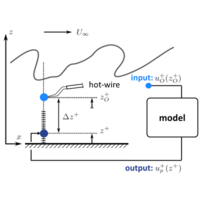
Spectral stochastic estimation of high-Reynolds-number wall-bounded turbulence for a refined inner-outer interaction model

Woutijn J. Baars, Nicholas Hutchins, and Ivan Marusic

Phys. Rev. Fluids 1, 054406 (2016) - Published 23 September, 2016

An inner-outer interaction model for predicting statistics of the near-wall streamwise velocity fluctuations via an input signal in the log region is refined using linear spectral stochastic estimation. Velocity fluctuations that are stochastically coherent between the outer and inner region are processed with a scale-dependent gain and phase during predictions.

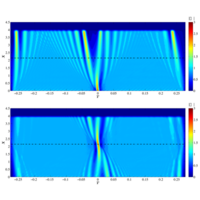
Time-reversal of nonlinear waves: Applicability and limitations

G. Ducrozet, M. Fink, and A. Chabchoub

Phys. Rev. Fluids 1, 054302 (2016) - Published 22 September, 2016

Recent experimental work reported the first evidence that time-reversal refocusing of waves can be applied to water waves. Now the first numerical study related to the validation of time-reversal applicability to hydrodynamics, beyond laboratory limitations is presented.

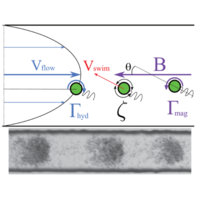
Destabilization of a flow focused suspension of magnetotactic bacteria

Nicolas Waisbord, Christopher T. Lefèvre, Lydéric Bocquet, Christophe Ybert, and Cécile Cottin-Bizonne

Phys. Rev. Fluids 1, 053203 (2016) - Published 21 September, 2016

A suspension of magnetotactic bacteria is driven against a Poiseuille flow in a magneto-microfluidic experiment. Fine tuning of the control parameters allows a transition from a single-cell regime, well described by analytical results, to a spectacular artificial bioconvection phenomena.

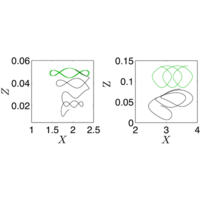
Resonant alignment of microswimmer trajectories in oscillatory shear flows

Alexander Hope, Ottavio A. Croze, Wilson C. K. Poon, Martin A. Bees, and Mark D. Haw

Phys. Rev. Fluids 1, 051201(R) (2016) - Published 20 September, 2016

Researchers experimentally characterize the response of helically swimming alga to oscillatory shear flows and find that algal swimming trajectories orient perpendicular to the flow-shear plane. Their results have implications for both active suspension rheology and the design of novel cell processing methods.

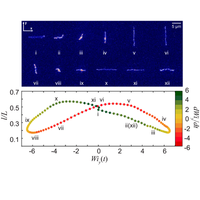
Single polymer dynamics under large amplitude oscillatory extension

Yuecheng Zhou and Charles M. Schroeder

Phys. Rev. Fluids 1, 053301 (2016) - Published 20 September, 2016

The dynamics of single polymers in large-amplitude oscillatory extensional flow are studied over a wide range of flow strengths and cycle frequencies using a combination of single-molecule experiments and Brownian dynamics simulations.

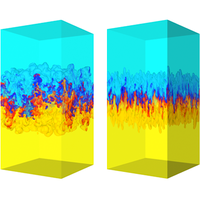
Rotating Rayleigh-Taylor turbulence

G. Boffetta, A. Mazzino, and S. Musacchio

Phys. Rev. Fluids 1, 054405 (2016) - Published 20 September, 2016

High-resolution numerical simulations show that rotation decreases the production of turbulent velocity fluctuations in Rayleigh-Taylor turbulence thus decreasing the growth of the turbulent mixing layer. Rotation also reduces the turbulent heat transfer and leads to a different regime in the Nusselt-Rayleigh scaling.

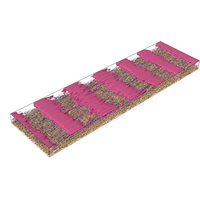
Leidenfrost drops on a heated liquid pool

L. Maquet, B. Sobac, B. Darbois-Texier, A. Duchesne, M. Brandenbourger, A. Rednikov, P. Colinet, and S. Dorbolo

Phys. Rev. Fluids 1, 053902 (2016) - Published 19 September, 2016

The roughness of a solid is known to increase the minimal temperature for observing the Leidenfrost effect. A new study shows that a volatile liquid drop placed on the surface of a smooth substrate—a non-volatile liquid pool—reaches the Leidenfrost state as soon as the liquid of the pool is just hotter than the drop boiling point, with no apparent Leidenfrost threshold.

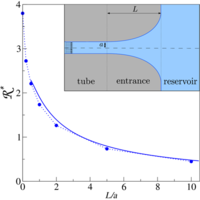
Optimal shape of entrances for a frictionless nanochannel

Christophe Belin, Laurent Joly, and François Detcheverry

Phys. Rev. Fluids 1, 054103 (2016) - Published 19 September, 2016

In a nearly frictionless channels such as narrow carbon nanotubes, flow is limited by the viscous dissipation occurring at the tube mouth. Using both numerical and analytical approaches, it is demonstrated that such end effects can be reduced to a considerable extent by adding an entrance of well-chosen shape.

Linear instabilities and recurring bursts of turbulence in rotating channel flow simulations

Geert Brethouwer

Phys. Rev. Fluids 1, 054404 (2016) - Published 19 September, 2016

Intense recurring bursts of turbulence triggered by a linear instability are seen in several rotating channel flow simulations even when the flow is partly strongly turbulent. Linear stability analysis agrees in some cases with simulations, but in others the growth rate is over-predicted.

Instability of flow around a rotating, semi-infinite cylinder

Srikanth Derebail Muralidhar, Benoît Pier, and Julian F. Scott

Phys. Rev. Fluids 1, 053602 (2016) - Published 16 September, 2016

An investigation of the linear stability properties of a boundary layer flow around a semi-infinite rotating cylinder reveals that the stability characteristics significantly depend on the rotation rate.

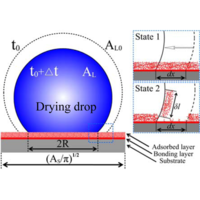
Evaporation-induced failure of hydrophobicity

H. Luo, T. Liu, J. Ma, P. Wang, Y. Wang, Y. Leprince-Wang, and G. Jing

Phys. Rev. Fluids 1, 053901 (2016) - Published 15 September, 2016

A new study shows that a moving contact line could be more dangerous for a hydrophobic coating layer on a surface than lamellar flow. The tiny water drops generate a driving force that removes the coating molecules, collecting and depositing them on the substrate as the contact line recedes.

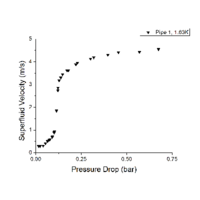
Pressure driven flow of superfluid He4 through a nanopipe

Jeffrey Botimer and Peter Taborek

Phys. Rev. Fluids 1, 054102 (2016) - Published 14 September, 2016

An experimental study of the flow of superfluid helium through single nanopipes with radii of order 100 nm and lengths of a few millimeters, reveals the existence of two distinct flow regimes above and below a critical pressure drop Pc. For P>Pc, the flow velocity is more than an order of magnitude higher than the Feynman critical velocity.

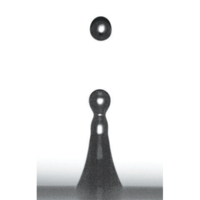
Size of the top jet drop produced by bubble bursting

Elisabeth Ghabache and Thomas Séon

Phys. Rev. Fluids 1, 051901(R) (2016) - Published 13 September, 2016

A scaling law is found for the drop on the top of the jet that arises when a bubble bursts.

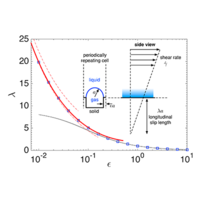
Singular effective slip length for longitudinal flow over a dense bubble mattress

Ory Schnitzer

Phys. Rev. Fluids 1, 052101(R) (2016) - Published 13 September, 2016

The effective slip length for flow over a mattress of bubbles is considered in the singular limit of close separation of the bubbles. The slip length is shown to diverge inversely with the square root of the solid fraction and three terms in an asymptotic expansion are determined.

Theoretical analysis of streamwise vortex circulation induced by a strut injector

Toshihiko Hiejima

Phys. Rev. Fluids 1, 054501 (2016) - Published 13 September, 2016

The circulation of streamwise vortices generated by a hypermixer strut in a supersonic flow is studied theoretically and numerically.

Editorial: Introduction to the 33rd Annual Gallery of Fluid Motion (Boston, Massachusetts, USA, 2015)

Andrzej Herczyński and John W. M. Bush

Phys. Rev. Fluids 1, 050001 (2016) - Published 12 September, 2016

Drop floating on a granular raft

Etienne Jambon-Puillet and Suzie Protière

Phys. Rev. Fluids 1, 050501 (2016) - Published 12 September, 2016
Sign In to Your Journals Account

Filter

Recent Issues

Vol. 11, Iss. 11
November 2026
Vol. 11, Iss. 10
October 2026
Vol. 11, Iss. 9
September 2026
Vol. 11, Iss. 8
August 2026
Category
Article Type
Section

Filter

Article Lookup

Enter a citation