Recent Articles

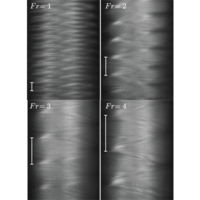
Observations of the stratorotational instability in rotating concentric cylinders

Ruy Ibanez, Harry L. Swinney, and Bruce Rodenborn

Phys. Rev. Fluids 1, 053601 (2016) - Published 1 September, 2016

Stratified flow between co-rotating vertical cylinders has many similarities with the dynamics observed in stellar and planetary accretion disks: The flow has rotation, anticyclonic shear, and a stabilizing density gradient parallel to the rotation axis. A new experiment extends the scope of previous work and demonstrates inconsistencies with linear instability theory, both viscous and inviscid.

Direct simulation Monte Carlo investigation of the Rayleigh-Taylor instability

M. A. Gallis, T. P. Koehler, J. R. Torczynski, and S. J. Plimpton

Phys. Rev. Fluids 1, 043403 (2016) - Published 31 August, 2016

The Rayleigh-Taylor instability (RTI) is investigated using the direct simulation Monte Carlo method of molecular gas dynamics. Fully resolved two-dimensional simulations are performed to quantify the growth of flat and single-mode perturbed interfaces between two atmospheric-pressure monatomic gases as a function of the Atwood number and the gravitational acceleration. Future simulations on more extreme computational platforms will enable investigation of the RTI in greater detail.

Linear control of oscillator and amplifier flows

Peter J. Schmid and Denis Sipp

Phys. Rev. Fluids 1, 040501 (2016) - Published 30 August, 2016

This invited article, presented at the 2012 APS-DFD meeting, provides a thoughtful explanation of tools and approaches for the design of flow control strategies for both stable and unstable flows.

Shear-induced clustering of Brownian colloids in associative polymer networks at moderate Péclet number

Juntae Kim and Matthew E. Helgeson

Phys. Rev. Fluids 1, 043302 (2016) - Published 30 August, 2016

Shearing colloidal suspensions in viscoelastic fluids exhibit clustering at relatively high shear rates. New experiments on fluids with thermoresponsive viscoelasticity suggest that this clustering can be driven by the perturbative effect of suspension anisotropy on hydrodynamic interactions.

Solitary-like waves in a liquid foam microchannel

Yann Bouret, Alexandre Cohen, Nathalie Fraysse, Médéric Argentina, and Christophe Raufaste

Phys. Rev. Fluids 1, 043902 (2016) - Published 30 August, 2016

The liquid microchannels located at the contact between three bubbles in liquid foams exhibit peculiar inertial flows. Experiments and theory show that their relaxation can trigger traveling depression waves having the characteristics of solitons.

Minimum-dissipation scalar transport model for large-eddy simulation of turbulent flows

Mahdi Abkar, Hyun J. Bae, and Parviz Moin

Phys. Rev. Fluids 1, 041701(R) (2016) - Published 29 August, 2016

The anisotropic minimum dissipation (AMD) subfilter eddy-viscosity model for large-eddy simulations is tested, and results show good agreement with well-established empirical correlations and theoretical predictions of the resolved flow statistics. In particular, the AMD model can accurately predict the expected surface-layer similarity profiles and power spectra for both velocity and scalar concentration.

Node dynamics and cusps size distribution at the border of liquid sheets

E. Villermaux and C. Almarcha

Phys. Rev. Fluids 1, 041902(R) (2016) - Published 29 August, 2016

A careful experimental study of the dynamics of nodes and the distribution of the sizes of cusps at the border of liquid sheets is presented.

Closed-loop control of boundary layer streaks induced by free-stream turbulence

George Papadakis, Liang Lu, and Pierre Ricco

Phys. Rev. Fluids 1, 043501 (2016) - Published 26 August, 2016

A rigorous approach to include the effect of free-stream turbulence in the optimal control of streaks developing in an incompressible laminar boundary layer is presented. The control problem is formulated in wavenumber space and solved analytically. Under appropriate conditions, it is shown that the adjoint variables admit a self similar solution, whose scaling is different from that of the direct variables. The new scaling is derived analytically and confirmed numerically.

Dynamics of nitrogen dissociation from direct molecular simulation

Paolo Valentini, Thomas E. Schwartzentruber, Jason D. Bender, and Graham V. Candler

Phys. Rev. Fluids 1, 043402 (2016) - Published 25 August, 2016

Nitrogen dissociation is studied using direct molecular simulation with a new potential-energy surface. Both N2 - N2 and N - N2 processes are simulated as they concurrently take place in an evolving nonequilibrium gas system. The coupling between vibrational excitation and dissociation is quantified leading to several new insights.

Effective viscosity of two-dimensional suspensions: Confinement effects

Vincent Doyeux, Stephane Priem, Levan Jibuti, Alexander Farutin, Mourad Ismail, and Philippe Peyla

Phys. Rev. Fluids 1, 043301 (2016) - Published 24 August, 2016

Confined 3D suspensions of spherical and non-Brownian particles show a remarkable rheological property: hydrodynamic interactions between spheres negatively contribute to the effective viscosity. This effect survives in 2D, and simulations help explain this surprising effect

Elastic instabilities in parallel shear flows of a viscoelastic shear-thinning liquid

R. J. Poole

Phys. Rev. Fluids 1, 041301(R) (2016) - Published 23 August, 2016

Experimental results from two parallel shear flows of a highly shear-thinning viscoelastic polymer solution show that at low flow rates, the mean velocity profiles are steady and in agreement with analytical expectations. At higher flow rate, however, instability arises and the flow becomes weakly time dependent.

Opto-electro-fluidics and tip coax conical surface plasmons

Touvia Miloh

Phys. Rev. Fluids 1, 044105 (2016) - Published 23 August, 2016

The emerging field of plasmofluidics combines plasmonics and nanofluids as an efficient technological platform for manipulating nanoparticles and begetting indirect mixing in aqueous phases due to micro/nano vortices. In a theoretical study, conical metallic structures with small apex angles are considered, and the analytical dispersion relation under optimal operating conditions is derived. It is shown that nanoparticle control can be achieved in way that is similar to optical tweezers.

Induced charge electrophoresis of a conducting cylinder in a nonconducting cylindrical pore and its micromotoring application

Huicheng Feng, Teck Neng Wong, and Zhizhao Che

Phys. Rev. Fluids 1, 044103 (2016) - Published 22 August, 2016

A careful study of induced-charge electrophoresis of a cylinder in a cylindrical pore reveals that the cylinder not only translate but also rotate. The discovery of the cylinder rotation is an important stepping stone for the development of micromotors.

AFM study of hydrodynamics in boundary layers around micro- and nanofibers

Julien Dupré de Baubigny, Michael Benzaquen, Caroline Mortagne, Clémence Devailly, Sébastien Kosgodagan Acharige, Justine Laurent, Audrey Steinberger, Jean-Paul Salvetat, Jean-Pierre Aimé, and Thierry Ondarçuhu

Phys. Rev. Fluids 1, 044104 (2016) - Published 22 August, 2016

Three AFM techniques are combined to investigate hydrodynamics around micro- and nanofibers. Comparing the experimental findings to a classical theoretical model reveals the potential of AFM for quantitative measurement of dissipation processes at the submicron scale.

Axial dispersion of Brownian colloids in microfluidic channels

Michael P. Howard, Aishwarya Gautam, Athanassios Z. Panagiotopoulos, and Arash Nikoubashman

Phys. Rev. Fluids 1, 044203 (2016) - Published 19 August, 2016

A theoretical and computational study of the axial dispersion of colloidal suspensions confined in a parallel-plate channel with colloid diameters comparable to the channel width is presented.

Onsager's cross coupling effects in gas flows confined to micro-channels

Ruijie Wang, Xinpeng Xu, Kun Xu, and Tiezheng Qian

Phys. Rev. Fluids 1, 044102 (2016) - Published 18 August, 2016

Onsager’s cross-coupling relations are validated for gas flows in microgeometries, including ratchet surfaces used for the design of Knudsen pumps.

Force variation within arrays of monodisperse spherical particles

G. Akiki, T. L. Jackson, and S. Balachandar

Phys. Rev. Fluids 1, 044202 (2016) - Published 17 August, 2016

A numerical study of the flow over dispersed spherical particles proposes new correlations to determine the statistics of the aerodynamic forces acting on each particle.

Evaporation-driven dewetting of a liquid film

L. Fourgeaud, E. Ercolani, J. Duplat, P. Gully, and V. S. Nikolayev

Phys. Rev. Fluids 1, 041901(R) (2016) - Published 16 August, 2016

From observations by grid deflection and by interferometry, the evaporating film is found to be nearly flat across the interior with a ridge at its edge, the ridge giving a large receding contact angle.

Intrusive gravity currents propagating into two-layer stratified ambients: Vorticity modeling

M. A. Khodkar, M. M. Nasr-Azadani, and E. Meiburg

Phys. Rev. Fluids 1, 044302 (2016) - Published 16 August, 2016

Theorists offer an alternate approach to the 1960s theory for gravity currents. The new approach uses vorticity conservation instead of energy conservation. The latest contribution extends previous studies to examine the evolution of an intrusion of moderate-density fluid passing horizontally into a stratified experiment.

Wake meandering statistics of a model wind turbine: Insights gained by large eddy simulations

Daniel Foti, Xiaolei Yang, Michele Guala, and Fotis Sotiropoulos

Phys. Rev. Fluids 1, 044407 (2016) - Published 16 August, 2016

A numerical investigation of the wake of an axial flow miniature wind turbine is presented to elucidate the three-dimensional structure of the wake and the mechanisms controlling near and far wake instabilities.

Sign In to Your Journals Account

Filter

Recent Issues

Vol. 11, Iss. 11
November 2026
Vol. 11, Iss. 10
October 2026
Vol. 11, Iss. 9
September 2026
Vol. 11, Iss. 8
August 2026
Category
Article Type
Section

Filter

Article Lookup

Enter a citation