Recent Articles

Flows driven by libration, precession, and tides in planetary cores

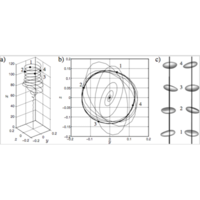
Michael Le Bars

Phys. Rev. Fluids 1, 060505 (2016) - Published 18 October, 2016

A thorough description of challenges and recent progress in the understanding of flows in planetary molten cores is provided, with particular attention to flow driven by mechanical forcing due to the tugging of one celestial body on another. This case is particularly relevant for the understanding of the reciprocal actions in the Moon/Earth system.

Analogies between elastic and capillary interfaces

Jacco H. Snoeijer

Phys. Rev. Fluids 1, 060506 (2016) - Published 18 October, 2016

A study of the analogies between elastic and capillary interfacial flows is presented.

Efficient coordination of swarms of sensor-laden balloons for persistent, in situ, real-time measurement of hurricane development

Thomas Bewley and Gianluca Meneghello

Phys. Rev. Fluids 1, 060507 (2016) - Published 18 October, 2016

Swarms of balloons released into hurricane formation regions can be used to measure meteorological variables and help improve short-term prediction models.

History effects on the gas exchange between a bubble and a liquid

Shigan Chu and Andrea Prosperetti

Phys. Rev. Fluids 1, 064202 (2016) - Published 17 October, 2016

A study of gas exchange between a bubble and the surrounding liquid, in the limit of small radial velocities, reveals that history effects are important in determining the threshold conditions.

Numerical study into the morphology and formation mechanisms of three-dimensional particle structures in vibrated cylindrical cavities with various heating conditions

Marcello Lappa

Phys. Rev. Fluids 1, 064203 (2016) - Published 17 October, 2016

Particle accumulation dynamics in vibrated nonisothermal monodisperse suspensions of solid spheres (in a liquid) are investigated. The diversity of particle agglomerates when the direction of the imposed temperature gradient is changed results from the different roles played by (curved or straight) boundaries in constraining particles and from the different topology of the resulting thermovibrational flow.

Thermocapillary motion on lubricant-impregnated surfaces

Nada Bjelobrk, Henri-Louis Girard, Srinivas Bengaluru Subramanyam, Hyuk-Min Kwon, David Quéré, and Kripa K. Varanasi

Phys. Rev. Fluids 1, 063902 (2016) - Published 14 October, 2016

Thermocapillary induced droplet motion is markedly enhanced when using lubricant impregnated surfaces instead of a solid substrates. These surfaces provide weak pinning, which makes them ideal for droplet transportation, and specifically for water transportation

Coalescence-induced nanodroplet jumping

Hyeongyun Cha, Chenyu Xu, Jesus Sotelo, Jae Min Chun, Yukihiro Yokoyama, Ryan Enright, and Nenad Miljkovic

Phys. Rev. Fluids 1, 064102 (2016) - Published 14 October, 2016

Experiments show, for the first time, two water droplets coalescing and jumping on a superhydrophobic surface. Adhesion, contact angle hysteresis, and initial wetting behavior governed by the surface structure morphology and length scale, are all shown to play a role in droplet jumping.

Exploring non-normality in magnetohydrodynamic rotating shear flows: Application to astrophysical accretion disks

Tanayveer Singh Bhatia and Banibrata Mukhopadhyay

Phys. Rev. Fluids 1, 063101 (2016) - Published 12 October, 2016

Transient energy growth (TEG) in magnetohydrodynamic flows is shown to play an important role in the emergence of nonlinearity and plausible turbulence in shear flows, which has important astrophysical applications.

Crossover from shear-driven to thermally activated drainage of liquid-infused microscale capillaries

Carlos E. Colosqui, Jason S. Wexler, Ying Liu, and Howard A. Stone

Phys. Rev. Fluids 1, 064101 (2016) - Published 12 October, 2016

Surface roughness can play a critical role in dynamic wetting processes like imbibition and drainage of capillaries. In the presence of nanoscale roughness, The shear-driven drainage of microscale capillary grooves exhibits regimes that cannot be described by solely considering hydrodynamic and capillary effects. Thermal motion and nanoscale surface roughness “characterized by AFM” induce drainage rates predicted by Kramers theory of thermally activated transitions.

Parameter governing the far-field features of round jets

Xi Xia and Kamran Mohseni

Phys. Rev. Fluids 1, 062401(R) (2016) - Published 10 October, 2016

The enhanced entrainment and mixing of synthetic (pulsed) jets is characterised by a modified effective eddy viscosity.

Smooth- and rough-wall boundary layer structure from high spatial range particle image velocimetry

D. T. Squire, C. Morrill-Winter, N. Hutchins, I. Marusic, M. P. Schultz, and J. C. Klewicki

Phys. Rev. Fluids 1, 064402 (2016) - Published 7 October, 2016

Two novel particle image velocimetry arrangements are used to make true spatial comparisons between high Reynolds number smooth- and rough-wall boundary layer flows across a very wide range of streamwise scales.

Size segregation in a granular bore

A. N. Edwards and N. M. Vriend

Phys. Rev. Fluids 1, 064201 (2016) - Published 6 October, 2016

The effect of particle size segregation in an upslope propagating, bidisperse granular bore is investigated and experimental observations agree with recent progress that upwards and downwards segregation of large and small particles, respectively, is asymmetric.

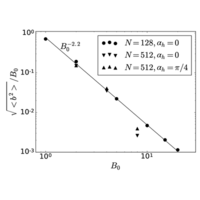
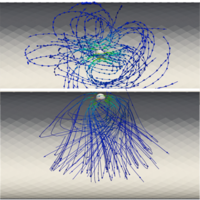
Dynamo generated by the centrifugal instability

Florence Marcotte and Christophe Gissinger

Phys. Rev. Fluids 1, 063602 (2016) - Published 5 October, 2016

A numerical study of the magnetohydrodynamic flow generated in a thin spherical shell in rapid rotation reports, for the first time, the generation of a dynamo magnetic field by the centrifugal instability in a spherical geometry and provides a new explanation for the astrophysical magnetic fields which cannot rely on thermal convection.

Mesolayer of attached eddies in turbulent channel flow

Yongyun Hwang

Phys. Rev. Fluids 1, 064401 (2016) - Published 4 October, 2016

The Reynolds-dependent scaling of the outer peak in the streamwise turbulence intensity in wall-bounded turbulent flows is explained with the discovery of the inner-scaling nature of the outer structure in the near-wall region. Theoretical generalization further reveals that this feature indicates incomplete self-similarity of the wall-parallel velocity components of the log-layer motions in the region close to the wall.

Large-scale instabilities of helical flows

Alexandre Cameron, Alexandros Alexakis, and Marc-Étienne Brachet

Phys. Rev. Fluids 1, 063601 (2016) - Published 3 October, 2016

3D turbulence leads to the formation of small-scale structures. For moderate Reynolds number, helically forced flows are shown to generate large-scale instabilities. These large-scale instabilities are quantified with a new numeric model using Floquet theory.

Instability of nanometric fluid films on a thermally conductive substrate

N. Dong and L. Kondic

Phys. Rev. Fluids 1, 063901 (2016) - Published 3 October, 2016

The dynamics of a thin, incompressible viscous fluid, subject to both van der Waals and Marangoni forces, on a thermally conducting substrate, is theoretically considered in the regime where the temperature field of the film and of the substrate evolve on a comparable time scale. Calculations show that the Marangoni flows have a strong effect on the instability and that the evolution of the temperature field, coupled to the evolving film profile, qualitatively changes the instability.

Shock interaction with three-dimensional face centered cubic array of particles

Y. Mehta, C. Neal, T. L. Jackson, S. Balachandar, and S. Thakur

Phys. Rev. Fluids 1, 054202 (2016) - Published 30 September, 2016

New results on the computation of shock interactions with a 3D array of spherical particles, fixed in a face-centered-cubic arrangement, quantify multiparticle effects on their drag for different volume fractions and strengths.

Tridimensional to bidimensional transition in magnetohydrodynamic turbulence with a guide field and kinetic helicity injection

N. E. Sujovolsky and P. D. Mininni

Phys. Rev. Fluids 1, 054407 (2016) - Published 29 September, 2016

As the strength of an external uniform magnetic field is increased in a 3D magnetohydrodynamic flow, the flow can undergo a transition and change its dimensionality. Numerical simulations using helical mechanical forcing show that the presence of helicity changes the spectral scaling of the energy and affects the statistics of velocity field fluctuations. Morever, for very strong external magnetic fields a direct cascade of mechanical helicity is observed, which allows derivation of scaling laws for the system.

Nanoparticle stochastic motion in the inertial regime and hydrodynamic interactions close to a cylindrical wall

Helena Vitoshkin, Hsiu-Yu Yu, David M. Eckmann, Portonovo S. Ayyaswamy, and Ravi Radhakrishnan

Phys. Rev. Fluids 1, 054104 (2016) - Published 28 September, 2016

Scientists perform direct numerical calculations aimed at the optimization of drug delivery agents such as targeted therapeutic nanocarriers. The emphasis of their work is on hydrodynamic interactions between the nanocarrier and the vessel wall mediated by the fluid flow, and how the hydrodynamic interaction varies as the particle transitions from being at the center of the vessel to being very close to the wall prior to binding.

Paths and wakes of deformable nearly spheroidal rising bubbles close to the transition to path instability

José Carlos Cano-Lozano, Carlos Martínez-Bazán, Jacques Magnaudet, and Joël Tchoufag

Phys. Rev. Fluids 1, 053604 (2016) - Published 27 September, 2016

A computational study of the flow past freely deforming bubbles rising in still liquids is reported, refining the critical curve associated with path instability. Depending on the relative strength of inertia, viscous, and capillary effects, different regimes are observed in which the characteristics of the path, bubble shape, and wake structure, together with their couplings, are examined in detail.

Sign In to Your Journals Account

Filter

Recent Issues

Vol. 11, Iss. 11
November 2026
Vol. 11, Iss. 10
October 2026
Vol. 11, Iss. 9
September 2026
Vol. 11, Iss. 8
August 2026
Category
Article Type
Section

Filter

Article Lookup

Enter a citation