Recent Articles

Oscillatory shear rheology measurements and Newtonian modeling of insoluble monolayers

Fayaz Rasheed, Aditya Raghunandan, Amir H. Hirsa, and Juan M. Lopez

Phys. Rev. Fluids 2, 044002 (2017) - Published 5 April, 2017

Shear rheology of a harmonically driven knife-edge viscometer is analyzed with experiments and computations. The distribution of phase lag in surface velocity relative to the knife-edge speed is shown to be a robust measure of the rheology over a wide range of driving frequencies and amplitudes.

Universal and nonuniversal aspects of vortex reconnections in superfluids

Alberto Villois, Davide Proment, and Giorgio Krstulovic

Phys. Rev. Fluids 2, 044701 (2017) - Published 4 April, 2017

Vortex reconnections play a fundamental role in fluid dynamics. A study of reconnection events in superfluids using different vortex configurations is presented. By deriving asymptotic theory and using numerical simulations the universal and nonuniversal aspects of vortex reconnections are revealed.

Damped coalescence cascade of liquid drops

Suin Shim and Howard A. Stone

Phys. Rev. Fluids 2, 044001 (2017) - Published 3 April, 2017

During coalescence of a drop with a liquid bath, the damped coalescence cascade (DCC) occurs due to local Marangoni flow generated on the bath surface. The local Marangoni flow accelerates air film drainage between the drop and the bath, leading to suppression of the rebound of daughter drops.

Star-shaped oscillations of Leidenfrost drops

Xiaolei Ma, Juan-José Liétor-Santos, and Justin C. Burton

Phys. Rev. Fluids 2, 031602(R) (2017) - Published 31 March, 2017

An experimental investigation of oscillations of Leidenfrost drops finds that the oscillations are driven by capillary waves beneath the drop.

Influence of Rayleigh-Bénard convection on electrokinetic instability in overlimiting current conditions

Joeri C. de Valença, Aziz Kurniawan, R. Martijn Wagterveld, Jeffery A. Wood, and Rob G. H. Lammertink

Phys. Rev. Fluids 2, 033701 (2017) - Published 31 March, 2017

The coupling and interplay of electrokinetic and Rayleigh-Bénard instabilities are experimentally investigated in the flow towards an ion selective interface. The flow, concentration profiles, and electrical response are measured and modeled based on Fick’s second law.

Role of grain dynamics in determining the onset of sediment transport

Abram H. Clark, Mark D. Shattuck, Nicholas T. Ouellette, and Corey S. O'Hern

Phys. Rev. Fluids 2, 034305 (2017) - Published 31 March, 2017

Dimensional analysis and numerical simulations show that the onset of sediment transport by a flowing fluid may be best described as the point when mobile grains can no longer stop, as opposed to when static grains start to move in response to fluid forces.

Turbulence modulation in heavy-loaded suspensions of tiny particles

P. Gualtieri, F. Battista, and C. M. Casciola

Phys. Rev. Fluids 2, 034304 (2017) - Published 30 March, 2017

Particle-induced turbulence modulation is discussed by physically regularizing the interphase momentum coupling. Contrary to standard approaches, small-scale statistics converge and highlight the role of the particles in modifying the energy cascade. A new spectral law is verified by direct numerical simulation data.

Tunneling with a hydrodynamic pilot-wave model

André Nachbin, Paul A. Milewski, and John W. M. Bush

Phys. Rev. Fluids 2, 034801 (2017) - Published 30 March, 2017

A model equation for the 1D pilot-wave dynamics over a varying bottom is applied to tunnelling between two cavities.

Jets or vortices—What flows are generated by an inverse turbulent cascade?

Anna Frishman, Jason Laurie, and Gregory Falkovich

Phys. Rev. Fluids 2, 032602(R) (2017) - Published 29 March, 2017

Two-dimensional turbulence gives rise to surprising, symmetry-breaking, large-scale patterns. A numerical study reveals a mix of vortices and jets, sensitive to friction and box aspect ratio, instead of a dichotomy between the two. The resulting mean flow changes with the averaging time chosen.

Chaotic and regular instantons in helical shell models of turbulence

Massimo De Pietro, Alexei A. Mailybaev, and Luca Biferale

Phys. Rev. Fluids 2, 034606 (2017) - Published 29 March, 2017

A study of different families of chaotic or coherent instantonlike solutions in a class of inviscid models of the turbulent cascade finds nontrivial correlations between the anomalous scaling of the stationary viscous ensemble and the helicity contents of the instantons.

Instability of the roll-streak structure induced by background turbulence in pretransitional Couette flow

Brian F. Farrell, Petros J. Ioannou, and Marios-Andreas Nikolaidis

Phys. Rev. Fluids 2, 034607 (2017) - Published 29 March, 2017

Contrary to previous explanations for the ubiquitous occurrence of the roll-streak structure in wall-bounded shear flows as arising only from coherent perturbations, new analysis shows that the roll/streak structure can also arise from destabilization of this structure by free-stream turbulence.

Publisher's Note: Lubricated wrinkles: Imposed constraints affect the dynamics of wrinkle coarsening [Phys. Rev. Fluids 2, 014202 (2017)]

Ousmane Kodio, Ian M. Griffiths, and Dominic Vella

Phys. Rev. Fluids 2, 039901 (2017) - Published 29 March, 2017

Local dissipation limits the dynamics of impacting droplets on smooth and rough substrates

Yuli Wang, Gustav Amberg, and Andreas Carlson

Phys. Rev. Fluids 2, 033602 (2017) - Published 28 March, 2017

Numerical simulations show that dissipation local to the contact line of an impacting droplet limits its maximum spreading diameter, which scales with a function of the droplet viscosity, the impact Reynolds number, and the contact line friction parameter.

Numerical study of solitary wave attenuation in a fragmented ice sheet

Philippe Guyenne and Emilian I. Părău

Phys. Rev. Fluids 2, 034002 (2017) - Published 27 March, 2017

Ocean waves are attenuated when propagating in a marginal ice zone. A direct phase-resolved numerical model of nonlinear ocean waves in fragmented sea ice is proposed. Two-dimensional simulations quantify solitary wave scattering and attenuation through an irregular array of ice floes.

Similarity transformation for equilibrium boundary layers, including effects of blowing and suction

Xi Chen and Fazle Hussain

Phys. Rev. Fluids 2, 034605 (2017) - Published 27 March, 2017

A Lie group symmetry analysis is applied to the sink flow turbulent boundary layers, where a similarity transformation is obtained mapping mean velocity profiles under different blowing and suction conditions into a universal profile.

Lift-induced vortex dipole collapse

S. Ravichandran, Harish N. Dixit, and Rama Govindarajan

Phys. Rev. Fluids 2, 034702 (2017) - Published 27 March, 2017

Effects of buoyancy on fluid flow are studied through its action on countersigned light-cored vortex dipoles. Buoyant vortices can be modeled as spinning bodies experiencing a lift force. Theory and simulations show that buoyant vortex dipoles can annihilate, leading to large increases of enstrophy and kinetic energy.

Segregation of helicity in inertial wave packets

A. Ranjan

Phys. Rev. Fluids 2, 033801 (2017) - Published 24 March, 2017

The helicity segregation characteristic of a monochromatic inertial wave is tested for a wave packet. The effect of several forces, such as those due to buoyancy and magnetic field, on this characteristic is also investigated.

Analysis of the instability underlying electrostatic suppression of the Leidenfrost state

Arjang Shahriari, Soumik Das, Vaibhav Bahadur, and Roger T. Bonnecaze

Phys. Rev. Fluids 2, 034001 (2017) - Published 24 March, 2017

Electrostatic suppression of Leidenfrost state is studied experimentally and theoretically. Linear stability theory successfully predicts threshold voltages required for different drop volumes and surface temperatures.

Dynamics of a flexible helical filament rotating in a viscous fluid near a rigid boundary

M. K. Jawed and P. M. Reis

Phys. Rev. Fluids 2, 034101 (2017) - Published 24 March, 2017

The effects of a no-slip wall on flagellar propulsion are investigated by experiments with macroscopic-scale model flagella and simulations based on algorithms from computer graphics. A nearby wall shifts the threshold for buckling of the flexible flagellum and increases the propulsive force.

Collapse of superhydrophobicity on nanopillared surfaces

Matteo Amabili, Alberto Giacomello, Simone Meloni, and Carlo Massimo Casciola

Phys. Rev. Fluids 2, 034202 (2017) - Published 24 March, 2017
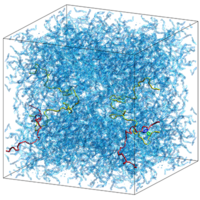
The collapse of the superhydrophobic state on a nanopillared surface is investigated via rare-event molecular dynamics simulations, which show that the collapse mechanism is asymmetric and involves several pillars. Nanoscale effects are assessed by comparison with macroscopic continuum models.

Sign In to Your Journals Account

Filter

Recent Issues

Vol. 11, Iss. 11
November 2026
Vol. 11, Iss. 10
October 2026
Vol. 11, Iss. 9
September 2026
Vol. 11, Iss. 8
August 2026
Category
Article Type
Section

Filter

Article Lookup

Enter a citation