Recent Articles

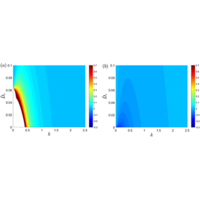
Radial buoyancy effects on momentum and heat transfer in a circular Couette flow

Changwoo Kang, Antoine Meyer, Innocent Mutabazi, and Harunori N. Yoshikawa

Phys. Rev. Fluids 2, 053901 (2017) - Published 5 May, 2017

The stability of the Taylor-Couette flow with a stationary outer cylinder is sensitive to the radial temperature gradient. A numerical investigation shows that the nature of the bifurcation and the consequent heat transfer depend significantly on the heating direction as well as on the diffusive properties of the fluid.

Purely elastic instabilities in a microfluidic flow focusing device

P. Ballesta and M. A. Alves

Phys. Rev. Fluids 2, 053301 (2017) - Published 4 May, 2017

Complex fluids generate different types of flow instabilities with increasing flow rate under inertialess flow conditions in a flow focusing device.

Searching for turbulence models by artificial neural network

Masataka Gamahara and Yuji Hattori

Phys. Rev. Fluids 2, 054604 (2017) - Published 4 May, 2017

An artificial neural network establishes a turbulence model for large-eddy simulation using direct numerical simulation of a turbulent channel flow. The resulting model is similar to an existing turbulence model (the gradient model).

Fast inertial particle manipulation in oscillating flows

Raqeeb Thameem, Bhargav Rallabandi, and Sascha Hilgenfeldt

Phys. Rev. Fluids 2, 052001(R) (2017) - Published 3 May, 2017

Microparticles are quickly and efficiently sorted by size through the action of an oscillating bubble attached to a microfluidic channel. Experimental observations and a quantitative theory of general particle deflections near oscillating interfaces are presented.

Ultimate-state transition of turbulent Rayleigh-Bénard convection

Guenter Ahlers, Eberhard Bodenschatz, and Xiaozhou He

Phys. Rev. Fluids 2, 054603 (2017) - Published 3 May, 2017

A prediction (solid line) for the ultimate-state transition Rayleigh-number, with its pre-factor adjusted to fit the experimental value for a Prandtl number Pr = 0.82, passes through the DNS estimate for Pr = 0.021. Cryogenic observations of transitions (solid circles) fall well below this line.

Lagrangian acceleration statistics in a turbulent channel flow

Nickolas Stelzenmuller, Juan Ignacio Polanco, Laure Vignal, Ivana Vinkovic, and Nicolas Mordant

Phys. Rev. Fluids 2, 054602 (2017) - Published 2 May, 2017

Fluid particles trajectories are reconstructed experimentally and numerically in a high Reynolds number turbulent channel flow. A statistical Lagrangian analysis of acceleration and velocity reveals a complex behavior and a persistent anisotropy at the smallest scales.

Optimal initial condition of passive tracers for their maximal mixing in finite time

Mohammad Farazmand

Phys. Rev. Fluids 2, 054601 (2017) - Published 1 May, 2017

The mixing of passive tracers in unsteady fluid flow is considered. A general systematic framework is proposed to determine the optimal initial condition of the passive tracer so that the most homogeneous mixture is obtained after finite-time advection.

Stochastic kinetic theory for collective behavior of hydrodynamically interacting active particles

Yuzhou Qian, Peter R. Kramer, and Patrick T. Underhill

Phys. Rev. Fluids 2, 043104 (2017) - Published 28 April, 2017

A stochastic kinetic theory is used to quantify hydrodynamic interactions among swimming microorganisms. The interactions alter the correlations and dynamics of organisms and the mixing of passive tracers. Tracers can exhibit superdiffusive motion even without interactions of the organisms.

Collapse of elongated voids in porous energetic materials: Effects of void orientation and aspect ratio on initiation

Nirmal Kumar Rai, Martin J. Schmidt, and H. S. Udaykumar

Phys. Rev. Fluids 2, 043201 (2017) - Published 28 April, 2017

The sensitivity of elongated voids in pressed explosives is analyzed with reactive mesoscale simulations. A strong dependence of the sensitivity on void aspect ratio and elongation is found. Ranges that enhance or inhibit initiation are identified.

High-resolution simulations of cylindrical void collapse in energetic materials: Effect of primary and secondary collapse on initiation thresholds

Nirmal Kumar Rai, Martin J. Schmidt, and H. S. Udaykumar

Phys. Rev. Fluids 2, 043202 (2017) - Published 28 April, 2017

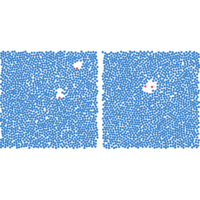
Void collapse in solid explosives leads to hot spot formation and enhanced sensitivity. Here a grid resolution study is presented for a two-dimensional circular void for various shock strengths. We find that mesoscale simulations of voids may contain significant predictive uncertainty.

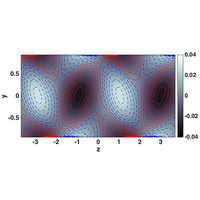
Streak instability in viscoelastic Couette flow

L. Biancofiore, L. Brandt, and T. A. Zaki

Phys. Rev. Fluids 2, 043304 (2017) - Published 28 April, 2017

Bypass transition in wall-bounded flows is delayed upon addition of polymers. A torque is established by the polymer forces and opposes the local vorticity, thus weakening the amplification of streaks and delaying transition.

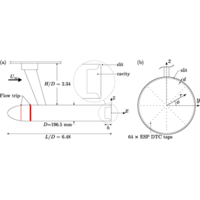
Passive control of base pressure on an axisymmetric blunt body using a perimetric slit

Juan Marcos García de la Cruz, Anthony R. Oxlade, and Jonathan F. Morrison

Phys. Rev. Fluids 2, 043905 (2017) - Published 28 April, 2017

The effect of a peripheral slit on the wake dynamics and mean base pressure of an axisymmetric body is studied experimentally. The mean base pressure is found to increase monotonically with slit size until a saturation is reached. The main mechanism for this is an improved symmetry of the wake.

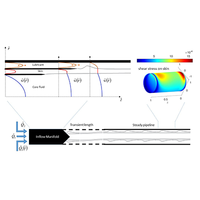
Triple-layer configuration for stable high-speed lubricated pipeline transport

Parisa Sarmadi, Sarah Hormozi, and Ian A. Frigaard

Phys. Rev. Fluids 2, 044302 (2017) - Published 28 April, 2017

A novel methodology for efficient transport of heavy oil via a core-annular flow using a viscoplastic fluid is presented. In this triple layer structure, the viscoplastic fluid acts as an intermediate shaped skin layer to eliminate interfacial instability and balance buoyancy of the core fluid.

Hot particles attract in a cold bath

Hidenori Tanaka, Alpha A. Lee, and Michael P. Brenner

Phys. Rev. Fluids 2, 043103 (2017) - Published 27 April, 2017

Active particles in a passive medium is a ubiquitous motif in biology. A novel long-range attractive force between highly diffusive “hot” particles in a less diffusive “cold” bath is reported. The interaction range of hot particles in a cold bath can be more than 10 times the particle radius.

Flow of viscoelastic fluids around a sharp microfluidic bend: Role of wormlike micellar structure

Margaret Y. Hwang, Hadi Mohammadigoushki, and Susan J. Muller

Phys. Rev. Fluids 2, 043303 (2017) - Published 27 April, 2017

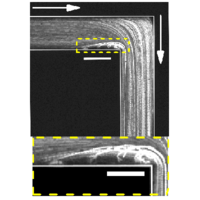
Flow transitions for wormlike micelle solutions and solutions of linear polymers flowing around a microfluidic 90˚ bend are compared. The first transition in all fluids is at similar Weissenberg number, but the form of secondary flow and higher transitions depend on the wormlike micellar structure.

Couette-Poiseuille flow experiment with zero mean advection velocity: Subcritical transition to turbulence

L. Klotz, G. Lemoult, I. Frontczak, L. S. Tuckerman, and J. E. Wesfreid

Phys. Rev. Fluids 2, 043904 (2017) - Published 27 April, 2017

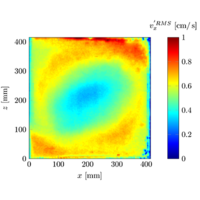
By experimentally counterbalancing a pressure gradient with moving boundaries the subcritical transition to turbulence is studied in a shear flow with zero mean advection velocity. Nearly stationary turbulent structures result. Velocimetry is used to characterize the structures vs Reynolds number.

Slip at liquid-liquid interfaces

P. Poesio, A. Damone, and Omar K. Matar

Phys. Rev. Fluids 2, 044004 (2017) - Published 27 April, 2017

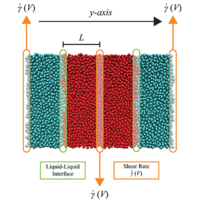
A new study shows that the need for slip models at interfaces and detailed molecular dynamics simulations can be obviated by continuum models that only require knowledge of the density, component mole fractions, and the dependence of the viscosity on the density

Inertial particle dynamics in the presence of a secondary flow

Mike Garcia and Sumita Pennathur

Phys. Rev. Fluids 2, 042201(R) (2017) - Published 26 April, 2017

An experimental investigation in a novel tangential flow filtration geometry at a moderate Reynolds number reveals how the presence of a secondary flow can can modify inertial migration and focusing of microparticles.

Development of Tollmien-Schlichting disturbances in the presence of laminar separation bubbles on an unswept infinite wavy wing

Christian Thomas, Shahid Mughal, and Richard Ashworth

Phys. Rev. Fluids 2, 043903 (2017) - Published 26 April, 2017

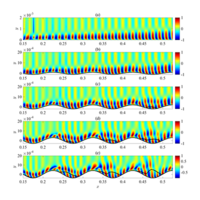
Wavy surface variations establish separation bubbles on an unswept wing. The development of Tollmien-Schlichting disturbances are investigated, and PSE analysis is shown to agree with LNS solutions for some configurations.

Velocity fluctuations and boundary layer structure in a rough Rayleigh-Bénard cell filled with water

Olivier Liot, Quentin Ehlinger, Éléonore Rusaouën, Thibaut Coudarchet, Julien Salort, and Francesca Chillà

Phys. Rev. Fluids 2, 044605 (2017) - Published 26 April, 2017

Velocimetry is used to compare boundary layer and Large Scale Circulation structures in Rayleigh-Bénard cells with and without bottom plate roughness. Velocity fluctuations dramatically rise with roughness, and turbulence scaling changes. Roughness seems to lead to a turbulent boundary layer.

Sign In to Your Journals Account

Filter

Recent Issues

Vol. 11, Iss. 11
November 2026
Vol. 11, Iss. 10
October 2026
Vol. 11, Iss. 9
September 2026
Vol. 11, Iss. 8
August 2026
Category
Article Type
Section

Filter

Article Lookup

Enter a citation