Recent Articles

Transport of flexible fibers in confined microchannels

Jean Cappello, Mathias Bechert, Camille Duprat, Olivia du Roure, François Gallaire, and Anke Lindner

Phys. Rev. Fluids 4, 034202 (2019) - Published 5 March, 2019

The deformation of a flexible fiber transported perpendicularly in a plug flow in a confining microchannel is studied using experiments and numerical simulations. The fiber deflection, resulting from an inhomogeneous force distribution, is a function of an elastoviscous number and fiber confinement.

Orientation dynamics of nonspherical particles under surface gravity waves

Michelle H. DiBenedetto, Jeffrey R. Koseff, and Nicholas T. Ouellette

Phys. Rev. Fluids 4, 034301 (2019) - Published 5 March, 2019

Nonspherical particles in the ocean are relevant to phenomena such as microplastics, plankton and sediment. Experimental results of the orientation dynamics of nonspherical particles in waves find competition between the waves and the inertial effects on particle orientation.

Linear and nonlinear regimes of an inertial wave attractor

Maxime Brunet, Thierry Dauxois, and Pierre-Philippe Cortet

Phys. Rev. Fluids 4, 034801 (2019) - Published 5 March, 2019

We report an experimental study of the nonlinear regime of an inertial wave attractor revealing the emergence of a triadic resonance instability with singular features. The attractor properties are shown to be well described by introducing a turbulent viscosity in the linear attractor model.

Excitation and resonant enhancement of axisymmetric internal wave modes

S. Boury, T. Peacock, and P. Odier

Phys. Rev. Fluids 4, 034802 (2019) - Published 5 March, 2019

Inspired by geophysical phenomena, such as storm generated internal waves in the ocean, an experimental study is performed using an axisymmetric internal wave generator. Radial and vertical confinement lead to Bessel-shaped standing waves and resonance effects caused by multiple cavity reflections.

Effects of trailing edge shape on vortex formation by pitching panels of small aspect ratio

Arman Hemmati, Tyler Van Buren, and Alexander J. Smits

Phys. Rev. Fluids 4, 033101 (2019) - Published 4 March, 2019

A study examines wake dynamics for oscillating foils with different trailing edges and relates them to unsteady propulsive performance of the foil. It also connects the main wake features to surface pressure fluctuations on both faces of the foil during an oscillatory period.

Vibration-induced thermal instabilities in supercritical fluids in the absence of gravity

Deewakar Sharma, Arnaud Erriguible, Gurunath Gandikota, Daniel Beysens, and Sakir Amiroudine

Phys. Rev. Fluids 4, 033401 (2019) - Published 4 March, 2019

Supercritical fluids when subjected to vibrations in the direction parallel and normal to the interface lead to Rayleigh-vibrational and parametric instabilities. These instabilities arise in the thermal boundary layer as a result of strong thermomechanical coupling.

Thermocapillary and electrohydrodynamic effects on the stability of dynamic contact lines

Devin T. Conroy, Leonardo Espín, Omar K. Matar, and Satish Kumar

Phys. Rev. Fluids 4, 034001 (2019) - Published 4 March, 2019

Electric fields and temperature fields significantly modify the stability of dynamic contact lines. Electric fields enhance the growth of transverse perturbations, whereas temperature fields can enhance or suppress growth depending on the direction of the temperature gradient.

Steady flow regimes and mixing performance in arrow-shaped micro-mixers

A. Mariotti, C. Galletti, E. Brunazzi, and M. V. Salvetti

Phys. Rev. Fluids 4, 034201 (2019) - Published 4 March, 2019

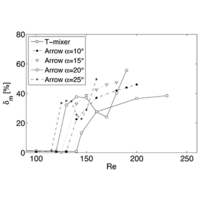
The steady flow regimes and mixing performances of arrow-like micro-mixers are investigated experimentally and by DNS for varying Re and tilting angles. Arrow-mixers trigger mixing at lower Re than for T-mixers, but for large tilting angles mixing does not increase monotonically with Re.

Taylor dispersion in the presence of cross flow and interfacial mass transfer

Tiras Y. Lin and Eric S. G. Shaqfeh

Phys. Rev. Fluids 4, 034501 (2019) - Published 1 March, 2019

A solute flowing in a pressure-driven channel flow experiences an enhanced effective axial dispersion coefficient due to the transverse velocity gradients. An investigation shows how this phenomenon, known as Taylor dispersion, is affected by cross flow and mass transfer at the wall.

Acoustogravitational balance in climbing films

Amihai Horesh, Daniel Khaikin, Mackenzie Karnilaw, Anna Zigelman, and Ofer Manor

Phys. Rev. Fluids 4, 022001(R) (2019) - Published 28 February, 2019

In experiments a surface acoustic wave at 20 Mhz propagating down a vertical surface induces a liquid film to climb up the surface against gravity.

Numerical investigation of the collapse of a static bubble at the free surface in the presence of neighbors

Digvijay Singh and Arup Kumar Das

Phys. Rev. Fluids 4, 023602 (2019) - Published 28 February, 2019

Formation of a liquid jet and drop as a consequence of the bursting of a bubble in symmetric and asymmetric neighborhoods is modeled numerically. We find that unbalanced interaction of neighbors forces the jet and drop to bend towards the absent bubbles.

Breakup of elongated droplets in microfluidic T-junctions

Cees Haringa, Conrad de Jong, Duong A. Hoang, Luis M. Portela, Chris R. Kleijn, Michiel T. Kreutzer, and Volkert van Steijn

Phys. Rev. Fluids 4, 024203 (2019) - Published 28 February, 2019

Long droplets entering a microfluidic T-junction get trapped below, and break beyond, a critical capillary number, which is determined theoretically and experimentally in this work.

Self-diffusion in compressible gas flow through a microconduit

Di Shen and Kang Ping Chen

Phys. Rev. Fluids 4, 024202 (2019) - Published 27 February, 2019

The compressible Navier-Stokes equations already include the self-diffusion effect. Comparisons with 35 experiments show that the self-diffusion effect is too small to account for the mass flow rate enhancement in steady compressible gas flow through a microconduit in the slip flow regime.

Low-dimensional representations and anisotropy of model rotor versus porous disk wind turbine arrays

Elizabeth H. Camp and Raúl Bayoán Cal

Phys. Rev. Fluids 4, 024610 (2019) - Published 27 February, 2019

We experimentally compare wakes within three-bladed rotor and porous disk wind turbine arrays using PIV measurements and proper orthogonal decomposition. Disparities between rotors and disks with important implications for wind turbine simulations is found.

No return to reflection symmetry in freely decaying homogeneous turbulence

Katsunori Yoshimatsu and Yukio Kaneda

Phys. Rev. Fluids 4, 024611 (2019) - Published 27 February, 2019

A certain homogeneous fully developed turbulence, which was initially reflection asymmetric at large scales, is studied theoretically and numerically. It is shown that the turbulence does not relax to any reflection symmetric state, even in the energy containing range.

Rayleigh-Taylor convective dissolution in confined porous media

Marco De Paoli, Francesco Zonta, and Alfredo Soldati

Phys. Rev. Fluids 4, 023502 (2019) - Published 26 February, 2019

RT instability and convection in confined porous media is examined via DNS. Interactions between gravity and diffusion produce efficient fluid mixing, and a superlinear asymptotic growth of the mixing rate is observed and modeled for the first time. Potential geophysical applications are envisioned.

Exponential scaling in early-stage agglomeration of adhesive particles in turbulence

Sheng Chen, Shuiqing Li, and Jeffrey S. Marshall

Phys. Rev. Fluids 4, 024304 (2019) - Published 26 February, 2019

Agglomeration of adhesive particles in turbulence is investigated. The size distribution of early-stage agglomerates follows a unified exponential scaling. A new agglomeration kernel containing information about the fractal structure of agglomerates and the sticking probability is constructed.

Experimental study of soft porous lubrication

Zenghao Zhu, Sheldon Weinbaum, and Qianhong Wu

Phys. Rev. Fluids 4, 024305 (2019) - Published 26 February, 2019

Lessons learned from the motion of red cells in capillaries are applied to a novel experimental study of soft porous lubrication, which conclusively demonstrates a dramatic decrease of friction coefficient with tremendously enhanced pore pressure as a planar board glides over a soft porous layer.

Driven active matter: Fluctuations and a hydrodynamic instability

T. R. Kirkpatrick and J. K. Bhattacherjee

Phys. Rev. Fluids 4, 024306 (2019) - Published 26 February, 2019

A new hydrodynamic instability in driven active matter is discussed. It is similar to the convective instability that occurs in passive fluids, but differs in several important ways. In particular, the transition to turbulence in the active matter system is expected to be novel.

Fountain mixing in a filling box at low Reynolds numbers

Nan Xue, Sepideh Khodaparast, and Howard A. Stone

Phys. Rev. Fluids 4, 024501 (2019) - Published 26 February, 2019

Pouring a liquid down into a container of a denser liquid creates a fountain. We measure the penetration depth of such fountains and characterize the mixing based on the Reynolds (Re) and Froude (Fr) numbers.

Sign In to Your Journals Account

Filter

Recent Issues

Vol. 11, Iss. 10
October 2026
Vol. 11, Iss. 9
September 2026
Vol. 11, Iss. 8
August 2026
Vol. 11, Iss. 7
July 2026
Category
Article Type
Section

Filter

Article Lookup

Enter a citation