Recent Articles

Pressure and spanwise velocity fluctuations in turbulent channel flows: Logarithmic behavior of moments and coherent structures

Ali Mehrez, Jimmy Philip, Yoshinobu Yamamoto, and Yoshiyuki Tsuji

Phys. Rev. Fluids 4, 044601 (2019) - Published 2 April, 2019

The logarithmic behavior of moments of the pressure and spanwise velocity fluctuations in turbulent channels is studied. Configurations of geometrically self-similar hairpin eddies play a key role in such behavior.

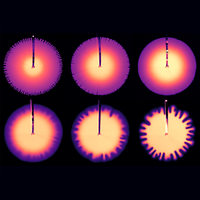
Transport and dispersion of active particles in periodic porous media

Roberto Alonso-Matilla, Brato Chakrabarti, and David Saintillan

Phys. Rev. Fluids 4, 043101 (2019) - Published 1 April, 2019

The long-time transport of active Brownian particles flowing through a porous lattice is studied using generalized Taylor dispersion theory and Langevin simulations. The effects of motility, lattice geometry, and fluid flow on the asymptotic spreading of a dilute cloud of microswimmers are unraveled.

Magnetohydrodynamic effects in a shock-accelerated gas cylinder

Wolfgang J. Black, Roy C. Allen, W. Curtis Maxon, Nicholas Denissen, and Jacob A. McFarland

Phys. Rev. Fluids 4, 043901 (2019) - Published 1 April, 2019

We numerically study the effect of magnetic field orientation and strength on a shock-accelerated gas cylinder susceptible to the Richtmyer-Meshkov instability. We find regimes where fluid mixing increases with field strength and a preferential field orientation for damping the instability.

Sphere entry through an oil lens floating on water

Linda B. Smolka and Clare K. McLaughlin

Phys. Rev. Fluids 4, 044001 (2019) - Published 1 April, 2019

Entry of a sphere impacting an oil lens floating on a water surface is studied. An air-entraining cavity forms, lined by oil, which at collapse forms an oil filament connecting the upper and lower cavities. These dynamics are different than that of a sphere impacting water where no cavity forms at all.

Impact of fundamental molecular kinetics on macroscopic properties of high-enthalpy flows: The case of hypersonic atmospheric entry

G. Colonna, F. Bonelli, and G. Pascazio

Phys. Rev. Fluids 4, 033404 (2019) - Published 29 March, 2019

A state-to-state approach and GPU processors are used to find the nonequilibrium vibrational distributions of O2 and N2 in a hypersonic flow past a sphere.

Nonequilibrium air flow predictions with a high-fidelity direct simulation Monte Carlo approach

Sergey F. Gimelshein and Ingrid J. Wysong

Phys. Rev. Fluids 4, 033405 (2019) - Published 29 March, 2019

A conventional and high-fidelity direct simulation Monte Carlo approach is applied to a number of hypersonic cases where validation data is available. Changes in the collision model are found to have a small effect on surface properties, with nitrogen recombination being the only notable exception.

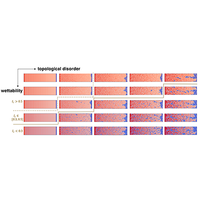
Disorder characterization of porous media and its effect on fluid displacement

Zhongzheng Wang, Kapil Chauhan, Jean-Michel Pereira, and Yixiang Gan

Phys. Rev. Fluids 4, 034305 (2019) - Published 29 March, 2019

Depending on topology of pore space, different patterns of multiphase flow in porous media are observed. By analyzing pore-scale mechanisms, a phase diagram is constructed showing that wettability and structural disorder collectively affect displacement efficiency and fluid-fluid interfacial area.

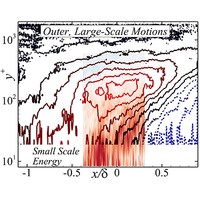
Investigation of inner-outer interactions in a turbulent boundary layer using high-speed particle image velocimetry

Gokul Pathikonda and Kenneth T. Christensen

Phys. Rev. Fluids 4, 034607 (2019) - Published 29 March, 2019

High-resolution, high-frame-rate particle image velocimetry measurements in a refractive index-matched flow facility are used to explore the spatiotemporal signature of outer, large-scale motions influencing near-wall, smaller scales (so-called inner-outer interactions) in a turbulent boundary layer.

Liquid spreading on cold surfaces: Solidification-induced stick-slip dynamics

Rémy Herbaut, Philippe Brunet, Laurent Limat, and Laurent Royon

Phys. Rev. Fluids 4, 033603 (2019) - Published 27 March, 2019

Spreading of liquid on a cold substrate with freezing is investigated. Experimental investigation of the criterion for a solidification-induced pinning of the liquid near the triple line finds that below a temperature-dependent velocity, spreading shows stick-slip dynamics.

Using vortex identifiers to build eddy-viscosity subgrid-scale models for large-eddy simulation

Xingjun Fang, Bing-Chen Wang, and Donald J. Bergstrom

Phys. Rev. Fluids 4, 034606 (2019) - Published 26 March, 2019

A generalized framework of incorporating vortex identifiers into subgrid-scale models for large-eddy simulation is presented. The proposed models can automatically identify the under-resolved vortex stretching process and drain energy from the inertial subrange.

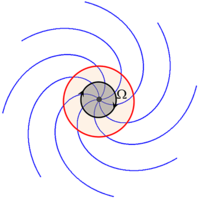
Scattering of surface shallow water waves on a draining bathtub vortex

Semyon Churilov and Yury Stepanyants

Phys. Rev. Fluids 4, 034704 (2019) - Published 26 March, 2019

Wave scattering on a bathtub vortex in shallow water is studied in the linear approximation. The results obtained are relevant to the interpretation of laboratory experiments and can be considered the hydrodynamic model of wave scattering by a rotating black hole in general relativity.

Elastohydrodynamics of swimming helices: Effects of flexibility and confinement

John LaGrone, Ricardo Cortez, and Lisa Fauci

Phys. Rev. Fluids 4, 033102 (2019) - Published 25 March, 2019

We examine the swimming of an elastic helix rotated by a torque at its base, both in free-space and confined to a tube. The image depicts the envelope of an excursion of a filament centerline over one rotation; the blue is the surface of the finite-radius helical filament at one snapshot in time.

Experimental study of convection in the compressible regime

Rémi Menaut, Yoann Corre, Ludovic Huguet, Thomas Le Reun, Thierry Alboussière, Michael Bergman, Renaud Deguen, Stéphane Labrosse, and Marc Moulin

Phys. Rev. Fluids 4, 033502 (2019) - Published 25 March, 2019

Compressible thermal convection is experimentally studied. In the large apparent gravity of a rotor centrifuge, using xenon gas, an adiabatic temperature difference of 14 °C over a height equal to 4 cm is obtained. Large Coriolis forces impose a quasigeostrophic regime.

Diffusion-driven transition between two regimes of viscous fingering

Thomas E. Videbæk and Sidney R. Nagel

Phys. Rev. Fluids 4, 033902 (2019) - Published 25 March, 2019

Diffusion between miscible fluids in the viscous-fingering instability produces an unexpected transition into a novel pattern. Usually thought of as a two-dimensional phenomena, this works shows the importance of three-dimensional structure to the patterns that form.

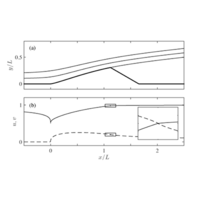
Inviscid flow separation at the crest of an erodible dune

F. Charru and P. Luchini

Phys. Rev. Fluids 4, 034304 (2019) - Published 25 March, 2019

Potential flow analysis is used to find the elevation profile of traveling dunes of given volume and locate the brink point where the flow separates without singularity.

Streamline segment statistics propagation in inhomogeneous turbulence

A. Rubbert, M. Albers, and W. Schröder

Phys. Rev. Fluids 4, 034605 (2019) - Published 25 March, 2019

Streamline segment statistics are collected from tomographic particle image velocimetry and direct numerical simulation data of a turbulent wavy channel flow. The model equation for such statistics is adapted for inhomogeneous turbulence. The novel formulation is applied to explain the observations and identify the locally acting mechanisms.

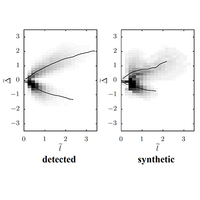
Flow structures govern particle collisions in turbulence

Jason R. Picardo, Lokahith Agasthya, Rama Govindarajan, and Samriddhi Sankar Ray

Phys. Rev. Fluids 4, 032601(R) (2019) - Published 21 March, 2019

Direct numerical simulations find that rapid head-on collisions of particles mostly occur in regions of straining compared to vortical regions, and that intense vortex tubes conspire with enveloping straining sheets, in the form of vortex-strain worm-rolls, to generate violent collisions.

Scattering of liquid droplets from axisymmetric targets

Jacob Hale and Jacob Boudreau

Phys. Rev. Fluids 4, 033602 (2019) - Published 21 March, 2019

A meniscus formed around a vertical cylinder looks and behaves like a repulsive central potential, deflecting noncoalescent droplets analogous to Rutherford scattering. The scattering behavior is used to probe the potential of the cylindrical meniscus, confirming theoretical models for its shape.

Modal analysis with proper orthogonal decomposition of hypersonic separated flows over a double wedge

Ozgur Tumuklu, Deborah A. Levin, and Vassilis Theofilis

Phys. Rev. Fluids 4, 033403 (2019) - Published 19 March, 2019

A study combining direct simulation Monte Carlo simulations with window proper orthogonal decomposition investigates the temporal characteristics of unsteady, laminar shock boundary-layer interactions for different gas mixtures for an Edney type-IV flow.

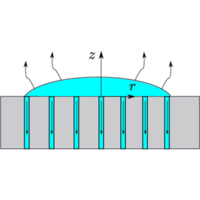
Imbibition and evaporation of droplets of colloidal suspensions on permeable substrates

Truong Pham and Satish Kumar

Phys. Rev. Fluids 4, 034004 (2019) - Published 19 March, 2019

Colloidal particles inside an evaporated droplet on a solid substrate are often preferentially deposited at the droplet contact line, a phenomenon known as the coffee-ring effect. A study shows how this phenomenon is affected by the permeability of the substrate.

Sign In to Your Journals Account

Filter

Recent Issues

Vol. 11, Iss. 10
October 2026
Vol. 11, Iss. 9
September 2026
Vol. 11, Iss. 8
August 2026
Vol. 11, Iss. 7
July 2026
Category
Article Type
Section

Filter

Article Lookup

Enter a citation