Recent Articles

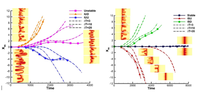
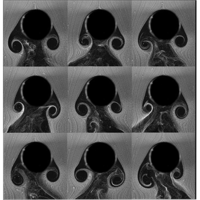
Drag reduction mechanisms of a car model at moderate yaw by bi-frequency forcing

Ruiying Li, Jacques Borée, Bernd R. Noack, Laurent Cordier, and Fabien Harambat

Phys. Rev. Fluids 4, 034604 (2019) - Published 19 March, 2019

We propose a windward bi-frequency control strategy to manipulate experimentally the wake past a yawed car model using pulsed jets. By varying the low frequency value in the actuation, we can provide a complete authority for the manipulation of the mean wake orientation and reduce drag.

Elasto-capillary adhesion: Effect of deformability on adhesion strength and detachment

Matthew Butler, Finn Box, Thomas Robert, and Dominic Vella

Phys. Rev. Fluids 4, 033601 (2019) - Published 18 March, 2019

Inspired by the droplet-mediated adhesion of insects, the adhesion between soft and rigid surfaces mediated by a droplet is studied. Deformability allows for enhanced adhesion as well as new routes for “unsticking,” but the dynamics of adhesion also plays a role.

Anomalous collapse of interacting bubbles in a fluidized bed: A magnetic resonance imaging study

C. M. Boyce, A. Penn, A. Padash, M. Lehnert, K. P. Pruessmann, and C. R. Müller

Phys. Rev. Fluids 4, 034303 (2019) - Published 18 March, 2019

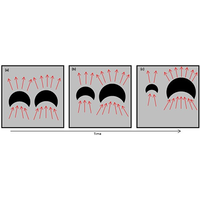
Rapid magnetic resonance imaging shows how bubbles collapse in fluidized beds as a result of gas channeling to neighboring bubbles.

Importance of small-scale anisotropy in the turbulent/nonturbulent interface region of turbulent free shear flows

O. R. H. Buxton, M. Breda, and K. Dhall

Phys. Rev. Fluids 4, 034603 (2019) - Published 18 March, 2019

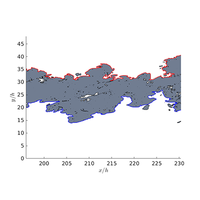
Turbulent flows are often bounded by nonturbulent fluid with a sharp interface between the two flow states. Drawing a parallel between this interface and the wall in a wall-bounded flow and similarly, to wall-bounded turbulence, shows the importance of the anisotropy very close to the interface.

Predictive large-eddy-simulation wall modeling via physics-informed neural networks

X. I. A. Yang, S. Zafar, J.-X. Wang, and H. Xiao

Phys. Rev. Fluids 4, 034602 (2019) - Published 15 March, 2019

A study shows that when trained using channel flow data at just one Reynolds number and informed with known flow physics, the neural network works robustly as a wall model in large-eddy simulation (LES) of channel flow at any Reynolds number. It also outperforms the equilibrium wall model in LES of a 3D boundary layer flow.

Orientation dependent elastic stress concentration at tips of slender objects translating in viscoelastic fluids

Chuanbin Li, Becca Thomases, and Robert D. Guy

Phys. Rev. Fluids 4, 031301(R) (2019) - Published 14 March, 2019

The elastic stress generated moving in a purely viscous flow around a slender cylinder is found to be large near the tips, and larger when the flow is parallel to the axis.

Effect of heat-flux boundary conditions on the Rayleigh-Bénard instability in a rarefied gas

Y. Ben-Ami and A. Manela

Phys. Rev. Fluids 4, 033402 (2019) - Published 14 March, 2019

The effect of heat-flux conditions on the Rayleigh-Bénard convection in a rarefied gas is investigated, extending instability to higher rarefaction rates compared with the isothermal walls case. The deviation from the Boussinesq limit with increasing compressibility is analyzed.

Turning depths: Evanescent to propagating wave kinetic energy density

Allison Lee and Julie Crockett

Phys. Rev. Fluids 4, 034803 (2019) - Published 14 March, 2019

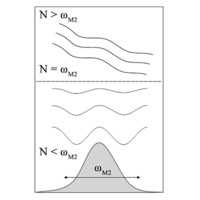
Evanescent regions exist in numerous areas of the deep ocean where the stratification also varies with depth. Using theoretical predictions and experiments, the kinetic energy density in propagating internal waves generated from these evanescent regions is explored.

Evaporation-driven solutocapillary flow of thin liquid films over curved substrates

Mariana Rodríguez-Hakim, Joseph M. Barakat, Xingyi Shi, Eric S. G. Shaqfeh, and Gerald G. Fuller

Phys. Rev. Fluids 4, 034002 (2019) - Published 13 March, 2019

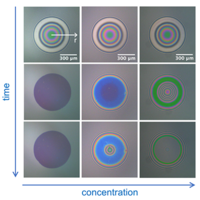
Evaporation of a volatile solvent induces solutocapillary Marangoni flows by creating gradients in species concentration and surface tension. These flows are experimentally and theoretically investigated in sub-micron films at dilute solute concentrations where Van der Waals effects are important.

Instabilities of nonisothermal nanocatalytic reactive flows in porous media

B. Dastvareh and J. Azaiez

Phys. Rev. Fluids 4, 034003 (2019) - Published 13 March, 2019

Chemo-hydrodynamic instabilities are investigated in the presence of nano-catalysts. The additional transport mechanism of nano-catalysts as a result of the heat of reaction, called thermophoresis, has affected both the dynamics and the amount of chemical products.

Measurements on a yawed rotor blade pitching in reverse flow

Luke R. Smith and Anya R. Jones

Phys. Rev. Fluids 4, 034703 (2019) - Published 12 March, 2019

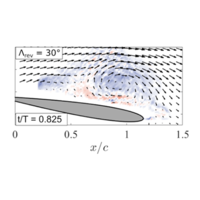
Vortex shedding patterns are examined on a yawed wing pitching in reverse flow. The yawed wing exhibits suppression of its secondary flow structures compared to an unyawed wing. Various physical mechanisms, particularly spanwise flow, are evaluated to explain the shedding pattern of the yawed wing.

Wall slip regimes in jammed suspensions of soft microgels

Justin Péméja, Baudouin Géraud, Catherine Barentin, and Marie Le Merrer

Phys. Rev. Fluids 4, 033301 (2019) - Published 11 March, 2019

The slip velocity of jammed polymer microgels is measured as the wall stress is increased by 4 orders of magnitude. The friction law exhibits a transition in slip regimes, from a nonlinear to a linear scaling, linked to two distinct dissipation mechanisms at the scale of the soft elements.

Enhanced and suppressed multiscale dispersion of bidisperse inertial particles due to gravity

Rohit Dhariwal and Andrew D. Bragg

Phys. Rev. Fluids 4, 034302 (2019) - Published 11 March, 2019

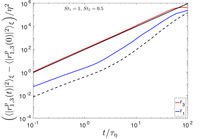
Direct numerical simulations are used to study the relative dispersion of settling, bidisperse inertial particles in isotropic turbulence. It is found that gravity can significantly enhance the relative dispersion, not only in the direction parallel, but even in the direction normal to gravity.

Transition from convection rolls to large-scale cellular structures in turbulent Rayleigh-Bénard convection in a liquid metal layer

Megumi Akashi, Takatoshi Yanagisawa, Yuji Tasaka, Tobias Vogt, Yuichi Murai, and Sven Eckert

Phys. Rev. Fluids 4, 033501 (2019) - Published 8 March, 2019

A new coherent structure appears on turbulent Rayleigh-Bénard convection in a liquid metal layer; transitions to large-scale cellular structures from oscillatory roll structures occur with Rayleigh numbers. A scaling law describing characteristic length of the structures is suggested.

Evaluation of potential flow models for unsteady separated flow with respect to experimental data

Field Manar and Anya R. Jones

Phys. Rev. Fluids 4, 034702 (2019) - Published 8 March, 2019

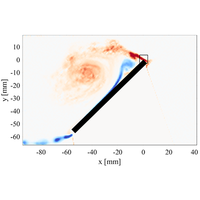
Wake characteristics and force production of a flat plate wing starting from rest at high incidence are examined. Circulation production at the wing leading edge is shown to be coupled to wing kinematics and the wake state. Several potential flow models are compared to experiments.

Velocity probability distribution scaling in wall-bounded flows at high Reynolds numbers

M.-W. Ge, Xiang I. A. Yang, and Ivan Marusic

Phys. Rev. Fluids 4, 034101 (2019) - Published 7 March, 2019

A study on the scaling implications of the attached eddy hypothesis and the large deviation theory on the velocity probability distribution function (PDF) concludes that, when scaled properly, the remote tails of the streamwise and spanwise velocity PDF collapse for flows in the logarithmic layer.

Trapped vorticity for controlled modification of an airfoil's aerodynamic loads

Daniel P. Brzozowski, Bojan Vukasinovic, and Ari Glezer

Phys. Rev. Fluids 4, 034601 (2019) - Published 7 March, 2019

Static and transient responses of an airfoil to bi-directional flow control actuation at the trailing-edge are investigated in wind tunnel experiments. Flow field measurements elucidate control of aerodynamic loads through regulation of trapped vorticity concentrations upstream of the trailing edge.

Flow force measurements and the wake transition in purely inline vortex-induced vibration of a circular cylinder

Tyler D. Gurian, Todd Currier, and Yahya Modarres-Sadeghi

Phys. Rev. Fluids 4, 034701 (2019) - Published 7 March, 2019

We find a novel shedding mode (Alternating-Symmetric) in the vortex-induced vibration response of a cylinder free to oscillate in the inline direction. In this mode, two vortices of opposite sign are shed simultaneously from two sides of the oscillating cylinder, but their sizes alternate per cycle.

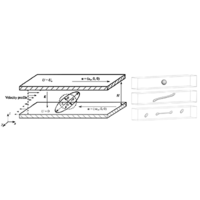
Electric field induced droplet deformation and breakup in confined shear flows

Rattandeep Singh, Supreet Singh Bahga, and Amit Gupta

Phys. Rev. Fluids 4, 033701 (2019) - Published 6 March, 2019

Deformation or breakup of a droplet suspended in confined shear flows and subjected to an electric field is investigated numerically. A contrasting behavior of the droplet depending upon the electrical properties of the fluids is reported.

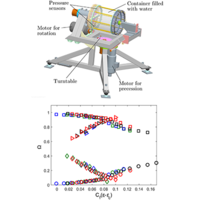
Instability of precession driven Kelvin modes: Evidence of a detuning effect

Johann Herault, André Giesecke, Thomas Gundrum, and Frank Stefani

Phys. Rev. Fluids 4, 033901 (2019) - Published 6 March, 2019

Experiments in a precessing cylinder filled with water show signatures of azimuthally drifting inertial waves. These modes originate from a triadic resonance and their characteristic frequency dependence is explained by a detuning mechanism due to the slowdown of the background flow.

Sign In to Your Journals Account

Filter

Recent Issues

Vol. 11, Iss. 10
October 2026
Vol. 11, Iss. 9
September 2026
Vol. 11, Iss. 8
August 2026
Vol. 11, Iss. 7
July 2026
Category
Article Type
Section

Filter

Article Lookup

Enter a citation