Recent Articles

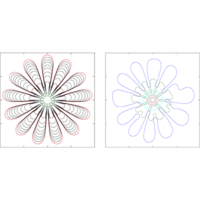
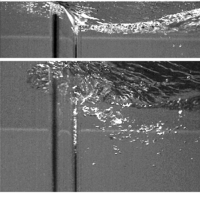
Flow and air-entrainment around partially submerged vertical cylinders

Valentin Ageorges, Jorge Peixinho, and Gaële Perret

Phys. Rev. Fluids 4, 064801 (2019) - Published 10 June, 2019

When a partially submerged vertical cylinder is moved at constant speed through water, the motion induces a turbulent wake, free-surface deformations up to the rupture, and air entrainment within the flow. Two modes of air entrainment are uncovered and the critical velocity is compared to a model.

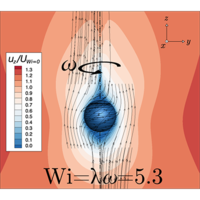
Drag coefficient for a sedimenting and rotating sphere in a viscoelastic fluid

Alfonso Castillo, William L. Murch, Jonas Einarsson, Baltasar Mena, Eric S. G. Shaqfeh, and Roberto Zenit

Phys. Rev. Fluids 4, 063302 (2019) - Published 7 June, 2019

The image shows the flow field around a sphere that sediments and rotates simultaneously in a viscoelastic liquid.

Anomalous percolation flow transition of yield stress fluids in porous media

Nicolas Waisbord, Norbert Stoop, Derek M. Walkama, Jörn Dunkel, and Jeffrey S. Guasto

Phys. Rev. Fluids 4, 063303 (2019) - Published 7 June, 2019

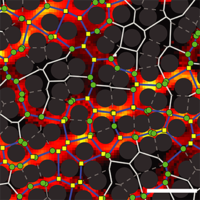
Microfluidic experiments and simulations reveal an anomalous percolation transition for the flow of a yield stress fluid through a random porous medium. The evolution of the fluidized network results in a highly nonlinear flow conductivity and reveals a novel dispersion mechanism.

Computational study of the collapse of a cloud with 12500 gas bubbles in a liquid

U. Rasthofer, F. Wermelinger, P. Karnakov, J. Šukys, and P. Koumoutsakos

Phys. Rev. Fluids 4, 063602 (2019) - Published 7 June, 2019

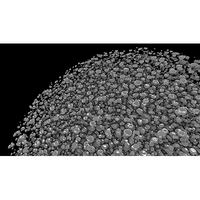
The collapse of a spherical cloud composed of 12 500 gas bubbles in water is studied. Wave propagation is captured and compared to existing reduced order models. Microjet formation is quantified and a dependence between microjet velocity magnitude and the strength of the collapse wave is identified.

Sensitivity of vortex pairing and mixing to initial perturbations in stratified shear flows

Wenjing Dong, E. W. Tedford, M. Rahmani, and G. A. Lawrence

Phys. Rev. Fluids 4, 063902 (2019) - Published 7 June, 2019

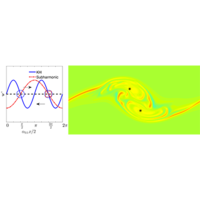
An investigation of the phase relationship between the Kelvin-Helmholtz mode and its subharmonic mode finds that it has important implications for vortex pairing and mixing in the flow by ensuring the instability. Results are consistent with laboratory observations for suppression of the subharmonic mode near an unfavorable phase.

Salt comets in hand sanitizer: A simple probe of microgel collapse dynamics

Arash Nowbahar, Art O'Connor, Vincent Mansard, Patrick Spicer, and Todd M. Squires

Phys. Rev. Fluids 4, 061301(R) (2019) - Published 6 June, 2019

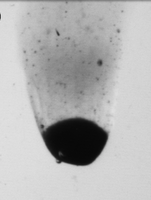
A single grain of salt, placed on the surface of everyday hand sanitizer, slowly bores a hole through it, leaving a milky “comet trail” in its wake. The fall speed does not depend on the size of the salt grain, but does depend on salt type, and reveals subtle aspects of collapsing microgels.

Regularized Stokeslet rings: An efficient method for axisymmetric Stokes flow with application to the growing pollen tube

J. Tyrrell, D. J. Smith, and R. J. Dyson

Phys. Rev. Fluids 4, 063102 (2019) - Published 6 June, 2019

The “regularized ringlet,” which is the fundamental solution to axisymmetric Stokes flow driven by a ring of smoothed point forces, is derived and used to model cytosolic flow in the growing pollen tube.

Resolvent-based modeling of coherent wave packets in a turbulent jet

Lutz Lesshafft, Onofrio Semeraro, Vincent Jaunet, André V. G. Cavalieri, and Peter Jordan

Phys. Rev. Fluids 4, 063901 (2019) - Published 6 June, 2019

Linear instability analysis, performed on the mean flow of a fully turbulent jet, provides quantitatively correct predictions of the energetic coherent turbulent structures found in experiments. It is concluded that the most energetic structures in jet turbulence are governed by linear dynamics.

Self-similar and disordered front propagation in a radial Hele-Shaw channel with time-varying cell depth

C. Vaquero-Stainer, M. Heil, A. Juel, and D. Pihler-Puzović

Phys. Rev. Fluids 4, 064002 (2019) - Published 6 June, 2019

An air bubble expanding into a viscous liquid in the small gap between parallel plates deforms into highly branched, continuously evolving interfacial fingering patterns. By separating the plates following a power law in time, it is found that the interface can also form self-similar fingering patterns.

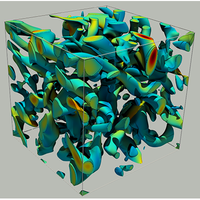
Self-organization in purely viscous non-Newtonian turbulence

H. J. Seybold, H. A. Carmona, H. J. Herrmann, and J. S. Andrade, Jr.

Phys. Rev. Fluids 4, 064604 (2019) - Published 6 June, 2019

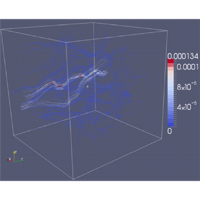
Snapshot of vortex structure in a shear-thickening fluid in fully developed turbulence. Colors from blue to red go from low to high vorticities. Relative to Newtonian fluids, shear-thinning fluids adjust to have an augmented dissipation inside vortices, the opposite of shear-thickening fluids.

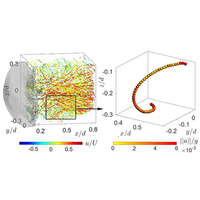
Lagrangian description of the unsteady flow induced by a single pulse of a jellyfish

Jin-Tae Kim and Leonardo P. Chamorro

Phys. Rev. Fluids 4, 064605 (2019) - Published 6 June, 2019

Lagrangian statistics and pair dispersion induced by an isolated pulse of a small jellyfish are quantified with 3D particle tracking velocimetry. Lagrangian velocity shows more intense mixing in the radial direction and reveals three stages dominated by flow acceleration, mixing, and dissipation.

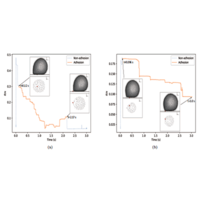
Investigation of shear rates of rolling adhesion on leukocytes with bending of microvilli

Tai-Hsien Wu and Dewei Qi

Phys. Rev. Fluids 4, 063101 (2019) - Published 5 June, 2019

A leukocyte model is used to show how different flow shear rates affect bending deformation of the microvilli and adhesive bond forces.

Experimental and numerical determination of Darcy's law for yield stress fluids in porous media

D. Bauer, L. Talon, Y. Peysson, H. B. Ly, G. Batôt, T. Chevalier, and M. Fleury

Phys. Rev. Fluids 4, 063301 (2019) - Published 5 June, 2019

Experiments and three-dimensional numerical simulations of yield stress fluids in heterogeneous porous media show that, as a result of this disorder, the fluid flows through a single channel near a critical pressure. Beyond that, the number of open channels increases with the pressure applied.

Slightly deformable Darcy drop in linear flows

Y.-N. Young, Yoichiro Mori, and Michael J. Miksis

Phys. Rev. Fluids 4, 063601 (2019) - Published 5 June, 2019

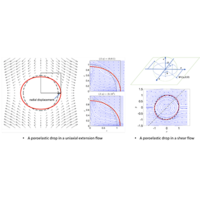
When a poroelastic spherical drop is under a uniaxial extension flow or a shear flow, the elastic network deforms in response to the external fluid viscous stress. A small-deformation analysis is conducted to investigate effects of interfacial slip and permeability on flow around the drop.

Synthetic turbulent inflow generator using machine learning

Kai Fukami, Yusuke Nabae, Ken Kawai, and Koji Fukagata

Phys. Rev. Fluids 4, 064603 (2019) - Published 4 June, 2019

Machine-learning-based turbulence generators are developed to generate unsteady inflow conditions for turbulent flow simulations. The proposed method can provide inflow conditions with reasonable turbulence statistics without spurious periodicity and at a low computational cost.

Faraday waves on band pattern under zero gravity conditions

T. Lyubimova, A. Ivantsov, Y. Garrabos, C. Lecoutre, and D. Beysens

Phys. Rev. Fluids 4, 064001 (2019) - Published 3 June, 2019

Coupled Faraday waves can develop under weightlessness on liquid-vapor bands induced by vibrations. The instability appears above a threshold that is determined by theoretical analysis and numerical simulation. It compares well with sounding rocket experiments in CO2 near its critical point.

Transport across a bathymetric interface in quasi-two-dimensional flow

Lei Fang and Nicholas T. Ouellette

Phys. Rev. Fluids 4, 064501 (2019) - Published 3 June, 2019

In many geophysical situations, variable bathymetry can affect surface transport and mixing. Experiments show that the effect of bathymetry is to produce a porous transport barrier leading to asymmetric transport. These results may help to explain the dynamics of phenomena such as ocean dead zones.

Statistical properties of an incompressible passive vector convected by isotropic turbulence

Jingyuan Yang, Toshiyuki Gotoh, Hideaki Miura, and Takeshi Watanabe

Phys. Rev. Fluids 4, 064601 (2019) - Published 3 June, 2019

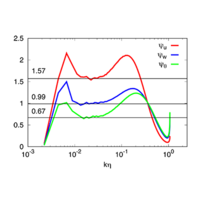
Statistical properties of an incompressible passive vector in isotropic turbulence are compared with the velocity and passive scalar in order to explore the physics behind their differences and similarities.

Emergence of skewed non-Gaussian distributions of velocity increments in isotropic turbulence

W. Sosa-Correa, R. M. Pereira, A. M. S. Macêdo, E. P. Raposo, D. S. P. Salazar, and G. L. Vasconcelos

Phys. Rev. Fluids 4, 064602 (2019) - Published 3 June, 2019

A theoretical framework, the H-theory, is applied to describe the skewed non-Gaussian distribution of velocity increments as a weighted mixture of asymmetric Gaussians. The weighing distribution is obtained from a hierarchical stochastic model of intermittency. Good agreement with direct numerical simulation data is found.

Stability of inclined flow of a liquid film with soluble surfactants and variable mass density

J. P. Pascal, S. J. D. D'Alessio, and E. Ellaban

Phys. Rev. Fluids 4, 054004 (2019) - Published 31 May, 2019
Adding surfactant to clean fluid stabilizes the inclined flow. A theoretical study shows that beyond a critical level the flow is destabilized as more surfactant is added due to desorption from the surface. If the mass density of the fluid increases with surfactant concentration in the bulk, a later stabilizing stage occurs.

Sign In to Your Journals Account

Filter

Recent Issues

Vol. 11, Iss. 10
October 2026
Vol. 11, Iss. 9
September 2026
Vol. 11, Iss. 8
August 2026
Vol. 11, Iss. 7
July 2026
Category
Article Type
Section

Filter

Article Lookup

Enter a citation