Recent Articles

Sedimentation of gas-fluidized particles with random shape and size

Laurence Girolami and Frédéric Risso

Phys. Rev. Fluids 4, 074301 (2019) - Published 3 July, 2019

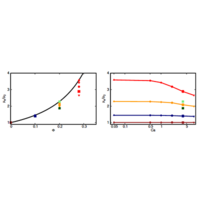
Observations of the settling velocity of suspensions of irregular particles are found to depend on (i) the difference of density between the particles and the suspension and (ii) a viscosity which depends on the ratio of the concentration to the loose packing concentration.

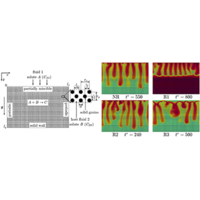
Quantifying silo flow using MRI velocimetry for testing granular flow models

Luke Fullard, Daniel J. Holland, Petrik Galvosas, Clive Davies, Pierre-Yves Lagrée, and Stéphane Popinet

Phys. Rev. Fluids 4, 074302 (2019) - Published 3 July, 2019

Compared to fluid dynamics, granular material flow is poorly understood. Magnetic resonance imaging of poppy seeds flowing through three silos reveals three distinct flow regimes. A continuum mathematical model using an effective viscosity captures the dynamics in two of the three regimes.

Sharp transitions in rotating turbulent convection: Lagrangian acceleration statistics reveal a second critical Rossby number

Kim M. J. Alards, Rudie P. J. Kunnen, Richard J. A. M. Stevens, Detlef Lohse, Federico Toschi, and Herman J. H. Clercx

Phys. Rev. Fluids 4, 074601 (2019) - Published 3 July, 2019

The sharp transition in flow behavior in turbulent weakly rotating thermal convection is explored with Lagrangian velocity and acceleration statistics of fluid particles. The transition consists of two distinct phenomena: 1) transition in heat transfer and 2) emergence of cyclonic vortical plumes.

Rate of decay of turbulent kinetic energy in abruptly stabilized Ekman boundary layers

Stimit Shah and Elie Bou-Zeid

Phys. Rev. Fluids 4, 074602 (2019) - Published 3 July, 2019

In the late afternoon, the surface temperature drops below air temperature and the lower atmosphere’s density stratification becomes stable. A simple model that predicts the rate at which turbulence kinetic energy and mixing decrease after the onset of stable stratification is presented.

Dynamics of a trapped vortex in rotating convection

J. W. Atkinson, P. A. Davidson, and J. E. G. Perry

Phys. Rev. Fluids 4, 074701 (2019) - Published 3 July, 2019

Numerical simulations of rotating convection as a simple model for atmospheric vortices show that the eye that forms at the center may become unstable and bifurcate into an oscillatory state. It is proposed that these oscillations result from a trapped inertial wave at the core.

Identifying four-wave-resonant interactions in a surface gravity wave turbulence experiment

Antoine Campagne, Roumaissa Hassaini, Ivan Redor, Thomas Valran, Samuel Viboud, Joël Sommeria, and Nicolas Mordant

Phys. Rev. Fluids 4, 074801 (2019) - Published 3 July, 2019

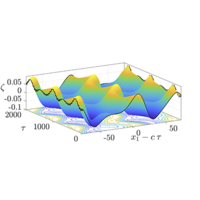
The level of nonlinearity of experimental surface gravity wave turbulence is investigated. The measured average steepness of 10% is considered high. It is shown that the high nonlinearity of our flow is mainly supplied by bound waves, the free waves being in a weakly nonlinear state.

Flow dynamics of a dandelion pappus: A linear stability approach

P. G. Ledda, L. Siconolfi, F. Viola, S. Camarri, and F. Gallaire

Phys. Rev. Fluids 4, 071901(R) (2019) - Published 2 July, 2019

A dandelion pappus is modelled as a porous disk. A stability analysis finds that if the disk is sufficiently porous the steady wake is stable and consists in a separated recirculating vortex ring, which allows a long-distance dispersal of the dandelion seeds.

Effect of the irreversible A+B→C reaction on the onset and the growth of the buoyancy-driven instability in a porous medium: Asymptotic, linear, and nonlinear stability analyses

Min Chan Kim

Phys. Rev. Fluids 4, 073901 (2019) - Published 2 July, 2019

A theoretical analysis of the effect of an irreversible A+B→C reaction on the growth of a buoyancy-driven instability in a Hele-Shaw cell, taking different diffusivities into account, is presented.

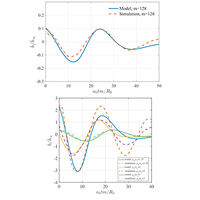
Oscillations of small bubbles and medium yielding in elastoviscoplastic fluids

Marco De Corato, Brice Saint-Michel, George Makrigiorgos, Yannis Dimakopoulos, John Tsamopoulos, and Valeria Garbin

Phys. Rev. Fluids 4, 073301 (2019) - Published 1 July, 2019

Bubble removal from yield-stress fluids by ultrasound is studied theoretically by combining the governing equation of bubble dynamics with an elastoviscoplastic constitutive model. The radius of the yielded region oscillates at twice the frequency of the ultrasound-driven bubble oscillations.

Pore-scale study of dissolution-driven density instability with reaction A+B→C in porous media

Timan Lei and Kai H. Luo

Phys. Rev. Fluids 4, 063907 (2019) - Published 28 June, 2019

A dissolution-driven density instability with reaction A+B→C is simulated in both homogeneous and heterogeneous media at pore scale. Six types of fingering scenarios are found in each medium, and it is shown that media with large pore size in the top layer can enhance the storage of solute A in the host fluid.

Incompressible models of magnetohydrodynamic Richtmyer-Meshkov instability in cylindrical geometry

A. Bakhsh and R. Samtaney

Phys. Rev. Fluids 4, 063906 (2019) - Published 27 June, 2019

With a cylindrical and incompressible model of an impulsively accelerated conducting fluid interface, effects of normal or azimuthal magnetic fields on interface growth rates are studied. In the normal case growth decays at late times and in the azimuthal one a growth perturbation oscillates.

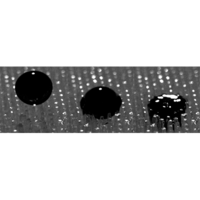
Drop impact on hairy surfaces

Alice Nasto, P.-T. Brun, and A. E. Hosoi

Phys. Rev. Fluids 4, 064004 (2019) - Published 26 June, 2019

A study of the impact of liquid drops on millimeter-scale hairy surfaces finds that the behavior of the impacting drops depends on the amount of kinetic energy dissipated through the hairs via a balance of inertia, viscosity, and surface tension.

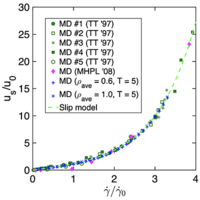
Universal molecular-kinetic scaling relation for slip of a simple fluid at a solid boundary

Gerald J. Wang and Nicolas G. Hadjiconstantinou

Phys. Rev. Fluids 4, 064201 (2019) - Published 26 June, 2019

A molecular-kinetic model, based on thermally activated processes, is developed for the slip of a simple fluid on a smooth solid boundary. Navier slip is recovered at low shear-rates. Predictions at higher shear-rates are tested against experiments and MD simulations.

Propulsion driven by self-oscillation via an electrohydrodynamic instability

Lailai Zhu and Howard A. Stone

Phys. Rev. Fluids 4, 061701(R) (2019) - Published 24 June, 2019

When a flexible elastic filament is attached to a Quincke rotating sphere, an elasto-electro-hydrodynamic instability leads to self-propulsion of the composite system.

Dynamics of gravity-driven viscoelastic films on wavy walls

Arjun Sharma, Prasun K. Ray, and Demetrios T. Papageorgiou

Phys. Rev. Fluids 4, 063305 (2019) - Published 24 June, 2019

An investigation finds that instability in gravity-driven thin viscoelastic films can be substantively enhanced or suppressed by sinusoidal wall topography with an appropriately chosen wavelength. Topography also introduces finer temporal scales in the film dynamics, and simulations produce a broad range of nonlinear states.

Electroosmotic flow in soft microchannels at high grafting densities

Arman Sadeghi, Milad Azari, and Steffen Hardt

Phys. Rev. Fluids 4, 063701 (2019) - Published 24 June, 2019

The ion partitioning effect due to polyelectrolyte layer (PEL)-electrolyte permittivity contrast in soft microchannels leads to depletion of electrolyte ions within the PEL. This effect, surprisingly, magnifies the electroosmotic flow rate because of the space charge increase outside the PEL.

Effect of elastic walls on suspension flow

Marco Edoardo Rosti, Mehdi Niazi Ardekani, and Luca Brandt

Phys. Rev. Fluids 4, 062301(R) (2019) - Published 21 June, 2019

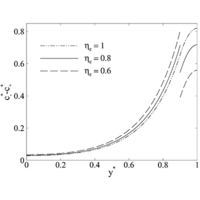
A suspension of rigid particles in plane Couette flow with elastic boundaries is simulated numerically. Reduction in apparent viscosity for the more deformable boundaries is modeled as a concentration reduction as the volume for particles expands in amount equal to the boundary elastic deformation.

Dynamic jamming of dense suspensions under tilted impact

Endao Han, Liang Zhao, Nigel Van Ha, S. Tonia Hsieh, Daniel B. Szyld, and Heinrich M. Jaeger

Phys. Rev. Fluids 4, 063304 (2019) - Published 21 June, 2019

High-speed ultrasound imaging is used to reconstruct the three-dimensional flow field of dense cornstarch suspensions under tilted impact. Experiments show how jamming fronts propagate and get deformed in a nonaxisymmetric manner under different impact angles.

Group theory analysis of early-time scale-dependent dynamics of the Rayleigh-Taylor instability with time varying acceleration

Desmond L. Hill, Aklant K. Bhowmick, Dan V. Ilyin, and Snezhana I. Abarzhi

Phys. Rev. Fluids 4, 063905 (2019) - Published 21 June, 2019

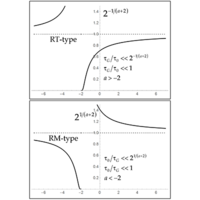
Group theory analysis of the Rayleigh-Taylor instability with an acceleration varying in time finds that the early time behavior depends on whether the acceleration decays faster or slower than 1/t2.

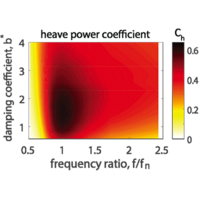
Resonant response and optimal energy harvesting of an elastically mounted pitching and heaving hydrofoil

Yunxing Su and Kenneth Breuer

Phys. Rev. Fluids 4, 064701 (2019) - Published 20 June, 2019

Experiments using a cyber-physical hydrofoil, tested over a wide range of stiffness and damping coefficients, reveal that the optimal response is achieved at the structural resonant frequency where the leading-edge vortex formation is synchronized with the foil pithing and heaving.

Sign In to Your Journals Account

Filter

Recent Issues

Vol. 11, Iss. 10
October 2026
Vol. 11, Iss. 9
September 2026
Vol. 11, Iss. 8
August 2026
Vol. 11, Iss. 7
July 2026
Category
Article Type
Section

Filter

Article Lookup

Enter a citation