Recent Articles

Rotational dynamics of a particle in a turbulent stream

Yayun Wang, Adam Sierakowski, and Andrea Prosperetti

Phys. Rev. Fluids 4, 064304 (2019) - Published 19 June, 2019

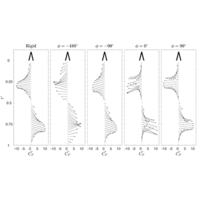
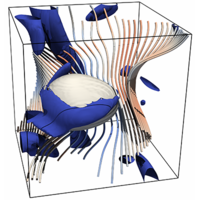
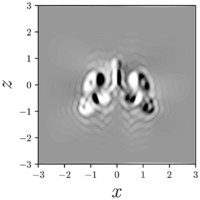
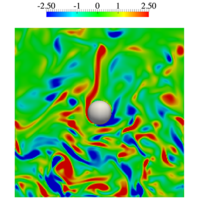
Numerical simulations of turbulent flow past a sphere immersed in decaying turbulence, free to rotate around a fixed center, are presented. This arrangement allows the same simulations with and without the sphere, thus permitting the identification of the flow features that most affect the sphere rotation.

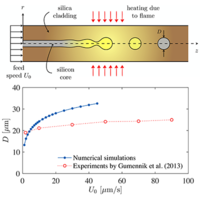
Particle size selection in capillary instability of locally heated coaxial fiber

Saviz Mowlavi, Isha Shukla, P.-T. Brun, and François Gallaire

Phys. Rev. Fluids 4, 064003 (2019) - Published 18 June, 2019

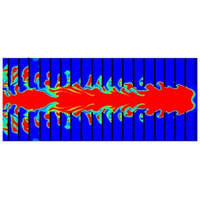
An analysis of the drop-size selection mechanism in a locally heated silicon-in-silica coaxial fiber is presented. Surprisingly, it is found that the size of the silicon drops is independent of the linear stability properties of the system and is instead set by nonlinear effects.

Role of the near-tip region of a fin in fish propulsion

F. J. Huera-Huarte and Morteza Gharib

Phys. Rev. Fluids 4, 063103 (2019) - Published 17 June, 2019

We examine the effects of locally altering the tip region of a periodic flapping fin system with a low order robotic model and load, motion, and wake measurements. This actuation modifies propulsive performance and unveils the importance of the phase difference between the fin and the tip.

Bypass transition delay using oscillations of spanwise wall velocity

Prabal S. Negi, Maneesh Mishra, Philipp Schlatter, and Martin Skote

Phys. Rev. Fluids 4, 063904 (2019) - Published 17 June, 2019

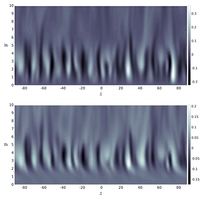
Bypass transition in boundary layers is governed by streak instability. An investigation of the effect of oscillatory wall-control on bypass transition shows that transition delay is due to streak attenuation via the modification of the eigenfunction of the Orr-Sommerfeld operator.

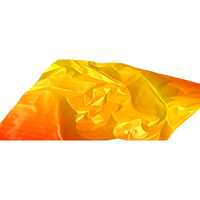
Topological mixing of yield stress materials

D. R. Lester and A. Chryss

Phys. Rev. Fluids 4, 064502 (2019) - Published 14 June, 2019

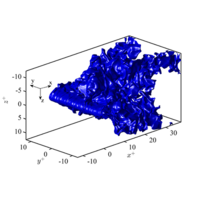
Chaotic mixing of yield stress fluids is considered in a novel static mixer that imparts uniformly efficient mixing due to the underlying topology of the device. Experimental and computational studies indicate that mixing is largely insensitive to flow dynamics, boundary conditions, and fluid rheology.

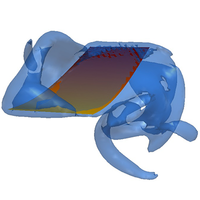
Small-scale flow topologies in decaying isotropic turbulence laden with finite-size droplets

Michael S. Dodd and Lluís Jofre

Phys. Rev. Fluids 4, 064303 (2019) - Published 13 June, 2019

The small-scale flow topologies in droplet-resolved direct numerical simulations of isotropic turbulence are classified using tensor invariants. The results show that when approaching the droplet surface, the flow topologies fundamentally change from those found in isotropic turbulence to boundary-layer-like structures.

Frozen waves in turbulent mixing layers

Benoît-Joseph Gréa and Antoine Briard

Phys. Rev. Fluids 4, 064608 (2019) - Published 13 June, 2019

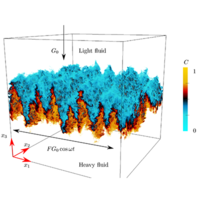
The horizontal vibrations of an interface between miscible fluids trigger a parametric instability, leading to frozen wave patterns. Theory and numerical simulations reveal that the mixing layer size varies as the square of the forcing amplitude in the turbulent regime.

Strong turbulence for vibrating plates: Emergence of a Kolmogorov spectrum

Gustavo Düring, Christophe Josserand, Giorgio Krstulovic, and Sergio Rica

Phys. Rev. Fluids 4, 064804 (2019) - Published 13 June, 2019

In the low viscosity liquid and zero thickness vibrating elastic sheet, turbulent behavior is observed. We find the same Kolmogorov spectrum cascade for energy redistribution per scale Ek∼P2/3k−5/3 in both, apparently, completely disparate physical situations.

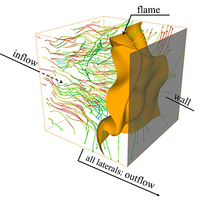
Vectorial structure of the near-wall premixed flame

Peipei Zhao, Lipo Wang, and Nilanjan Chakraborty

Phys. Rev. Fluids 4, 063203 (2019) - Published 12 June, 2019

A turbulent premixed flame anchored by a solid wall can reach a statistically stationary state. Overall the configuration is counterflowlike. Flame-wall interactions under such conditions are key to understanding combustion in a confined space and in developing wall flame models. A numerical study is presented.

Turning strategies for plunging elastic plate propulsor

Peter D. Yeh, Ersan Demirer, and Alexander Alexeev

Phys. Rev. Fluids 4, 064101 (2019) - Published 12 June, 2019

Complex actuation of a caudal fin can generate turning moments enabling underwater swimmer navigation. A numerical study explores the hydrodynamics resulting from two actuation strategies leading to pitching and yaw moments.

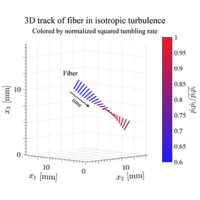
Inertial effects on the dynamics of rigid heavy fibers in isotropic turbulence

Sofia Kuperman, Lilach Sabban, and René van Hout

Phys. Rev. Fluids 4, 064301 (2019) - Published 12 June, 2019

Holographic cinematography is used to measure rotational and translational dynamics of inertial fibers in isotropic turbulence. Results show that for the present parameter range, translational motion is similar to that for spheres. In contrast, tumbling rates peaked at an intermediate Stokes number.

Quantitative study of the rheology of frictional suspensions: Influence of friction coefficient in a large range of viscous numbers

William Chèvremont, Bruno Chareyre, and Hugues Bodiguel

Phys. Rev. Fluids 4, 064302 (2019) - Published 12 June, 2019

A numerical study of sheared suspensions of frictional and frictionless rigid spheres finds that macroscopic friction in granular suspensions is nearly independent of interparticle contact friction, and besides contact lubrication, the viscous contribution of the pore fluid is negligibly small.

Evolution of a line vortex in stratified flow

Surupa Shaw and John P. McHugh

Phys. Rev. Fluids 4, 064803 (2019) - Published 12 June, 2019

A pair of distributed vortices in stratified flow disintegrate sooner than a traditional vortex pair and form multiple coherent vortex structures.

Analysis of nonequidiffusive premixed flames in obstructed channels

Abdulafeez Adebiyi, Olatunde Abidakun, Gbolahan Idowu, Damir Valiev, and V’yacheslav Akkerman

Phys. Rev. Fluids 4, 063201 (2019) - Published 11 June, 2019

The impact of the Lewis number on ultrafast premixed flame acceleration in channels equipped with comb-shaped arrays of tightly spaced obstacles attached to the walls is studied by the computational simulations of the reacting flow equations, including fully compressible hydrodynamics.

Unresolved stress tensor modeling in turbulent premixed V-flames using iterative deconvolution: An a priori assessment

Z. M. Nikolaou, Y. Minamoto, and L. Vervisch

Phys. Rev. Fluids 4, 063202 (2019) - Published 11 June, 2019

The application of an iterative deconvolution modeling framework for the unresolved stresses in turbulent and reacting flows is demonstrated using high-fidelity direct numerical simulation data of premixed rod-stabilized V-flames.

Influence of a small amount of noncondensable gas on shock wave generation inside a collapsing vapor bubble

Kyohei Yamamoto, Kazumichi Kobayashi, Masao Watanabe, Hiroyuki Fujii, Misaki Kon, and Hiroyuki Takahira

Phys. Rev. Fluids 4, 063603 (2019) - Published 11 June, 2019

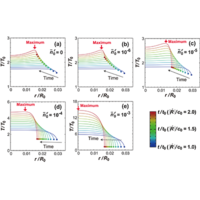
A numerical study of the collapse of a vapor bubble finds that a small amount of noncondensable molecules affects the temperature profile inside the collapsing vapor bubble, preventing shock wave generation inside the collapsing bubble.

Vortex merging in a laminar separation bubble under natural and forced conditions

J. W. Kurelek, S. Yarusevych, and M. Kotsonis

Phys. Rev. Fluids 4, 063903 (2019) - Published 11 June, 2019

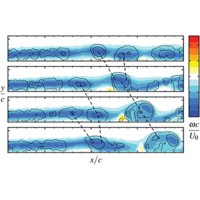
Experiments find that vortex merging occurs naturally in a laminar separation bubble. Acoustic forcing at the subharmonic and fundamental vortex shedding frequency promotes and inhibits merging, respectively. In all cases, merging occurs in the aft portion of the bubble in a spanwise nonuniform manner.

Pancake making and surface coating: Optimal control of a gravity-driven liquid film

E. Boujo and M. Sellier

Phys. Rev. Fluids 4, 064802 (2019) - Published 11 June, 2019

Imagine a thin liquid film that must cover the substrate it spreads over before solidifying: tilting the substrate is useful to get a little push from gravity, but obtaining a uniform film thickness is challenging. Here, an adjoint method finds time-dependent motions that improve uniformity.

Lagrangian acceleration timescales in anisotropic turbulence

Peter D. Huck, Nathanael Machicoane, and Romain Volk

Phys. Rev. Fluids 4, 064606 (2019) - Published 10 June, 2019

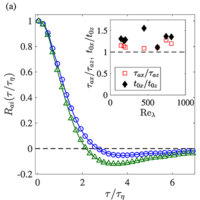
In a Lagrangian point of view, anisotropy in small time scales of turbulent flow is not yet well understood. Using Particle Tracking Velocimetry over nearly a decade in Taylor-scale based Reynolds numbers, we theoretically predict anisotropic acceleration correlation times of tracer particles in turbulent flow.

Kinetic energy budget of the largest scales in turbulent pipe flow

C. Bauer, A. von Kameke, and C. Wagner

Phys. Rev. Fluids 4, 064607 (2019) - Published 10 June, 2019
Very-large-scale motions contribute significantly to the kinetic energy in turbulent pipe flow. An analysis of the scale energy budget reveals a similar production mechanism compared to the small scales, but the interscale energy exchange is found to be quite different.

Sign In to Your Journals Account

Filter

Recent Issues

Vol. 11, Iss. 10
October 2026
Vol. 11, Iss. 9
September 2026
Vol. 11, Iss. 8
August 2026
Vol. 11, Iss. 7
July 2026
Category
Article Type
Section

Filter

Article Lookup

Enter a citation