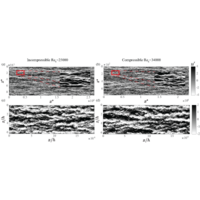
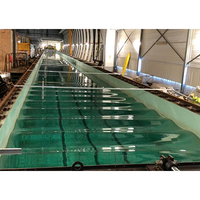
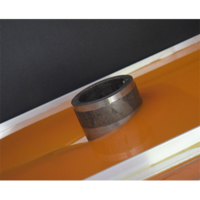
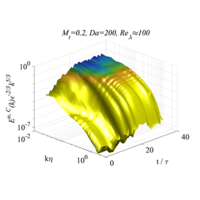
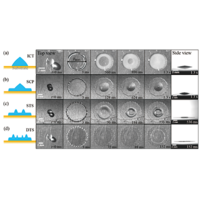
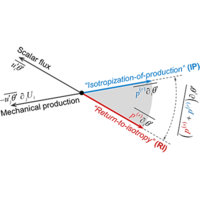
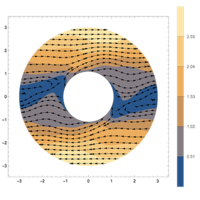
This experimental study investigates the effects of Reynolds number (, where ) and initial release diameter (2.2 mm 9.4 mm) on the scalar power spectra, fractal geometry, and turbulent length scales of high-Schmidt-number passive scalar fields resulting from an isokinetic release in a turbulent boundary layer. The turbulence analysis is based on 12 000 scalar fields collected using the planar laser-induced fluorescence technique for each case at six locations downstream. The scalar integral length scale and scalar Taylor microscale are calculated directly from the fields using the autocorrelation function and variance/gradient of the concentration fluctuation fields. With increasing downstream distance, the Taylor microscale decreases and the integral length scale increases, each to an asymptotic value. This indicates a larger range of scales exists as the scalar becomes more mixed, as one would expect. For locations beyond (where is the flow depth), the self-similarity condition is observed by considering the ratio between the scalar integral length scale and scalar Taylor microscale. Local isotropy is approached as measured by computing the ratio of longitudinal to transverse scalar Taylor microscales, and a change in the growth rate is observed for the fractal dimension computed from a planar section of the interfaces in the concentration fluctuation fields. The spectral slope magnitude in the inertial-convective regime decreases near the source () due to the large-scale anisotropy. In the self-similar regime (), the scaling-exponent is found to be dependent on the initial release diameter. The lower wave-number portion of the inertial-convective regime, where the scales are larger than or closer to the scale of the nozzle diameter, scales close to scaling in agreement with the cascade-bypass situation, and the spectral slope in the upper wave-number portion of the inertial-convective regime is found to be closer to . The viscous-convective scaling behavior deviated significantly from Batchelor's scaling law, clearly disputing the generality of Batchelor's arguments. Intermittency analysis, using computation of the intermittency factor as well as probability density functions of the fluctuating scalar gradient, suggests that the discrepancy between theory and observations for the scaling of the viscous-convective regime can be explained by the high intermittency in the small scales of the scalar fluctuations.