Recent Articles

Rotating tensiometer for the measurement of the elastic modulus of deformable particles

Massimiliano M. Villone and Howard A. Stone

Phys. Rev. Fluids 5, 083606 (2020) - Published 19 August, 2020

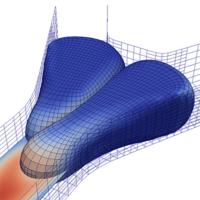
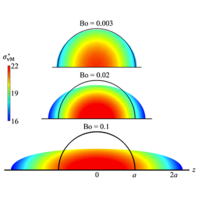
In a spinning drop tensiometer, the interfacial tension between two immiscible liquids can be inferred from the equilibrium shape of a drop suspended in a rotating medium. Similarly, an analytical solution is derived for the deformation dynamics of an initially spherical elastic particle suspended in a denser viscous rotating liquid. This gives a proof of concept for a rotating tensiometer for the measurement of the mechanical properties of soft solid beads. Direct numerical simulations are used to validate the theory and identify its limits of applicability.

Marangoni instability in the linear Jeffreys fluid with a deformable surface

Ramkarn Patne, Yehuda Agnon, and Alexander Oron

Phys. Rev. Fluids 5, 084005 (2020) - Published 19 August, 2020

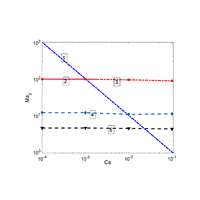
Advantages of thermocapillary techniques over other approaches to polymer patterning have been recently recognized and will promote them to further expansion and development. In this perspective, a study of Marangoni instability in a layer of a viscoelastic liquid with a deformable interface is of great importance. Its linear stability analysis shows the presence of (and competition among) the long-wave stationary, short-wave stationary, and oscillatory modes, which leads to the emergence of codimension-two and codimension-three points in the parameter space.

Thermoacoustic stabilization of a longitudinal combustor using adjoint methods

José G. Aguilar and Matthew P. Juniper

Phys. Rev. Fluids 5, 083902 (2020) - Published 18 August, 2020

Thermoacoustic oscillations in combustion chambers can usually be stabilized with small design changes. Here, an adjoint method is used to identify the required changes and a gradient-based optimization algorithm is used to implement them. The adjoint method reveals the physical mechanisms that are being exploited. These are to dephase the heat release rate from the pressure and to increase the mechanical work done at the acoustic boundaries.

Interaction of forced Orr-Sommerfeld and Squire modes in a low-order representation of turbulent channel flow

Ryan M. McMullen, Kevin Rosenberg, and Beverley J. McKeon

Phys. Rev. Fluids 5, 084607 (2020) - Published 18 August, 2020

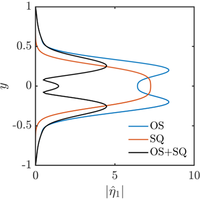
Spectra in turbulent channel flow are efficiently represented using a decomposition of the resolvent operator into Orr-Sommerfeld (OS) and Squire (SQ) families of modes. The accuracy of the OS-SQ representation is shown to be superior to the standard resolvent decomposition and results from the ability of the OS and SQ vorticity responses to interact. This interaction is then leveraged to derive Reynolds number scalings for the relative magnitudes of the OS and SQ mode weights for several classes of resolvent modes.

Particle motion nearby rough surfaces

Christina Kurzthaler, Lailai Zhu, Amir A. Pahlavan, and Howard A. Stone

Phys. Rev. Fluids 5, 082101(R) (2020) - Published 17 August, 2020

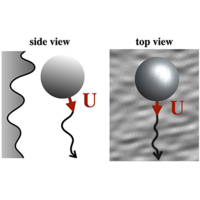
Natural and microfluidic environments display a variety of confining surfaces with structured topographies, which modify the surrounding flow fields and impact nearby particle motion. We study a non-Brownian spherical particle sedimenting nearby a random, rough surface by using an analytical theory and numerical simulations. Roughness of the wall induces fluctuations in the velocity of the fall, leading to a quadratic increase of the variance of the displacements at long times.

Interaction and breakup of droplet pairs in a microchannel Y-junction

Simon S. Schütz, Jian Wei Khor, Sindy K. Y. Tang, and Tobias M. Schneider

Phys. Rev. Fluids 5, 083605 (2020) - Published 17 August, 2020

Droplets pushed through small channels can undergo breakup, which limits the throughput in microfluidic applications. We combine theory, numerical simulation, and experiments to explain and quantify the underlying physical breakup process for interacting droplet pairs in a Y-junction. Breakup is driven by spatially varying Young-Laplace pressures, which drive the formation of a neck and a subsequent Rayleigh-Plateau-like pinch-off in the leading droplet. Quantitative analysis suggests that fast interface deformations can dynamically generate Marangoni stresses that significantly impact the dynamics.

Equilibrium and nonequilibrium molecular dynamics methods to compute the first normal stress coefficient of a model polymer solution

A. G. Menzel, P. J. Daivis, and B. D. Todd

Phys. Rev. Fluids 5, 084201 (2020) - Published 14 August, 2020

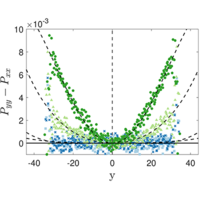
The first normal pressure (or stress) difference is directly computed from the local values of the pressure tensor components in molecular dynamics simulations of planar Poiseuille flow for a low molecular weight polymeric fluid. The resulting zero shear rate normal pressure difference agrees very well with the value computed using homogeneous shear simulations and the SLLOD algorithm, and less well with the result of the Coleman-Markowitz equation evaluated at equilibrium. This resolves doubts about the effects of homogeneous thermostats in homogeneous nonequilibrium molecular dynamics simulations.

Particle accumulation structures in noncylindrical liquid bridges under microgravity conditions

Paolo Capobianchi and Marcello Lappa

Phys. Rev. Fluids 5, 084304 (2020) - Published 14 August, 2020

We numerically investigate Particle Accumulation Structures (PAS) in noncylindrical liquid bridges (LB) for a high Prandtl number liquid. The work examines the morphological evolution of these structures in weightless conditions for various Marangoni and Stokes numbers, tracer densities, aspect ratios and LB volumes. Additionally, a model is used to interpret the increased ability of concave LBs to support these phenomena over a wider range of the particle Stokes number. The model relies mainly on geometrical factors, i.e., the relationship among the interface curvature, fluid streamline topology, and particle mass effects.

Resonance of droplets in constricted capillary tubes: Critical factors and nonlinearity

Chao Zeng, Wen Deng, and M. Bayani Cardenas

Phys. Rev. Fluids 5, 083604 (2020) - Published 12 August, 2020

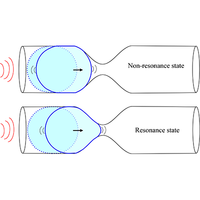
A stationary nonwetting droplet in a constricted tube can attain resonance in response to external seismic stimulation. Key parameters controlling droplet resonance are analyzed through a proposed theoretical model. The nonlinear effect of a fluid system on the resonance is also addressed.

Forward, reverse, and no motion of Marangoni surfers under confinement

Saeed Jafari Kang, Samrat Sur, Jonathan P. Rothstein, and Hassan Masoud

Phys. Rev. Fluids 5, 084004 (2020) - Published 12 August, 2020

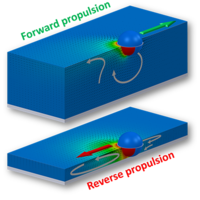
The propulsion characteristics of Marangoni surfers under confinement is examined. Through experimental measurements and numerical simulations, it is demonstrated that, contrary to what might be the usual expectation, the surfers may propel themselves in the direction of lower surface tension. It is discovered that negative pressure is the primary contributor to the fluid force experienced by the surfer and that this suction force is mainly responsible for the reverse Marangoni propulsion.

Modal analysis of the behavior of inertial particles in turbulence subjected to Stokes drag

Mahdi Esmaily and Ali Mani

Phys. Rev. Fluids 5, 084303 (2020) - Published 12 August, 2020

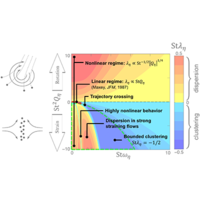
The complexity of the problem of clustering of inertial particles in turbulence has intrigued researchers for decades. Here it is shown how a simple one-dimensional flow oscillating at a single frequency explains much of that complexity, and a solution for the Lyapunov exponents of inertial particles subjected to oscillator fluid motion is derived.

Lift induced by slip inhomogeneities in lubricated contacts

Aidan Rinehart, Uğis Lācis, Thomas Salez, and Shervin Bagheri

Phys. Rev. Fluids 5, 082001(R) (2020) - Published 11 August, 2020

A small change of slip boundary condition within a lubrication region breaks the fore-aft symmetry, which leads to a significant lift force. The change of slippage arises naturally on surfaces where physical and/or chemical properties are not perfectly constant. The induced lift force may result in nontrivial trajectories of particles traveling near surfaces.

Convective flow driven by a chemical nanopump

Yang Ding, Julyan H. E. Cartwright, and Silvana S. S. Cardoso

Phys. Rev. Fluids 5, 082201(R) (2020) - Published 10 August, 2020

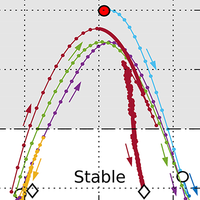
A cobalt chloride membrane grows in a bath of sodium silicate in stable, oscillatory or explosively unstable regimes, with experiments confirming a simple model.

Particle monolayer assembly in evaporating salty colloidal droplets

Myrthe A. Bruning, Laura Loeffen, and Alvaro Marin

Phys. Rev. Fluids 5, 083603 (2020) - Published 10 August, 2020

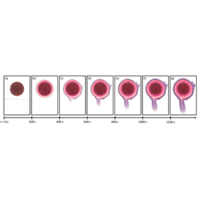
Evaporating a sessile colloidal droplet containing small amounts of salt results in the formation of a ring-shaped stain, resembling the classical coffee-stain effect. However, this ring shape is the only similarity: The structure is actually formed by a single monolayer of particles at the liquid-air interface of the droplet and driven by a solutal Marangoni flow. An experimental study, particle-per-particle, of the formation of this monolayer is presented and numerical simulations are performed to understand the particle aggregation mechanism.

Confinement and hydrophilicity effects on geologically relevant fluids in silica nanopores

James Moraes de Almeida and Caetano Rodrigues Miranda

Phys. Rev. Fluids 5, 083801 (2020) - Published 10 August, 2020

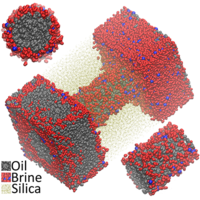
The confinement effects in brine, water, and oil are explored in hydrophilic silica nanopores. As the nanopores approach a 1.0-nm radius, the confinement effects are very pronounced, changing the interfacial tension behavior, as well as viscous flow properties. Also, a water-brine layer always stays adsorbed in the silica surface, mediating its interaction with the oil, even hindering the oil infiltration in a case.

Tunable flow asymmetry and flow rectification with bio-inspired soft leaflets

M. Brandenbourger, A. Dangremont, R. Sprik, and C. Coulais

Phys. Rev. Fluids 5, 084102 (2020) - Published 10 August, 2020

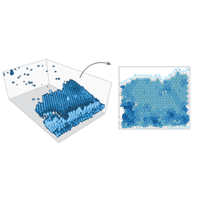
The lymphatic system relies on a complex arrangement of soft valves to pump lymph. While it is widely assumed that the pumping relies on a fluid-structure interaction mechanism, the role of the valve in this mechanism remains poorly understood. A combination of precision desktop-scale experiments, numerical simulations, and theoretical modeling are used to reveal the relationship between valve geometry and flow properties, which are harnessed to induce flow rectification and pumping. The findings enhance the understanding of directed flow in living systems and open avenues for bio-inspired microfluidic and soft robotic devices

Inertial effects in shear flow of a fluid-particle mixture: Resolved simulations

Gedi Zhou and Andrea Prosperetti

Phys. Rev. Fluids 5, 084301 (2020) - Published 10 August, 2020

We conduct resolved simulations of spherical particles suspended in a light fluid in shear flow with a ratio of particle to fluid density in the range of 2.5 to 10 and a focus on inertial rather than gravitational effects. Particle volume fractions range from 5% to 33% and particle Reynolds numbers (Rep) of 20 and 40 are examined. Significant effects are found due to the memory of the particles earlier motion related to inertia including on collision rates, momentum transfers, and stress differences. We find that increasing the particle density has similar effects to increasing Rep.

Lagrangian and Eulerian drag models that are consistent between Euler-Lagrange and Euler-Euler (two-fluid) approaches for homogeneous systems

S. Balachandar

Phys. Rev. Fluids 5, 084302 (2020) - Published 10 August, 2020

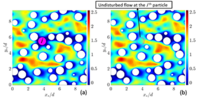
The undisturbed flow of a particle controls both the undisturbed flow force and the perturbation (quasi-steady, added-mass and history) forces. With the pairwise interaction extended point particle framework we evaluate the undisturbed flow of each particle in a random array through superposition of the perturbation flow induced by all its neighbors. From this the undisturbed flow statistics can be calculated. We obtain a force consistency relation between drag on an individual particle for use in an Euler-Lagrange simulation and the average drag suitable for use in an Euler-Euler simulation.

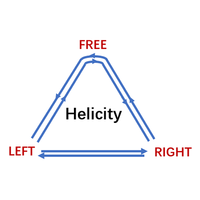
Cross-chirality transfer of kinetic energy and helicity in compressible helical turbulence

Zheng Yan, Xinliang Li, Changping Yu, and Jianchun Wang

Phys. Rev. Fluids 5, 084604 (2020) - Published 10 August, 2020

The regularity of chirality transfer is numerically investigated in compressible helical turbulent flows. It is found that the compressible component of velocity serves as a medium role for chirality transfer, and the expansion of fluid elements can lead to a stronger lack of mirror symmetry. These conclusions not only uncover the complexity of compressible chiral turbulence but also may serve as a possible controlling method for chiral turbulence.

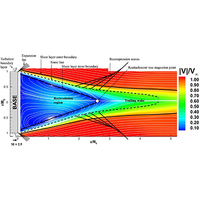
Coherent turbulence and entrainment in a supersonic, axisymmetric, separated/reattaching shear layer

Branden M. Kirchner, Gregory S. Elliott, and J. Craig Dutton

Phys. Rev. Fluids 5, 084605 (2020) - Published 10 August, 2020
Pressure loading in massively separated flow regions is intimately tied to the entrainment characteristics of the separated shear layer, which also determines the streamwise distance required for shear layer reattachment. Using stereoscopic particle image velocimetry measurements of a Mach 2.49 longitudinal cylinder wake, a clear relationship between the presence of coherent turbulent structures (i.e., hairpin vortices) and the shear layer reattachment length is demonstrated.

Sign In to Your Journals Account

Filter

Recent Issues

Vol. 11, Iss. 10
October 2026
Vol. 11, Iss. 9
September 2026
Vol. 11, Iss. 8
August 2026
Vol. 11, Iss. 7
July 2026
Category
Article Type
Section

Filter

Article Lookup

Enter a citation