Recent Articles

Migration, trapping, and venting of gas in a soft granular material

Sungyon Lee, Jeremy Lee, Robin Le Mestre, Feng Xu, and Christopher W. MacMinn

Phys. Rev. Fluids 5, 084307 (2020) - Published 31 August, 2020

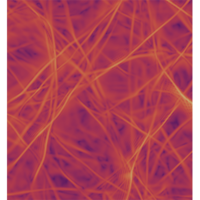
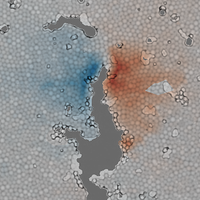
Gas migration through a soft, liquid-saturated granular material involves a strong coupling between the motion of the gas and the deformation of the material. This process is central to many natural and industrial systems, such as the generation and venting of gases from lake beds and waste ponds. Using high-resolution experiments and a simple mechanistic model, grain-scale fluid and solid mechanics are linked with macroscopic migration, trapping, and venting. The largest amount of trapping and the largest venting events are found to occur at intermediate confining stress.

Formulating turbulence closures using sparse regression with embedded form invariance

S. Beetham and J. Capecelatro

Phys. Rev. Fluids 5, 084611 (2020) - Published 28 August, 2020

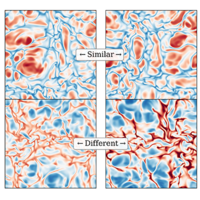
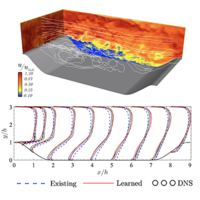
In recent years, machine-learning techniques have been leveraged to improve closures for the Reynolds-average Navier-Stokes equations. The efficacy of a sparse regression-based method that results in compact, algebraic models and ensures key physical properties such as form invariance is demonstrated. Further, success for learning accurate models from data spanning full high-fidelity sets to experimental (sparse and noisy) data is shown.

Elastohydrodynamical instabilities of active filaments, arrays, and carpets analyzed using slender-body theory

Ashok S. Sangani and Arvind Gopinath

Phys. Rev. Fluids 5, 083101 (2020) - Published 27 August, 2020

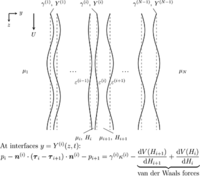
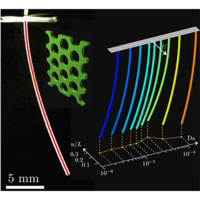
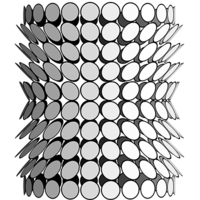
A linear stability theory is developed to examine the conditions under which self-sustained oscillations occur in elastic filaments attached to a sphere or a wall subject to uniform force applied parallel to the axis of the filament. We shown that N equi-spaced filaments attached to a wall can undergo N different oscillation modes. The mode of first oscillation onset as the magnitude of the tangential force is increased, however, always corresponds to the mode of all filaments oscillating together in-phase. The figure shows the critical load and emergent frequency at the onset of instability for filaments oscillating in phase.

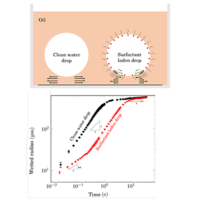
Retarding spreading of surfactant drops on solid surfaces: Interplay between the Marangoni effect and capillary flows

Parisa Bazazi and S. Hossein Hejazi

Phys. Rev. Fluids 5, 084006 (2020) - Published 27 August, 2020

Early time spreading of a water drop on a hydrophilic surface is characterized by the wetted radius which grows linearly in time. We report the unexpected result that the initial spread of surfactant-laden drops is impeded by Marangoni stresses, leading to a large increase in total spreading time. The nonuniform distribution of surfactants at the interface generates Marangoni stresses before the drop-solid contact suppresses film drainage and droplet expansion. Our experiments show that, remarkably, surfactants delay the initial fast motion of the three-phase contact lines.

Dynamics of retracting surfactant-laden ligaments at intermediate Ohnesorge number

Cristian R. Constante-Amores, Lyes Kahouadji, Assen Batchvarov, Seungwon Shin, Jalel Chergui, Damir Juric, and Omar K. Matar

Phys. Rev. Fluids 5, 084007 (2020) - Published 27 August, 2020

Three-dimensional direct numerical simulations of the ligaments retraction process over a range of system parameters that account for surfactant solubility, sorption kinetics, and Marangoni stresses are presented. The presence of surfactant inhibits the “end-pinching” mechanism and promotes neck reopening through Marangoni flow induced by the formation of surfactant concentration gradients that drive flow reversal toward the neck.

Physical modeling of the dam-break flow of sedimenting suspensions

Laurence Girolami and Frédéric Risso

Phys. Rev. Fluids 5, 084306 (2020) - Published 27 August, 2020

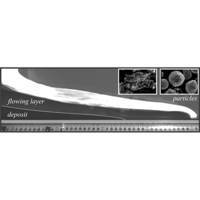
This paper develops a physical model able to describe the dam-break flow of particulate suspensions that sediment progressively during propagation at a constant velocity that solely depends on the mixture properties. The model considers the suspension as an equivalent fluid of constant density and negligible viscosity and leads to a good prediction of the flow duration and deposits shape. These findings allow the formulation of consistent shallow-water equations that can be used to compute the dense basal layer of small-volume pyroclastic flows.

Specific features of the gas-dynamic structure of supersonic axisymmetric microjets of a nonequilibrium SF6 gas

Vladimir Aniskin, Nikolay Maslov, Sergey Mironov, Elena Tsybulskaya, and Ivan Tsyryulnikov

Phys. Rev. Fluids 5, 083401 (2020) - Published 26 August, 2020

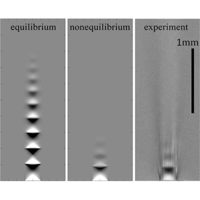
The effect of vibrational nonequilibrium of SF6 molecules on the gas dynamic structure of microjets is revealed, manifesting in a decrease in the longitudinal cell size of the wave structure and weakening of variations in flow parameters along the axis of the microjet compared to the equilibrium flow. The physical justification is found for the diameter of the nozzle, which is the boundary value between the macro- and microjets of vibrationally relaxing gases.

Behavior of the square-back Ahmed body global modes at low ground clearance

Baptiste Plumejeau, Laurent Keirsbulck, Sébastien Delprat, Marc Lippert, and Wafik Abassi

Phys. Rev. Fluids 5, 084701 (2020) - Published 26 August, 2020

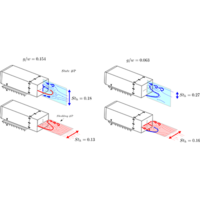
A study of the evolution of the wake flow of a square-back Ahmed body is presented. Various ground clearance configurations around the critical case associated with the onset of the lateral bistability are investigated. The oscillation modes vary between stable and bistable states, the corresponding Strouhal numbers for the horizontal (respectively, vertical) evolve from 0.16 (respectively, 0.27) to 0.13 (respectively, 0.18).

Statistical transition to turbulence in plane channel flow

Sébastien Gomé, Laurette S. Tuckerman, and Dwight Barkley

Phys. Rev. Fluids 5, 083905 (2020) - Published 25 August, 2020

The subcritical route to turbulence in shear flows is characterized by metastable localized turbulent-laminar patterns. In plane channel flow, these take the form of intermittent oblique turbulent bands, which either proliferate or decay on timescales that depend on the Reynolds number. A statistical study via direct numerical simulations in a narrow tilted domain leads to the determination of a crossing Reynolds number of around 965, above which the probability for a band to split outpaces its probability to disappear.

Linear analysis of dewetting instability in multilayer planar sheets for composite nanostructures

Bingrui Xu and Daosheng Deng

Phys. Rev. Fluids 5, 083904 (2020) - Published 24 August, 2020

Dewetting instability of multilayer planar sheets are studied by linear analysis. Several unstable modes are identified, while the maximum growth rate depends on fluid properties. These results provide theoretical guidance to enhance or suppress the dewetting instability via material selection and structure design, enabling fabrication of sophisticated nanostructures for functional fibers and wearable textiles.

Explicit algebraic relation for calculating Reynolds normal stresses in flows dominated by bubble-induced turbulence

Tian Ma, Dirk Lucas, and Andrew D. Bragg

Phys. Rev. Fluids 5, 084305 (2020) - Published 24 August, 2020

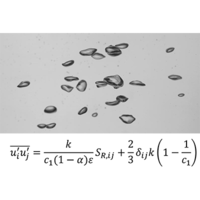
Two new algebraic turbulence models for flows dominated by bubble-induced turbulence (BIT) are presented. The first model, referred to as the algebraic Reynolds normal stress model, is derived from a differential Reynolds stress model for bubbly flows. The second model utilizes one two-equation turbulence model to achieve algebraic expressions for k and ϵ in the BIT dominated cases. If both models are combined, it results in a purely algebraic, explicit relation for the Reynolds normal stresses.

Universality and scaling in homogeneous compressible turbulence

Diego A. Donzis and John Panickacheril John

Phys. Rev. Fluids 5, 084609 (2020) - Published 24 August, 2020

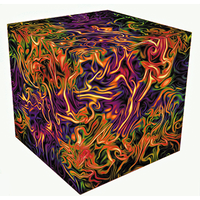
Universality concepts have played a pivotal role in the development of complex systems. This has not been the case in compressible turbulence as no unifying set of parameters has been found to yield universal scaling laws. An analysis supported with DNS databases and studies across the literature shows how universality can indeed be achieved in homogeneous compressible turbulence from specific limiting behavior, paving the way toward a more unified fundamental understanding of compressible turbulence and development of robust compressible turbulence models.

Transitions between turbulent states in a two-dimensional shear flow

Vassilios Dallas, Kannabiran Seshasayanan, and Stephan Fauve

Phys. Rev. Fluids 5, 084610 (2020) - Published 24 August, 2020

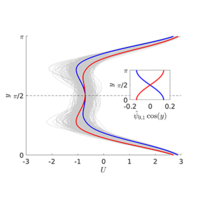
The bifurcations of large-scale jets in a turbulent shear flow driven by a Kolmogorov forcing are studied. These bifurcations, seen also in the mean velocity profile of the forced-dissipative system, are then reproduced using a system at equilibrium, namely, the truncated Euler equations. Statistical properties of the large-scale mode exhibit 1/f noise and are in qualitative agreement in both systems.

Deformation of porous flexible strip in low and moderate Reynolds number flows

M. Pezzulla, E. F. Strong, F. Gallaire, and P. M. Reis

Phys. Rev. Fluids 5, 084103 (2020) - Published 21 August, 2020

The combination of porosity and permeability of a fluid-loaded structure strongly influences its behavior, but separating the two effects has traditionally proven challenging. Here, results from an experimental and numerical investigation are presented in which the porosity is fixed while systematically varying the permeability of cantilevered strips, which are towed through a viscous fluid. Their steady-state deformations and the associated drags at low and moderate Reynolds (Re) numbers are studied. At moderate Re, the permeability plays an important role, whereas its effect is small for low Re.

Fluctuations and correlations of reactive scalars near chemical equilibrium in incompressible turbulence

Wenwei Wu (吴文伟), Enrico Calzavarini, François G. Schmitt, and Lipo Wang (王利坡)

Phys. Rev. Fluids 5, 084608 (2020) - Published 21 August, 2020

In reacting systems in turbulent fluid environments, a competition exists between the chemical reactions that tend to dump reactant concentration fluctuations and enhance their correlation intensity, and the turbulent mixing that, on the contrary, increases fluctuations and removes relative correlations. It is shown that close to chemical equilibrium, a unique control parameter—the Damkhöler number, based on the reactant Taylor microscale—allows quantitative predictions of the reactants’ statistical properties.

Convective dynamics with mixed temperature boundary conditions: Why thermal relaxation matters and how to accelerate it

Evan H. Anders, Geoffrey M. Vasil, Benjamin P. Brown, and Lydia Korre

Phys. Rev. Fluids 5, 083501 (2020) - Published 20 August, 2020

Simulations of astrophysical convection often use different thermal boundary conditions (TBC) at the domain top and bottom, but the consequences of using “mixed” TBC (MTBC) have not been thoroughly examined. Here we show that for MTBC, poorly chosen initial conditions cause a long thermal relaxation which is physically uninteresting and computationally expensive. A couple of mechanisms for avoiding this long relaxation are demonstrated. We also study asymmetries caused by MTBC and find that despite strong asymmetries in the temperature field near the boundaries, MTBC do not meaningfully break the symmetry in the bulk of the flow.

Transient shape variation and inner flow field of a rotating two-lobed liquid droplet

Tadashi Watanabe

Phys. Rev. Fluids 5, 083607 (2020) - Published 20 August, 2020

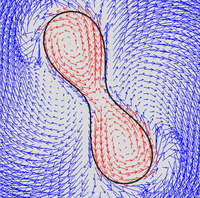
The transient shape variation and the inner flow field of a rotating liquid droplet are simulated numerically. It is found that two vortices appear in the two-lobed droplet, and a countercurrent flow is formed in between two lobes. The relationship between the maximum deformation and the rotation rate is affected by the surface tension and the density, and the effect of density becomes small as the deformation increases.

Wide domain simulations of flow over an unswept laminar wing section undergoing transonic buffet

Markus Zauner and Neil D. Sandham

Phys. Rev. Fluids 5, 083903 (2020) - Published 20 August, 2020

Laminar-flow wings are often seen as an important component of reducing the emissions of future aircraft. However, at high speeds, compressible flow phenomena, such as transonic buffet, limit the flight envelope. The application of scale-resolving simulations is studied to help improve the understanding of the physical mechanisms of this limiting instability.

Taylor-Couette instability in disk suspensions: Experimental observation and theory

J. J. J. Gillissen, N. Cagney, T. Lacassagne, A. Papadopoulou, S. Balabani, and H. J. Wilson

Phys. Rev. Fluids 5, 083302 (2020) - Published 19 August, 2020

Experimental evidence is provided for the authors’ theoretical prediction that suspended disks reduce the onset speed for instability in Taylor-Couette flow.

Slippery flows of a Carbopol gel in a microchannel

Eliane Younes, Volfango Bertola, Cathy Castelain, and Teodor Burghelea

Phys. Rev. Fluids 5, 083303 (2020) - Published 19 August, 2020
The microscopic structure of a physical gel such as Carbopol flowing in a confined microchannel is strongly heterogeneous over space. Thus tackling the wall-slip behavior using the classical assumption of the presence of a thin layer of Newtonian solvent of constant width near the channel’s walls is unjustified. To address the wall-slip scaling behavior, we propose a novel method of directly relating macroscopic rheological measurements to the measured wall velocity gradients. The scaling behavior we obtain via this method differs substantially from the previously published results.

Sign In to Your Journals Account

Filter

Recent Issues

Vol. 11, Iss. 10
October 2026
Vol. 11, Iss. 9
September 2026
Vol. 11, Iss. 8
August 2026
Vol. 11, Iss. 7
July 2026
Category
Article Type
Section

Filter

Article Lookup

Enter a citation