Highlights

Droplet impact on a prewetted mesh

Long Xu, Wenjie Ji, Jie Lu, Yalei Li, Jiguang Hao, Gengkai Hu, and J. M. Floryan

Phys. Rev. Fluids 6, L101602 (2021) - Published 28 October, 2021

The effects of the liquid trapped in a mesh on droplet penetration were investigated. It was found that penetrations could be entirely suppressed by the trapped liquid. A model for predicting the transition thresholds is proposed and compared with experimental results. It is suggested that the impact type is determined by the momentum exchange between the impacting droplet and the liquid trapped in the mesh.

Dynamics of migrating sand dunes interacting with obstacles

Karol A. Bacik, Priscilla Canizares, Colm-cille P. Caulfield, Michael J. Williams, and Nathalie M. Vriend

Phys. Rev. Fluids 6, 104308 (2021) - Published 26 October, 2021

Wind- and water-driven migrating sand dunes frequently interact with elevated natural and artificial topographical features. Generically, dunes interact with obstacles either by ‘crossing’ over the obstacle or by being ‘trapped’. We study this problem in an idealized quasi-two-dimensional laboratory experiment. We show that the outcome – crossing or trapping – depends on the size and shape of the obstacle and we relate these observations to the flow structure in the immediate vicinity of the obstacle.

Ensemble-variational assimilation of statistical data in large-eddy simulation

Vincent Mons, Yifan Du, and Tamer A. Zaki

Phys. Rev. Fluids 6, 104607 (2021) - Published 21 October, 2021

Data assimilation is employed to improve the accuracy of large-eddy simulation (LES) of wall-bounded flows. The methodology is adjoint-free and can assimilate any reference statistical quantities that are available from experiments or direct simulations. The outcome is enhanced fidelity LES that outperforms a variety of traditional subgrid models.

Dynamics of three-dimensional turbulence from Navier-Stokes equations

Katepalli R. Sreenivasan and Victor Yakhot

Phys. Rev. Fluids 6, 104604 (2021) - Published 15 October, 2021

Turbulent flows contain occasional, well-separated sharp features, as illustrated in this picture by Bonn et al. (1993), reproduced with permission, surrounded mostly by low levels of activity. Both interacting structures contribute to the complexity of turbulence. A full theory requires the understanding of both, which is what our paper attempts to do. We predict quantitatively the multi-scaling exponents for these singular-like features of different strengths, while also showing that the background flow is Gaussian. The large spatial separation between the sharp structures enables one to treat them as a “weakly interacting gas”.

Wave damping by flexible marsh plants influenced by current

Xiaoxia Zhang and Heidi Nepf

Phys. Rev. Fluids 6, 100502 (2021) - Published 13 October, 2021

We develop a wave damping model based on a prediction of current- and wave-induced force on individual plants. The model captures the influence of reconfiguration on wave forces, the impact of current on wave group velocity, and the modification of in-canopy time-mean and wave orbital velocity associated with canopy drag, all of which affect the wave dissipation by vegetation. The model explains why weak current reduces wave dissipation while strong current increases wave dissipation, as observed both in the present and previous studies. Further, we explore the impact of plant flexibility and leaf morphology on wave dissipation over a wide range of current to wave velocity ratio.

Effects of spanwise confinement on stratified shear instabilities

Yves-Marie Ducimetière, François Gallaire, Adrien Lefauve, and Colm-cille P. Caulfield

Phys. Rev. Fluids 6, 103901 (2021) - Published 11 October, 2021

We study the influence of transverse confinement on the linear instability properties of velocity and density distributions evoking exchange flows in stratified inclined ducts. In the chosen parameter space, we find that the presence of lateral walls has a stabilizing effect. The growth-rate predictions for the spanwise-invariant cases are almost systematically an upper bound to the growth-rate corresponding to the confined geometry. In addition, accounting for spanwise-varying perturbations result in the proliferation of unstable modes that present an odd-even regularity in their spatial structures, which is rationalized by comparison to the dispersion relation obtained for oblique waves.

Nonequilibrium turbulent dissipation in buoyant axisymmetric plume

Sunita and G. C. Layek

Phys. Rev. Fluids 6, 104602 (2021) - Published 8 October, 2021

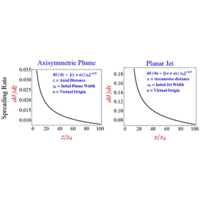
This paper established the existence of non-Kolmogorov turbulence in free shear flows. The authors propose a set of dissipation laws and link them with the spreading rates as well as the entrainment coefficient, which varies with the rise of the plume in contrast to the Kolmogorov case. The work also show how the parameters of two stretching transformations determine both Kolmogorov and non-Kolmogorov turbulence.

Surfactant-driven instability of a divergent flow

G. Koleski, J.-C. Loudet, A. Vilquin, B. Pouligny, and T. Bickel

Phys. Rev. Fluids 6, 094001 (2021) - Published 7 September, 2021

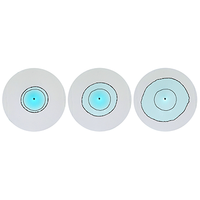
The flow of a submerged water jet directed toward the liquid interface is investigated both experimentally and theoretically. We find evidence that the presence of a small amount of surfactants can trigger an azimuthal instability. Our theoretical model reveals that surfactant advection in the Stokes regime contains the minimal ingredients to explain the instability.

Diffusive and capillary instabilities of viscous fluid threads in microchannels

Thomas Cubaud, Bryan Conry, Xiaoyi Hu, and Thai Dinh

Phys. Rev. Fluids 6, 094202 (2021) - Published 7 September, 2021

We experimentally investigate the flow behavior of viscous oil threads in a a variety of miscible and immiscible low-molecular weight alcohols in microchannels. A comparative study is conducted between diffusive and capillary regimes using simple functional relationships for the thread characteristics, including diameter and detachment length. We develop a comprehensive classification of immiscible and miscible fluid dynamics in square microfluidic channels and provide a quantitative analysis of the evolution of multiphase flow properties across flow patterns.

Promoting global stability in data-driven models of quadratic nonlinear dynamics

Alan A. Kaptanoglu, Jared L. Callaham, Aleksandr Aravkin, Christopher J. Hansen, and Steven L. Brunton

Phys. Rev. Fluids 6, 094401 (2021) - Published 7 September, 2021

Modeling realistic fluid and plasma flows is computationally intensive, motivating the use of reduced-order models for a variety of scientific and engineering tasks. However, it is challenging to characterize, much less guarantee, the global stability (i.e., long-time boundedness) of these models. In this work, we illustrate how to modify the objective function in machine learning algorithms to promote globally stable data-driven models of fluid and plasma flows. This innovation significantly extends the applicability of sparse system identification for complex dynamics, such as models of turbulent boundary layers.

Taylor dispersion of elongated rods

Ajay Harishankar Kumar, Stuart J. Thomson, Thomas R. Powers, and Daniel M. Harris

Phys. Rev. Fluids 6, 094501 (2021) - Published 7 September, 2021

In many complex fluids, the geometry of particles in suspension can be complex, prompting the need to understand how shape influences their bulk transport. We consider the Taylor dispersion of passive, elongated Brownian rods subject to a background Poiseuille flow. Monte-Carlo simulations demonstrate that elongated particles exhibit enhanced longitudinal dispersion compared to their spherical counterparts, in excellent agreement with integral expressions derived from asymptotic analysis. For particles of high aspect-ratio, the dispersion coefficient can be collapsed along a single curve, providing a simple correction factor that extends Taylor’s seminal results to elongated particles.

Relaxation of a fluid-filled blister on a porous substrate

Danielle L. Chase, Ching-Yao Lai, and Howard A. Stone

Phys. Rev. Fluids 6, 084101 (2021) - Published 18 August, 2021

We study the relaxation dynamics of a fluid-filled blister between an elastic sheet and a porous substrate using laboratory experiments and a mathematical model. The dynamics are controlled by the deformation of the elastic sheet, the viscous stresses in the pores, and the capillary pressure at the liquid-air interface due to imbibition. We identify two regimes of drainage, where for thick sheets and more permeable substrates, drainage is primarily due to the stresses in the deformed elastic sheet, and for thin sheets and less permeable substrates, drainage is driven by the imbibition of the liquid into the pore space.

Stratified shear instability in the cabbeling regime

Taylor Hanson, Marek Stastna, and Aaron Coutino

Phys. Rev. Fluids 6, 084802 (2021) - Published 5 August, 2021

In temperate lakes, early springs typically lead to a weak thermal stratification involving water both above and below the temperature at which the density maximum occurs. This implies that mixing of two parcels with the same density, but different temperature, can lead to the creation of denser fluid: a phenomenon known as cabbeling. Here we document the nature of the three-dimensionalization of shear instability at moderate Reynolds number in the cabbeling regime of freshwater.

Collective organization and screening in two-dimensional turbulence

Javier Jiménez

Phys. Rev. Fluids 6, 084601 (2021) - Published 2 August, 2021

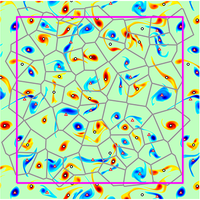
The kinetic energy in two-dimensional turbulence evolves towards larger sizes, eventually condensing into quasi-steady states of a few vortices at the scale of the simulation domain. When this happens in decaying turbulence, the flow initially segregates into a background of fast-moving small vortices and a system of larger ones that move more slowly. The slow component is shown here to form a low-energy ‘stochastic crystal’ in which vortices of opposite sign locally screen each other. Screening has long been conjectured for turbulence, and its mechanism is documented here, but global ordering is believed to be a new observation.

Enhanced wind-farm performance using windbreaks

Luoqin Liu and Richard J. A. M. Stevens

Phys. Rev. Fluids 6, 074611 (2021) - Published 30 July, 2021

Using large eddy simulations, we demonstrate that windbreaks can enhance the power production of large wind farms. The optimal windbreak height in a wind farm depends on the balance between the flow speedup and drag effects associated with windbreaks. This result is surprising since it has been argued that the added drag would cancel any benefits resulting from the flow speedup. We find the ideal windbreak height in a wind farm is lower than for an individual turbine. This limits the added drag from the windbreaks and enables their effective use in wind farms.

Contact-line deposits from multiple evaporating droplets

Alexander W. Wray, Patrick S. Wray, Brian R. Duffy, and Stephen K. Wilson

Phys. Rev. Fluids 6, 073604 (2021) - Published 22 July, 2021

Evaporating sessile droplets interact with neighboring droplets via their vapor fields, resulting in nonaxisymmetric evaporative fluxes from their surfaces. One of the consequences of this asymmetry is that, unlike the uniform deposits left at the contact lines of isolated droplets, the deposits left at the contact lines of droplets with neighbors are, in general, nonuniform. In this work we develop a theoretical model for the contact-line deposits from multiple evaporating droplets, and find its predictions for a pair of identical droplets to be in excellent agreement with recent experimental results.

Large eddy simulation of transitional channel flow using a machine learning classifier to distinguish laminar and turbulent regions

Ghanesh Narasimhan, Charles Meneveau, and Tamer A. Zaki

Phys. Rev. Fluids 6, 074608 (2021) - Published 19 July, 2021

Breakdown to turbulence in wall-bounded flows takes place through sporadic bursts of turbulent spots. Wall-modelled large-eddy simulations (LES) of transition to turbulence must dynamically identify the nascent turbulent regions, track their evolution, and apply the appropriate wall stress within and outside the turbulent/non-turbulent (T-NT) interface. Self-organized maps (SOM), a machine learning classifier, objectively and efficiently captures the T-NT interface. Wall-modeled LES with SOM interface identification predicts both orderly and bypass transition.

Lord Kelvin's isotropic helicoid

Darci Collins, Rami J. Hamati, Fabien Candelier, Kristian Gustavsson, Bernhard Mehlig, and Greg A. Voth

Phys. Rev. Fluids 6, 074302 (2021) - Published 13 July, 2021

Can a propeller be isotropic? Nearly 150 years ago, Lord Kelvin proposed the isotropic helicoid, but there are no published measurements on his particle. We 3D-printed his particle and unexpectedly found no measurable translation-rotation coupling. We explain these results by demonstrating theoretically and computationally that Kelvin’s proposed coupling exists, but it is small since it is only due to a weak breaking of a symmetry of non-interacting vanes in Stokes flow.

Pinch-off dynamics to elucidate animal lapping

Sunghwan Jung

Phys. Rev. Fluids 6, 073102 (2021) - Published 12 July, 2021

Most carnivorous mammals (e.g., cats and dogs) lap water with their tongues to drink water at high frequencies by creating a liquid column out of a bath. Presumably, the animals bite just before the pinch-off time of the water column to maximize the water intake. Such a pinch-off phenomenon in the liquid column can be described as the acceleration-induced (i.e., unsteady) inertia balances with the capillary force.

Larger wavelengths suit hydrodynamics of carangiform swimmers

Muhammad Saif Ullah Khalid, Junshi Wang, Imran Akhtar, Haibo Dong, Moubin Liu, and Arman Hemmati

Phys. Rev. Fluids 6, 073101 (2021) - Published 9 July, 2021

We examine the connection between the physiology and wavy kinematics of carangiform swimmers, such as Jack, Tuna, and Sunfish. Using high-fidelity numerical simulations for flows over Jack Fish models obtained through reconstruction of high-speed images of real natural swimmers, it was revealed that undulation with larger wavelengths improves the hydrodynamic performance of the carangiform swimmer in terms of better thrust production by the caudal fin, lower drag production on the trunk, and reduced power consumption by the trunk.

Sign In to Your Journals Account

Filter

Section

Filter

Article Lookup

Enter a citation