Highlights

Numerical method for modeling photosynthesis of algae on pulsing soft corals

Matea Santiago, Kevin A. Mitchell, and Shilpa Khatri

Phys. Rev. Fluids 7, 033102 (2022) - Published 31 March, 2022

It is hypothesized that soft corals in the family Xeniidae pulse to enhance the photosynthesis of their symbiotic algae. This work seeks to understand this using numerical simulations to quantify the mixing in the fluid flow and directly model the effect of the flow on the photosynthesis. A mathematical model and numerical method are presented in which a chemical concentration is produced on a moving deforming boundary which models the algae photosynthesis on the pulsing corals. Additionally, Poincaré maps are used, taking advantage of the periodicity of the flow to quantify mixing in the fluid. Our results indicate that these corals operate in a parameter regime which optimizes mixing.

Deep spontaneous penetration of a water droplet into hot granular materials

Fangye Lin, Stéphane Dorbolo, Wei Wang, and Jun Zou

Phys. Rev. Fluids 7, 034301 (2022) - Published 21 March, 2022

The interaction between a liquid droplet and a hot granular material is explored in this work. Surprisingly, we found that the droplet deeply penetrated into the hot granular material when the temperature exceeds the boiling temperature of the liquid. The digging speed of the drop decreases with the temperature. A mechanism based on the Leidenfrost effect is proposed considering that the granular material can be modeled as a rough surface that can be eroded when the vapor speed is sufficient.

Oscillating non-progressing flows induce directed cell motion

Winfried Schmidt, Andre Förtsch, Matthias Laumann, and Walter Zimmermann

Phys. Rev. Fluids 7, L032201 (2022) - Published 16 March, 2022

A novel deformation-dependent propulsion phenomenon for (blood) cells and soft capsules in oscillating microflows is presented. It enables the separation of cells with different deformabilities, such as healthy and malignant cells, without their labeling or obstacles in a microfluidic device. The propulsion phenomeon is based on a broken time reversal symmetry, which is achieved by a fast forward and slow backward movement of a fluid through microchannels that does not progress on average.

Large-scale and small-scale contribution to the skin friction reduction in a modified turbulent boundary layer by a large-eddy break-up device

C. I. Chan, R. Örlü, P. Schlatter, and R. C. Chin

Phys. Rev. Fluids 7, 034601 (2022) - Published 15 March, 2022

In this work, we assess the contributions of large-scale and small-scale Reynolds shear stress events to the skin friction reduction of a turbulent boundary layer modified by a large-eddy break-up device, based on the quadrant analysis of Reynolds shear stress, the Fourier mode decomposition, and an extension of a skin friction decomposition scheme.

Tubular-body theory for viscous flows

Lyndon Koens

Phys. Rev. Fluids 7, 034101 (2022) - Published 10 March, 2022

The hydrodynamics of cable-like bodies play an important role in many biological and mechanical systems. These flows can be accurately modeled using slender-body theory when the body is isolated, thin, and not too coiled, but can be difficult to model outside these limits. In this paper we develop tubular-body theory; a slender-body theory-like method that allows the flow around such bodies to be determined exactly.

Wake identification of stratified flows using dynamic mode decomposition

Chan-Ye Ohh and Geoffrey R. Spedding

Phys. Rev. Fluids 7, 024801 (2022) - Published 22 February, 2022

In a density-stratified fluid, the wakes generated by a submerged body or topography can be placed into a number of distinct flow regimes, depending on the balance of forces represented by the Reynolds number, Re, and Froude number, Fr. Here we propose a dynamic mode decomposition (DMD) based classifier to automatically sort stratified wakes based on their strongest DMD modes. The performance of the classifier in a test range of low {Re, Fr} yields insights into the development of further data-driven methods for the more challenging and fully turbulent wakes expected from bodies and geographical features.

Feeding flow and membranelle filtration in ciliates

Mads Rode, Thomas Kiørboe, and Anders Andersen

Phys. Rev. Fluids 7, 023102 (2022) - Published 8 February, 2022

Feeding of ciliates on suspended food particles is complex and relies typically on coordinated motion in bands of transversal rows of cilia known as membranelles. We explore and model the fluid dynamics of feeding flow and particle retention in upstream collecting ciliates that use a single membranelle band to both generate feeding flow, retain food particles, and transport them to the cell mouth.

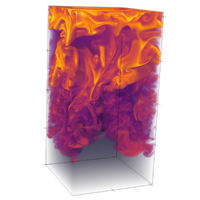
Numerical simulations of the three-dimensionalization of a shear flow in radiatively forced cold water below the density maximum

Andrew P. Grace, Marek Stastna, K. G. Lamb, and K. Andrea Scott

Phys. Rev. Fluids 7, 023501 (2022) - Published 7 February, 2022

In cold water (temperatures between water’s freezing point and the temperature of maximum density), near-surface heating (from the sun) generates dense water which in turn induces vertical currents. If there is a near-surface current, the resulting convective instabilities efficiently move momentum from the current to regions lower in the water column. Then, there is an induced momentum flux across the plume boundary leading to a complicated series of three-dimensional interactions resulting in turbulence. How might this process be affected by factors such as water clarity and current speed?

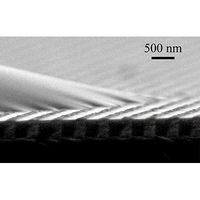
Condensation and wicking of water on solid nanopatterns

Jae Hong Lee, Buyoung Jung, Gui-su Park, and Ho-Young Kim

Phys. Rev. Fluids 7, 024202 (2022) - Published 7 February, 2022

We produce images of water-gas interfaces at a size of tens to hundreds of nanometers. An environmental scanning electron microscope with reduced electron-beam-induced heating is used for nanoscale liquid observation. We found that water completely wets very narrow hydrophobic nanometric grooves when condensing, although it cannot invade the gaps when an external drop contacts the same patterns.

Sinking dynamics and splitting of a granular droplet

Jens P. Metzger, Christopher P. McLaren, Sebastian Pinzello, Nicholas A. Conzelmann, Christopher M. Boyce, and Christoph R. Müller

Phys. Rev. Fluids 7, 014309 (2022) - Published 24 January, 2022

A granular droplet that is composed of smaller and denser particles in a bed of larger and lighter particles is found to sink and split when subjected to a combination of vibration and fluidizing gas flow. Despite visual similarities with fluid-like instabilities, the observed phenomenon is a result of the particulate character of granular matter. Combining experiments and numerical simulations, we show that the droplet of high-density particles causes the formation of an immobilized zone that obstructs the downwards motion of the droplet and causes the droplet to spread and ultimately to split. We further investigate the conditions required for droplet splitting.

Everlasting bubbles and liquid films resisting drainage, evaporation, and nuclei-induced bursting

Aymeric Roux, Alexis Duchesne, and Michael Baudoin

Phys. Rev. Fluids 7, L011601 (2022) - Published 18 January, 2022

Soap bubbles are by essence fragile and ephemeral. Depending on their composition and environment, bubble bursting can be triggered by gravity-induced drainage and/or the evaporation of the liquid and/or the presence of nuclei. In this paper, we design bubbles made of a composite liquid film able to neutralize all these effects and keep their integrity for more than one year in a standard atmosphere.

Wall turbulence at high friction Reynolds numbers

Sergio Hoyas, Martin Oberlack, Francisco Alcántara-Ávila, Stefanie V. Kraheberger, and Jonathan Laux

Phys. Rev. Fluids 7, 014602 (2022) - Published 10 January, 2022

An instantaneous streamwise velocity perturbation of a new simulation of a turbulent channel flow at an unprecedented friction Reynolds number of 10000 is conducted. One point statistics and turbulent budgets are discussed, solving some questions and raising new ones.

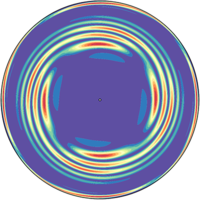
Weak branch and multimodal convection in rapidly rotating spheres at low Prandtl number

F. Garcia, F. Stefani, and E. Dormy

Phys. Rev. Fluids 6, 123501 (2021) - Published 6 December, 2021

Many planetary core fluid processes can be modeled with low Prandtl number convection in a rapidly rotating sphere. Close to the onset a regime of multimodal convection is typically found. We analyze azimuthally drifting periodic flows from which multimodal convection arises in terms of bifurcation theory.

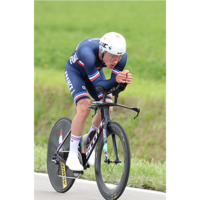
Cycling speeds in crosswinds

C. Clanet, Hector Abel, E. Brunet, Francesco Grasso, C. Robert, and C. Cohen

Phys. Rev. Fluids 6, 124601 (2021) - Published 1 December, 2021

What is the maximum speed that can be achieved for a given wind intensity and direction? The answer is detailed in our article using a new expression for the aerodynamic power dissipation. This evaluation of the aerodynamic power in crosswinds is established via precise wind tunnel experiments performed with a time trial specialist completed with a theoretical approach which allows determination of the maximum speed in any crosswind.

Experimental study of integrable turbulence in shallow water

Ivan Redor, Hervé Michallet, Nicolas Mordant, and Eric Barthélemy

Phys. Rev. Fluids 6, 124801 (2021) - Published 1 December, 2021

Integrable turbulence theoretically describes system states (in optics, hydrodynamics) where nonlinear phenomena dominate. Fourier analysis is challenged by the richness of such states also featuring solitons. Bidirectional soliton gases are generated in a straight 34 m long shallow water wave flume. The soliton content is quantified with a direct scattering transform provided by the finite-gap theory of the KdV equation. The conditions of soliton gas occurrence are discussed with regards to the wave-maker energy input and the viscous dissipation. The results of this study open up perspectives, for instance, to the understanding of sea states in shallow water.

Penetration and secondary atomization of droplets impacted on wet facemasks

Sombuddha Bagchi, Saptarshi Basu, Swetaprovo Chaudhuri, and Abhishek Saha

Phys. Rev. Fluids 6, 110510 (2021) - Published 23 November, 2021

We present a study of wetted facemasks to evaluate their capability in blocking respiratory droplets. We show that the increase in wetness progressively weakens the penetration capability of the impacted droplets. Such behavior is observed for hydrophobic and hydrophilic masks, although the underlying mechanism is different.

Quantifying the effect of a mask on expiratory flows

Philippe Bourrianne, Nan Xue, Janine Nunes, Manouk Abkarian, and Howard A. Stone

Phys. Rev. Fluids 6, 110511 (2021) - Published 23 November, 2021

In addition to their ability to filter pathogenic droplets, masks also represent a porous barrier to exhaled and inhaled air flow. In this study, we characterize the aerodynamic effect of a mask by tracking the air exhaled by a person through a mask. We show how a mask confines the exhaled flows within tens of centimeters in front of a person breathing or speaking.

Droplet trapping in bendotaxis caused by contact angle hysteresis

Alexander T. Bradley, Ian J. Hewitt, and Dominic Vella

Phys. Rev. Fluids 6, 114003 (2021) - Published 5 November, 2021

Bendotaxis is a mechanism in which a liquid droplet propels itself along an elastic walled channel: the deformation induced by the droplet’s capillary pressure leads to an imbalance in that pressure that generates motion. However, droplets on real surfaces often suffer contact angle hysteresis. We study the conditions under which contact angle hysteresis is strong enough to trap a droplet, preventing bendotaxis.

Estimating the filtration efficacy of cloth masks

Xinyu Mao and A. E. Hosoi

Phys. Rev. Fluids 6, 114201 (2021) - Published 5 November, 2021

Motivated by the current pandemic we analyze the use of cloth masks as effective alternatives to medical masks for the general public. In this paper, we establish a quantitative framework for estimating the filtration efficacy of cloth masks by deriving analytical estimates for the pressure drop across woven heterogeneous fabrics. We then introduce a filtration quality factor to compare the intrinsic filtration capabilities of diverse materials for submicron aerosols. Finally, we present a decision map to illustrate the trade-offs between filtration efficiency and breathability and to provide practical guidance on the selection of cloth masks.

Vortex-induced vibrations of a one-degree-of-freedom cylinder transitioning from the inline to the crossflow degree of freedom

Bridget M. Benner and Yahya Modarres-Sadeghi

Phys. Rev. Fluids 6, 114702 (2021) - Published 2 November, 2021

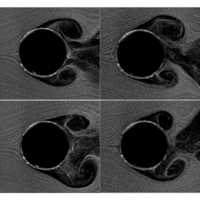
Vortex-Induced Vibration (VIV) is studied extensively for cases where the oscillations are possible in the direction of flow (IL VIV) or perpendicular to it (CF VIV). In this work, we study VIV for the angles in between and show how the cylinder’s response transitions from a purely IL VIV to a purely CF VIV.

Sign In to Your Journals Account

Filter

Section

Filter

Article Lookup

Enter a citation